




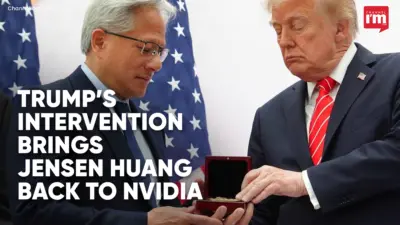

Nvidia's leadership crisis took an extraordinary turn when co-founder Jensen Huang returned as CEO just 11 days after stepping down.
The comeback followed direct intervention by US President Donald Trump, Vice President JD Vance and other senior administration officials, who reportedly persuaded the company's board to reverse its earlier decision.
The episode combined corporate leadership turmoil, national security concerns, political intervention and a historic stock market rally. Nvidia shares surged 31.5% on November 23, 2026, adding approximately $950 billion to the company's market capitalisation in a single trading session.
Why Did Jensen Huang Step Down?
Huang resigned on November 12 following revelations about extramarital relationships, including one involving Alice Huang, a former executive at Singapore-based Megaspeed.
Alice Huang was reportedly suspected by US intelligence officials of gathering information for China. Megaspeed also came under scrutiny over allegations involving the diversion of advanced Nvidia chips to China in possible violation of US export controls.
There is, however, no established finding that Jensen Huang was involved in espionage or that Nvidia's trade secrets were compromised.
The controversy raised questions about corporate governance, workplace relationships and possible national security risks.
How Trump Stepped In
Trump personally contacted Nvidia board members to push for Huang's reinstatement.
Vice President JD Vance reportedly coordinated the effort, while Treasury Secretary Scott Bessent and Commerce Secretary Howard Lutnick were also involved.
Trump said he feared Huang's departure could result in the loss of critical technological expertise to China. He also described the Nvidia chief as an important figure in America's technology industry.
The administration reportedly assured the board that it had found no evidence that Huang posed a national security risk.
Nvidia's board had initially resisted bringing Huang back. However, following the intervention, directors unanimously reversed their position on November 23 and reinstated him as president, CEO and board member.
Nvidia Shares Surge Nearly 32%
Huang's return triggered a massive rally in Nvidia shares.
- Share price gain: 31.5%
- Closing share price: $165.05
- Market value added: Approximately $950 billion
- Short-seller losses: Estimated at $11.2 billion in paper losses
The rally marked the largest single-day increase in market capitalisation recorded by a company, according to market data cited by Moneycontrol.
The dramatic rise also benefited investors who had purchased Nvidia shares during the preceding market decline.
Trump's Financial Interests Raise Questions
The episode has also drawn attention to Trump's personal investment holdings.
A Financial Times analysis of his financial disclosures through September 30 suggested that Trump could have held between 32,000 and 370,000 Nvidia shares.
If those holdings remained unchanged, the November 23 rally could have generated estimated paper gains of between $1.3 million and $15 million.
The White House has maintained that independent financial managers oversee Trump's investments without his involvement. Nevertheless, the possibility of financial gains following his intervention has raised questions about transparency and conflicts of interest.
What Does This Mean for Nvidia?
Huang's return has restored the company's original leadership, but the controversies surrounding his departure remain unresolved.
Nvidia's board has initiated an independent investigation into reports of a foreign intelligence effort targeting the CEO. Meanwhile, US authorities continue to examine allegations involving chip diversion and export-control violations.
Huang's reinstatement also matters to the global artificial intelligence industry. Nvidia is a central supplier of AI processors, and its leadership decisions can influence technology companies, investors and countries building AI infrastructure.
For now, the dramatic comeback has brought Huang back to the top job. But questions surrounding corporate accountability, national security and political influence remain.