


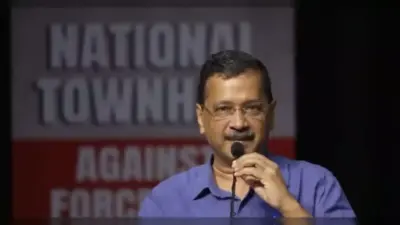

Aam Aadmi Party (AAP) national convener Arvind Kejriwal has announced that he will lead a march to Prime Minister Narendra Modi's residence on August 4 to protest against the Centre's E20 fuel policy.
Addressing a “National Town Hall Against E20” in New Delhi on Saturday, Kejriwal alleged that the Union government was imposing ethanol-blended petrol on citizens without presenting adequate scientific evidence to support its widespread implementation.
The AAP leader said a delegation of 100 people would march to the Prime Minister’s residence carrying a petition signed by citizens from across the country. He also outlined three key demands before the Central government, including providing consumers with the choice between pure petrol and E20 fuel, making E20 petrol cheaper than regular petrol, and reducing petrol prices to below ₹84 per litre.
The announcement marks the latest political confrontation over the government’s ethanol blending programme, which has been promoted as part of India’s broader energy security and biofuel strategy.
Kejriwal Announces Protest March to Prime Minister’s Residence
Speaking at the town hall meeting organised by the Aam Aadmi Party, Arvind Kejriwal said the protest would be held on August 4 in New Delhi.
According to Kejriwal, a group of 100 representatives will march to the Prime Minister’s residence to submit a public petition opposing the compulsory promotion of E20 fuel.
He claimed that the petition carries signatures from people across different parts of the country who are concerned about the impact of ethanol-blended petrol on vehicles and consumers.
The AAP leader described the planned march as a democratic effort to present public concerns directly before the Central government and seek policy changes through dialogue.
The protest is expected to draw participation from party workers, supporters and citizens who oppose the current implementation of the E20 programme.
AAP Places Three Demands Before the Centre
During his address, Kejriwal listed three principal demands that his party intends to place before the Narendra Modi government.
The first demand is that consumers should have the option to choose between pure petrol and E20 fuel at petrol pumps rather than being limited to ethanol-blended fuel.
Secondly, he argued that if the government wishes to promote E20 fuel, it should be sold at a lower price than conventional petrol so that consumers receive a direct financial benefit for opting for the blended fuel.
His third demand called for the reduction of petrol prices to below ₹84 per litre, saying lower fuel prices would provide relief to households and businesses facing rising transportation costs.
According to Kejriwal, these measures would allow consumers to make informed choices instead of being compelled to adopt a particular fuel.
Questions Raised Over Scientific Evidence
Kejriwal also questioned the government’s justification for promoting E20 petrol across the country.
He alleged that the Centre was imposing ethanol-blended fuel on citizens while failing to release comprehensive scientific studies demonstrating its long-term impact on vehicle performance and consumers.
The AAP chief claimed that individuals raising questions about E20 fuel were being labelled as “anti-national” instead of receiving factual responses supported by scientific research.
He argued that any nationwide policy affecting millions of vehicle owners should be accompanied by transparent technical data and public consultation.
The party maintained that consumers deserve complete information regarding engine compatibility, fuel efficiency, maintenance costs and long-term vehicle performance before such policies are implemented on a large scale.
E20 Fuel Policy Remains a Key Government Initiative
The Central government has been actively promoting ethanol blending as part of India’s long-term energy strategy aimed at reducing dependence on imported crude oil and increasing the use of domestically produced biofuels.
The E20 programme involves blending up to 20 percent ethanol with petrol, a move that the government believes will help reduce carbon emissions, strengthen energy security and support farmers by increasing demand for sugarcane and other feedstocks used in ethanol production.
The ethanol blending programme also forms an important component of India’s broader environmental and clean energy commitments.
Automobile manufacturers have been preparing vehicles compatible with higher ethanol blends, while fuel retailers have gradually expanded the availability of E20 fuel across various regions.
Supporters of the policy argue that ethanol blending can reduce fossil fuel consumption, lower greenhouse gas emissions and contribute to India’s transition towards cleaner energy sources.
Political Debate Intensifies
The AAP’s protest announcement has added a political dimension to the ongoing discussion surrounding India’s ethanol blending policy.
While the Central government continues to describe ethanol blending as a strategic economic and environmental initiative, the AAP has demanded greater transparency, consumer choice and financial incentives.
The debate is expected to intensify in the coming days as the proposed protest approaches.
Political observers believe the issue could generate wider public discussion, particularly among vehicle owners concerned about fuel prices, engine compatibility and maintenance costs.
The Centre has consistently maintained that ethanol blending has been introduced after extensive planning and coordination with the automobile industry, fuel companies and other stakeholders.
March Expected to Draw National Attention
The proposed march to the Prime Minister’s residence on August 4 is likely to attract significant political attention, with the Aam Aadmi Party positioning the demonstration as a campaign on behalf of consumers.
Whether the Centre responds directly to the party’s demands remains to be seen, but the protest is expected to further amplify the debate over fuel pricing, consumer rights and India’s transition towards cleaner energy alternatives.
As discussions over E20 fuel continue, the issue is emerging as another important point of political contest between the ruling government and opposition parties ahead of future policy debates.