
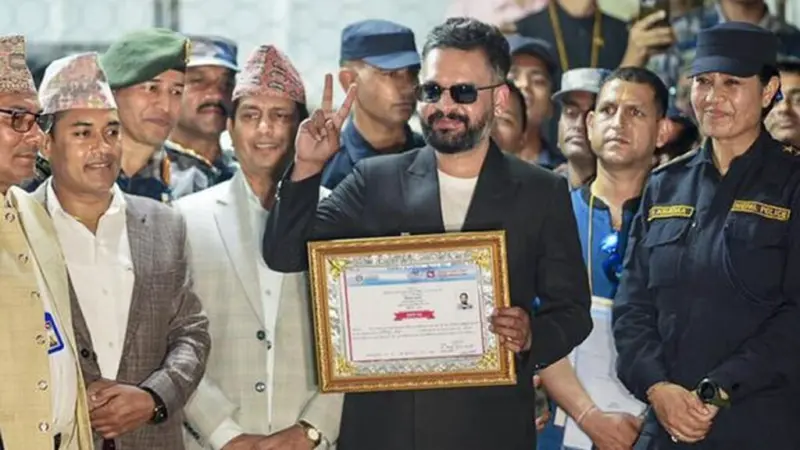

Nepal's political landscape appears set for a dramatic transformation as partial results from the recent general election indicate a sweeping victory for the party led by Balendra Shah.
The rapid rise of Shah's Rastriya Swatantra Party signals a major shift in the country's political order, which for decades has been dominated by traditional parties. Preliminary results show that Shah's party is on course to secure a commanding majority in parliament, a rare achievement in Nepal's complex two-tier electoral system that historically makes it difficult for a single party to win outright. The outcome reflects growing public frustration with established political forces and highlights the growing influence of a new generation of leaders and voters seeking structural change in the country.
The election results indicate that the Rastriya Swatantra Party has already secured 124 seats in parliament, leaving traditional political parties far behind in the race. In comparison, the Nepali Congress has managed to win only 17 seats, while the Communist Party of Nepal (Unified Marxist-Leninist), commonly known as CPN-UML, has won eight seats. The Nepal Communist Party has secured seven seats, and several smaller parties collectively account for only five seats. The significant margin between Shah's party and its rivals indicates a profound shift in voter sentiment across the country.
At just 35 years old, Balendra Shah has emerged as one of the most influential political figures in Nepal's contemporary history. Previously known as a rapper and later as the mayor of Kathmandu, Shah built his public image as an outsider willing to challenge traditional politics. His rise from local leadership to the threshold of national power reflects a broader demand among citizens for fresh leadership and accountability in governance.
One of the most dramatic moments of the election occurred when Shah defeated former Prime Minister KP Sharma Oli in the constituency of Jhapa 5. The seat has long been considered a stronghold for Oli, making the defeat particularly symbolic. By winning in a region closely associated with one of Nepal's most powerful political leaders, Shah reinforced the perception that a generational and political shift is underway.
The electoral success of the Rastriya Swatantra Party is especially significant because Nepal's electoral structure typically produces coalition governments rather than clear single-party mandates. If the current results are confirmed, it would mark the first time in decades that a single party has secured such a dominant parliamentary position.
Electoral defeat forces reflection within traditional parties
The election results have triggered a period of introspection among Nepal's traditional political parties, particularly the Communist Party of Nepal-Unified Marxist Leninist led by KP Sharma Oli. The scale of the defeat has been widely described by party members as a serious setback that could reshape the party's internal leadership and strategy.
After losing his parliamentary seat in Jhapa 5 to Balendra Shah, Oli faces mounting pressure from within his party to reassess its direction and leadership structure. The defeat is particularly striking because Jhapa has historically been regarded as a political stronghold for Oli, making the loss a powerful symbol of shifting public opinion.
Leaders within the CPN-UML have indicated that discussions are already underway regarding possible organizational restructuring and leadership changes. Many within the party believe that adapting to new political realities will be essential if the party hopes to regain public support in future elections.
Party president Raghuji Pant acknowledged the need for reflection and reform in remarks to local media. He stated that the party must move forward by breaking away from traditional methods and by honestly evaluating its past decisions. According to Pant, reconnecting with ordinary citizens and addressing their concerns directly will be essential steps in rebuilding public trust.
The electoral collapse of several major parties highlights the extent to which Nepal's political environment has changed in recent years. Many voters appear to have grown increasingly frustrated with the long-standing dominance of established parties that have alternated in power without delivering significant improvements in economic conditions or governance.
For many observers, the rise of the Rastriya Swatantra Party represents a protest vote against decades of perceived political stagnation. Citizens appear to have embraced Shah's image as an unconventional leader who challenges traditional political structures and promises a more transparent style of governance.
Political analysts note that such dramatic shifts often occur when public dissatisfaction reaches a tipping point. In Nepal's case, a combination of economic difficulties, corruption allegations, and political instability appears to have contributed to the electorate's desire for change.
Youth-led protests and public frustration reshape Nepal's political climate
The roots of Nepal's current political transformation can be traced in part to the widespread protests that shook the country in 2025. In September of that year, thousands of citizens, many of them young people, gathered near the parliament building in Kathmandu to demonstrate against government policies.
The immediate trigger for the protests was the government's decision to ban 26 social media platforms. The move sparked widespread anger, particularly among younger citizens who rely heavily on digital communication and online platforms for expression and activism.
However, the demonstrations quickly evolved into a broader movement that addressed deeper political and economic grievances. Protesters expressed frustration over the country's persistent economic challenges, including unemployment, rising living costs, and limited opportunities for young people.
Many participants also accused political leaders and members of Nepal's social elite of corruption, nepotism, and mismanagement. For years, critics had argued that the political system favored entrenched interests while failing to address the needs of ordinary citizens.
The protests rapidly expanded into a nationwide movement driven largely by digitally connected youth often described as Generation Z. Social media platforms played a central role in organizing demonstrations, sharing information, and mobilizing supporters.
Within less than forty-eight hours, the scale and intensity of the protests forced the government to collapse. While the movement succeeded in bringing down the administration, the unrest also came at a significant human cost.
The demonstrations became the deadliest civil unrest Nepal had experienced in decades. Official reports indicated that seventy-seven people lost their lives during the clashes, highlighting the severity of the confrontation between protesters and authorities.
In addition to the tragic loss of life, several buildings were damaged during the unrest. Government offices, residences of political leaders, and prominent establishments were targeted during the violence. Among the properties affected was the luxury Hilton Kathmandu, which had opened in July 2024 and symbolized the country's growing tourism and hospitality sector.
The protests revealed deep divisions within Nepalese society and underscored the urgency of political reform. They also demonstrated the increasing influence of younger generations in shaping the country's political discourse.
Many analysts believe that the electoral success of Balendra Shah and the Rastriya Swatantra Party cannot be understood without considering the context created by these protests. The demonstrations exposed widespread dissatisfaction with the status quo and created momentum for political change.
Shah's appeal among younger voters, combined with his outsider image and promises of reform, positioned him as a natural beneficiary of this political shift. For many citizens, his victory represents a new chapter in Nepal's political evolution and a potential turning point in the country's governance.