
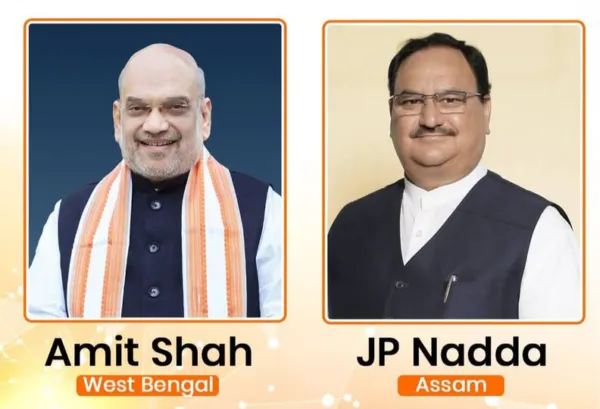

The Bharatiya Janata Party (BJP) on Tuesday announced the appointment of senior party leaders Amit Shah and J. P. Nadda as central observers for the election of legislative party leaders in West Bengal and Assam respectively, signalling the party's preparations for government formation and leadership consolidation in the two politically crucial states.
According to an official notification issued by the BJP leadership, Amit Shah has been designated as the party's central observer for West Bengal, where the BJP is preparing to form its first government after securing a historic electoral mandate in the recently concluded Assembly elections. Meanwhile, J.P. Nadda has been entrusted with overseeing the legislative party leader selection process in Assam.
The appointments come at a critical juncture for the BJP as the party moves swiftly to formalise leadership structures in states where it has either retained power or emerged victorious in fiercely contested elections. Political observers view the move as a clear indication that the BJP leadership wants senior and trusted figures to directly supervise the transition process and ensure organisational unity during government formation.
The BJP's notification also stated that Haryana Chief Minister Nayab Singh Saini has been appointed co-observer for Assam, while Odisha Chief Minister Mohan Charan Majhi will serve as co-observer for West Bengal. The inclusion of prominent chief ministers as co-observers reflects the importance the party is attaching to the leadership selection exercise in both states.
The appointment of Amit Shah as observer for West Bengal has attracted significant political attention because the state represents one of the BJP's most significant electoral breakthroughs in recent years. The BJP's victory in West Bengal ended decades of dominance by regional parties and marked a major expansion of the party's influence in eastern India.
Political analysts believe Shah's involvement underscores the BJP's intention to carefully manage the transition of power in Bengal and maintain cohesion within the legislative party. As one of the BJP's principal strategists, Shah has played a key role in expanding the party's footprint across eastern and northeastern India over the last decade.
The process of electing the BJP legislative party leader in West Bengal is expected to pave the way for the swearing-in of the state's first BJP-led government. Party leaders indicated that discussions regarding ministerial allocations, administrative priorities and organisational restructuring are likely to intensify in the coming days ahead of the oath-taking ceremony.
The BJP's Bengal victory has already generated significant political reactions nationwide, with several opposition leaders acknowledging the scale of the party's electoral performance. The party leadership is now focused on presenting a stable government while simultaneously addressing challenges related to governance, law and order and administrative transition.
Meanwhile, in Assam, the BJP's decision to appoint J.P. Nadda as central observer is being viewed as an attempt to ensure continuity and coordination within the state unit. Assam remains strategically important for the BJP because it serves as the party's political gateway to the Northeast.
Nadda, who has held several organisational responsibilities within the BJP over the years, is expected to oversee consultations among newly elected legislators before the formal selection of the legislative party leader. Sources within the party suggested that the leadership exercise in Assam is likely to proceed smoothly because of strong coordination between the central leadership and the state unit.
The BJP's electoral performance in Assam reinforced the party's dominance in the northeastern region, where it has steadily expanded its organisational network through alliances, welfare schemes and regional outreach initiatives. The leadership selection process is expected to focus on maintaining political stability while continuing the party's development agenda in the state.
Party insiders said the appointment of central observers follows the BJP's established organisational practice of involving senior national leaders in the process of selecting legislative party leaders after Assembly election victories. The observers are responsible for consulting elected MLAs, gathering consensus and formally reporting the final leadership decision to the party high command.
In West Bengal, the observer process is expected to be particularly significant because the BJP is preparing to form a government in the state for the first time. The legislative party meeting is likely to witness intense discussions regarding governance priorities, Cabinet formation and regional representation within the new administration.
Political observers believe the BJP leadership will place emphasis on balancing caste, regional and organisational considerations while selecting ministers and assigning portfolios in Bengal. The party is also expected to focus on maintaining unity among leaders who played key roles during the Assembly election campaign.
The appointment of Mohan Charan Majhi as co-observer for West Bengal is also politically notable because it reflects the BJP's effort to strengthen coordination between eastern Indian states governed by the party. Majhi's involvement could additionally help facilitate administrative and political exchanges between Odisha and Bengal as the BJP expands its regional influence.
Similarly, Nayab Singh Saini's role as co-observer for Assam demonstrates the BJP's strategy of involving chief ministers from different regions in organisational exercises to strengthen internal cohesion and leadership coordination.
The developments come amid heightened political activity across several states following recent Assembly election results. The BJP leadership is currently focused on consolidating governance structures, managing alliances and preparing for future electoral contests in key states.
Political analysts note that the successful management of government formation processes in West Bengal and Assam will carry long-term significance for the BJP's national strategy. Bengal, in particular, is likely to emerge as a major political battleground over the coming years as the BJP seeks to deepen its organisational roots in the state.
The party's top leadership is also expected to closely monitor administrative transitions and public response after the formation of the new governments. Governance performance in newly won states is likely to influence the BJP's broader political messaging ahead of future elections.
As preparations continue for legislative party meetings in both states, the appointments of Amit Shah and J.P. Nadda highlight the BJP's emphasis on central coordination and disciplined leadership transition. With government formation processes now entering the final stage, attention will remain focused on the legislative party decisions and the composition of the upcoming ministries in West Bengal and Assam.