




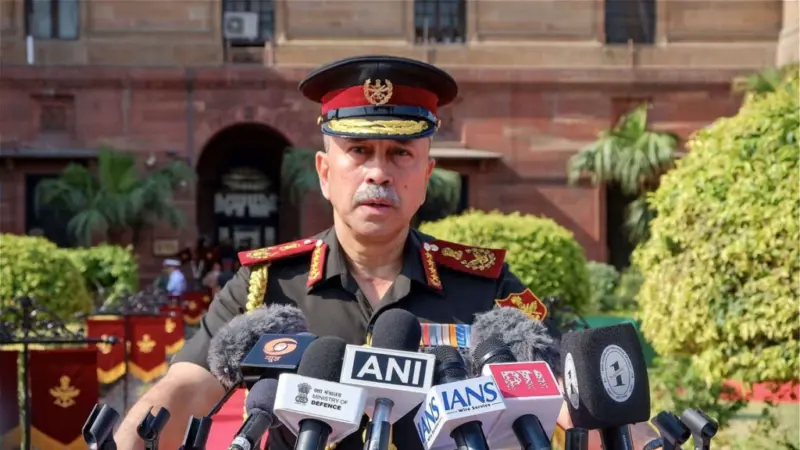

India has entered a new phase in its defence leadership with General NS Raja Subramani formally taking charge as the country's new Chief of Defence Staff (CDS), succeeding General Anil Chauhan.
The appointment comes at a critical moment for India's national security establishment, as the armed forces pursue ambitious structural reforms aimed at improving jointness, operational efficiency, and technological integration across services.
As the new CDS, General Subramani steps into the highest military position in the country, responsible for advising the government on tri-service matters and driving long-term defence transformation. His leadership is expected to play a central role in shaping India's evolving military doctrine, particularly in the context of growing regional tensions, rapid technological change, and shifting geopolitical dynamics in the Indo-Pacific.
A Key Leadership Change in a Transforming Security Landscape
The role of the Chief of Defence Staff has become one of the most influential positions in India's defence framework since its creation following the recommendations of the Kargil Review Committee. The office was designed to strengthen coordination among the Army, Navy, and Air Force while providing unified strategic advice to the government.
The institution gained prominence under the first CDS, General Bipin Rawat, who laid the foundation for inter-service integration and initiated discussions on theatre commands. His successor, General Anil Chauhan, continued efforts to streamline coordination and advance defence reforms during his tenure.
Now, with General Subramani assuming charge, expectations are high that the next phase of reforms will move from conceptual planning toward practical implementation. Defence experts believe his appointment signals continuity in reform efforts while also opening the door for faster execution of long-pending structural changes.
Nearly Four Decades of Operational and Strategic Experience
General NS Raja Subramani brings nearly forty years of distinguished military service to the post, with experience spanning operational command, training, strategic planning, and institutional leadership. His career has included diverse assignments that have given him deep insight into both frontline military operations and high-level defence policymaking.
Throughout his service, he has been closely associated with India's security challenges along the borders with China and Pakistan, two regions that continue to define India's defence priorities. His operational exposure across multiple theatres has shaped his understanding of evolving security threats and the importance of joint military coordination.
Military analysts note that the CDS role requires a rare balance between tactical understanding and strategic foresight. In this context, General Subramani's extensive experience is being seen as a significant advantage as India moves toward greater integration of its armed forces.
Strategic Roles Before Becoming CDS
Before taking over as CDS, General Subramani served as Military Advisor at the National Security Council Secretariat, one of India's most important strategic institutions. In this role, he was directly involved in national security assessments, inter-agency coordination, and strategic policy formulation at the highest levels of government.
Earlier, he held the position of Vice Chief of the Army Staff, where he contributed to modernization initiatives, operational preparedness, and organizational reforms within the Indian Army. He also served as General Officer Commanding-in-Chief of the Central Command, overseeing critical operational responsibilities and force deployment planning.
These roles provided him with comprehensive exposure to both strategic decision-making and ground-level operational challenges, equipping him with the experience necessary to lead tri-service transformation.
Theatre Command Reforms Emerge as Top Priority
One of the most significant responsibilities awaiting the new CDS is the implementation of theatre command structures, a long-debated reform in India's military establishment. Theatreisation involves reorganizing the armed forces into integrated commands that bring Army, Navy, and Air Force units under a single operational leadership for specific geographical or functional regions.
The objective is to enhance coordination, reduce duplication of resources, and improve response efficiency during conflict situations. Countries such as the United States and China already operate integrated command systems, which serve as models for India's ongoing reform efforts.
However, the transition has faced challenges due to differences in service doctrines, operational cultures, and command hierarchies. Building consensus among the three services remains one of the most complex tasks in this reform process.
General Subramani is expected to play a key role in resolving these challenges and accelerating the implementation of theatre commands, a reform that could significantly reshape India's military structure in the coming decade.
Why Theatreisation Matters for Modern Warfare
The push for integrated theatre commands is driven by the changing nature of warfare, which increasingly spans multiple domains including land, air, sea, cyber, and space. Modern conflicts require real-time coordination between different branches of the armed forces to ensure effective response and operational superiority.
In such scenarios, separate command structures can lead to delays and inefficiencies, whereas integrated systems enable faster decision-making and unified strategic execution. For India, which faces complex security challenges across multiple fronts, theatre commands are seen as essential for enhancing combat readiness and operational synergy.
Defence planners also argue that integrated commands can optimize resource utilization, improve logistics coordination, and enhance the overall effectiveness of military operations.
Strengthening Military Modernisation and Self-Reliance
Alongside structural reforms, military modernization remains a major focus area for the new CDS. India has been actively investing in advanced defence technologies, indigenous weapons systems, and modernization of military platforms under the Atmanirbhar Bharat initiative.
Efforts are underway to develop drones, missile systems, surveillance technologies, and next-generation combat platforms domestically, reducing dependence on foreign suppliers and strengthening strategic autonomy.
As CDS, General Subramani will play a key role in aligning procurement strategies across the three services, ensuring better coordination in capability development and modernization planning. Integrated procurement and joint capability planning are expected to be central themes of his tenure.
Managing a Complex Regional Security Environment
General Subramani assumes office at a time when India's security environment remains highly dynamic. Tensions along the Line of Actual Control with China, persistent challenges along the western border, and emerging threats such as cyber warfare and drone-based operations continue to shape defence planning.
The Indo-Pacific region is also witnessing increased geopolitical competition, making strategic preparedness and military diplomacy more important than ever.
Experts believe that the new CDS's operational background and strategic exposure will be critical in navigating these challenges and ensuring that India's military remains prepared for both conventional and non-conventional threats.
Enhancing Jointness Among the Armed Forces
A central mandate of the CDS is to promote greater jointness among the Army, Navy, and Air Force. Historically, each service has operated with its own structures, procurement priorities, and operational doctrines. While this has ensured specialization, it has also created coordination gaps.
The CDS is responsible for fostering integrated planning, joint training exercises, shared logistics systems, and coordinated procurement strategies. These reforms aim to enhance interoperability and improve the overall efficiency of India's defence forces.
General Subramani is expected to continue strengthening these initiatives while building on the groundwork laid by his predecessors.
Strategic Planning and Defence Diplomacy
Beyond operational responsibilities, the CDS also plays an important role in long-term strategic planning and defence diplomacy. As India expands its global partnerships, particularly in the Indo-Pacific region, military cooperation and international engagements have become increasingly significant.
The CDS participates in strategic dialogues, supports defence cooperation agreements, and engages with foreign military leadership as part of India's broader security outreach.
General Subramani's prior experience in the National Security Council Secretariat is expected to provide him with valuable insight into these broader dimensions of national security policy.
Building on the Legacy of Previous CDS Leadership
General Subramani inherits a role shaped by the foundational work of his predecessors. General Bipin Rawat initiated the process of military integration and set the stage for theatre command discussions, while General Anil Chauhan focused on advancing coordination and modernization efforts.
The new CDS is expected to carry forward these initiatives while addressing implementation challenges and accelerating the transition toward a more integrated military structure.
Continuity is expected to remain a key feature of India's defence reform process, even as new leadership brings fresh strategic perspectives.
Conclusion
The appointment of General NS Raja Subramani as India's Chief of Defence Staff marks a significant milestone in the country's ongoing military transformation. His leadership comes at a time when India is pursuing ambitious reforms aimed at creating a more unified, modern, and technologically advanced armed forces structure.
From theatre command integration to modernization and joint operational planning, the challenges ahead are substantial. However, with decades of experience across operational and strategic domains, the new CDS is expected to play a pivotal role in shaping India's defence future.
As India navigates an increasingly complex security environment, the coming years under his leadership will be crucial in determining the pace and direction of military transformation.