
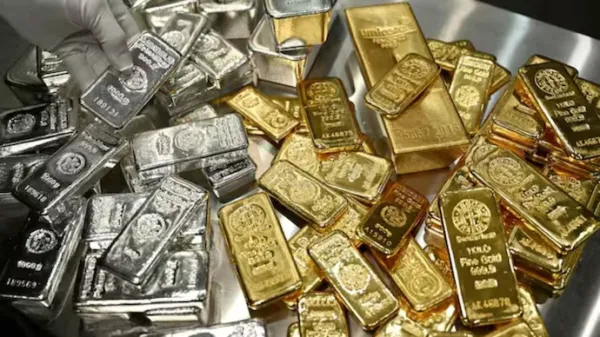

The sharp fall in gold and silver prices in India after recently touching record highs has once again highlighted the volatile nature of precious metal markets, where global developments, investor behavior, and macroeconomic signals intersect to drive rapid price fluctuations.
After surging to unprecedented levels, gold and silver witnessed a sudden correction, with prices dropping significantly across major Indian markets. This decline, while offering temporary relief to buyers, has also triggered uncertainty among investors who had been riding the upward trend. The movement reflects a broader global pattern, where geopolitical tensions, currency fluctuations, and profit-booking activities continue to influence the trajectory of safe-haven assets.
Global Triggers And Market Corrections Behind The Sharp Price Fall
The recent crash in gold and silver prices is closely linked to global developments, particularly geopolitical tensions and their evolving outcomes. Precious metals had earlier surged due to uncertainty surrounding international conflicts, which traditionally drive investors toward safe-haven assets like gold and silver. However, as signs of temporary stability began to emerge, including ceasefire developments in global conflict zones, investor sentiment shifted rapidly, leading to profit booking and a correction in prices.
This shift was evident in the Indian market, where gold prices saw a notable drop of around ₹800 per 10 grams in a single trading session, while silver prices also declined sharply. The correction was not limited to one purity level, as 24 karat, 22 karat, and 18 karat gold all experienced declines, indicating a broad-based adjustment across the market. The fall in silver prices was even more pronounced, with reports of declines reaching ₹2,000 per kilogram, reflecting heightened sensitivity to global cues.
Another key factor behind the decline is the unwinding of what market experts often describe as a "war premium." During periods of geopolitical uncertainty, gold and silver prices tend to rise as investors seek stability. However, once the perceived risk begins to ease, even temporarily, prices often correct sharply as investors book profits and exit positions. This pattern has been clearly visible in the recent price movements, where a rapid rise was followed by an equally sharp decline.
In addition to geopolitical factors, fluctuations in crude oil prices and currency movements have also played a role in shaping precious metal prices. Rising oil prices tend to increase inflationary pressures, which can have mixed effects on gold demand. At the same time, the strength of the US dollar often inversely impacts gold prices, creating a complex interplay of factors that influence market trends.
Domestic factors have further contributed to the volatility, including changes in demand patterns, import dynamics, and investor sentiment. India, being one of the largest consumers of gold, experiences significant price movements based on both global trends and local demand cycles, particularly during wedding and festive seasons.
Investor Reactions, Market Outlook, And Implications For Buyers
The sudden correction in gold and silver prices has elicited mixed reactions from different segments of the market. For retail buyers, especially those planning to purchase jewellery, the decline presents an opportunity to buy at relatively lower prices compared to recent highs. Reports indicate that gold prices, which had crossed ₹1.51 lakh per 10 grams, fell below the ₹1.50 lakh mark following the correction, making it more attractive for consumers.
However, for investors, the situation is more complex. Those who entered the market during the recent rally may face short-term losses, while long-term investors may view the correction as part of a broader upward trend. The volatility underscores the importance of timing and strategy in precious metal investments, where prices can change rapidly in response to global developments.
Silver, often considered both an industrial metal and an investment asset, has shown even greater volatility than gold. Its price movements are influenced not only by investor sentiment but also by industrial demand, making it more sensitive to economic cycles. The recent sharp drop in silver prices reflects this dual nature, where both global uncertainty and domestic demand dynamics play a role.
Market analysts suggest that the current correction may not necessarily indicate a long-term downward trend but rather a temporary adjustment following an extended rally. Gold prices had already experienced a significant decline earlier, including a sharp fall of nearly fourteen percent in March, indicating that the market has been undergoing a phase of consolidation.
At the same time, the broader outlook for gold and silver remains uncertain, with multiple factors likely to influence future price movements. Continued geopolitical tensions, fluctuations in global interest rates, inflation trends, and central bank policies will all play a role in determining the direction of precious metal prices. Investors are closely monitoring these variables, as even minor changes can lead to significant market reactions.
The recent price crash also highlights the psychological aspect of market behavior, where investor sentiment can shift rapidly based on news and expectations. The transition from a bullish to a cautious outlook within a short period underscores the dynamic nature of financial markets, particularly in the context of commodities like gold and silver.
For policymakers and economists, the movement in gold and silver prices carries broader implications for inflation, trade balances, and financial stability. India's high dependence on gold imports means that price fluctuations can impact the country's trade deficit and currency stability, adding another layer of complexity to the economic landscape.
The correction in prices, while offering short-term relief to buyers, serves as a reminder of the inherent volatility in commodity markets. It also reinforces the importance of informed decision-making for both investors and consumers, as price movements are often driven by a combination of global events and domestic factors that can change rapidly.