




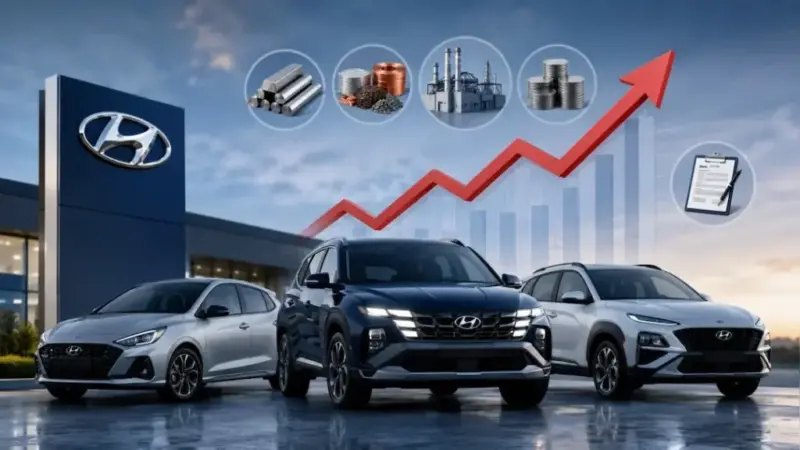

Hyundai Motor India has announced a fresh price increase across its vehicle portfolio, with car prices set to rise by up to Rs 12,800 from June 1, 2026. The decision comes amid rising input costs, higher commodity prices and growing operational expenses, adding further pressure on automobile buyers already grappling with elevated fuel costs and inflationary trends.
The company confirmed the development in a regulatory filing, stating that the revised prices would apply across multiple models and variants sold in the Indian market.
The latest hike marks another round of price revisions in the Indian automobile sector, where several leading manufacturers have increased vehicle prices over recent months due to escalating production costs and supply chain pressures.
Hyundai currently sells around ten passenger vehicle models in India, ranging from the affordable Grand i10 Nios to premium electric offerings such as the Ioniq 5. The company said the increase would vary depending on the specific model and variant selected by customers.
The announcement is expected to trigger a short-term surge in showroom enquiries and bookings as buyers attempt to purchase vehicles before the revised prices come into effect next month.
Rising Costs Force Automakers to Pass Burden to Consumers
According to Hyundai Motor India, the latest price increase has become necessary because of mounting financial pressure arising from higher raw material costs and operational expenditure.
The company stated that despite efforts to absorb part of the additional burden internally through cost optimization measures, certain increases could no longer be sustained without revising vehicle prices.
Industry analysts say automobile manufacturers across India have been struggling with sharp increases in the prices of essential industrial materials including steel, aluminum, plastics and non-ferrous metals.
Over the past year, prices of several key manufacturing inputs have reportedly risen between 10 and 30 percent, significantly affecting production economics across the automobile sector.
Logistics expenses, energy costs and supply chain adjustments have also added to operational challenges for carmakers.
Hyundai emphasized that the price hike was being implemented while attempting to maintain a balanced approach toward customer interests and market competitiveness.
However, analysts believe the broader industry trend indicates that further revisions by multiple manufacturers may continue if commodity inflation remains elevated.
Hyundai Joins Industry-Wide Wave of Vehicle Price Increases
The latest move by Hyundai follows similar announcements by several major automobile companies operating in India.
Maruti Suzuki recently declared that it would increase prices across its portfolio by up to Rs 30,000 from June 2026, citing persistent cost pressures and inflationary trends.
Mahindra and Mahindra as well as Tata Motors Passenger Vehicles have also implemented price hikes in recent months.
The repeated revisions suggest that the Indian automobile industry is entering a prolonged phase of pricing adjustments after years of volatile input costs and post-pandemic economic disruptions.
Industry experts say the cumulative effect of multiple price hikes could influence consumer sentiment, especially in the entry-level and mid-range vehicle segments where affordability remains highly sensitive.
At the same time, demand for premium SUVs and feature-rich vehicles has remained relatively resilient despite rising prices.
Hyundai, which maintains a strong presence across hatchback, sedan, SUV and electric vehicle categories, is expected to monitor market response carefully after the revised pricing structure takes effect.
Buyers Face Pressure From Fuel Prices and Inflation
The timing of the latest price increase may create additional challenges for consumers already facing higher transportation and household expenses.
Retail fuel prices have witnessed significant increases in recent weeks after government-owned oil marketing companies raised petrol and diesel rates sharply.
For many middle-class families, the combined impact of rising vehicle prices, higher loan interest rates and fuel inflation has increased the total cost of car ownership considerably.
Automobile dealerships in several cities have already reported increased customer urgency following announcements of upcoming price revisions by leading brands.
Some buyers are reportedly accelerating purchase decisions to avoid higher on-road prices after June 1.
Financial analysts note that inflationary trends in both manufacturing and energy sectors are beginning to reshape purchasing behavior in India's automobile market.
Consumers are increasingly evaluating total ownership costs, fuel efficiency and financing options more carefully before making vehicle purchases.
Hyundai's India Strategy Remains Strong Despite Market Pressures
Despite the latest price increase, Hyundai continues to remain one of India's strongest passenger vehicle manufacturers with a diversified product lineup and expanding market presence.
The company has maintained a significant share in the Indian automobile market through strong performance in compact cars, SUVs and premium segments.
Models such as the Creta, Venue and Exter have continued attracting buyers even amid growing competition from domestic and international manufacturers.
Hyundai has also been focusing aggressively on electric mobility and premium technology integration as consumer preferences evolve.
The company's premium electric crossover Ioniq 5 has helped strengthen Hyundai's positioning in India's emerging electric vehicle ecosystem.
Industry observers believe Hyundai's broad product range and established dealer network may help cushion the impact of moderate price hikes compared to smaller competitors.
However, continued inflation and slowing consumer spending could still create challenges for overall market growth during the coming quarters.
Auto Industry Navigates Complex Economic Environment
India's automobile sector is currently navigating a complex economic environment shaped by inflation, global supply chain disruptions and shifting consumer behavior.
While vehicle demand remains relatively stable in several urban markets, rising production costs continue pressuring company margins.
Manufacturers are increasingly attempting to balance profitability with customer affordability, especially in highly competitive market segments.
The industry also faces long-term transition costs associated with stricter emission regulations, electrification investments and technological upgrades.
Experts say these structural shifts may keep vehicle prices under upward pressure even if commodity prices stabilize in the short term.
Automobile financing trends, rural demand patterns and fuel price movements are likely to remain crucial factors influencing sales momentum during the remainder of the financial year.
Dealers Expect Short-Term Booking Surge Before June 1
Following Hyundai's announcement, dealerships in several cities are expecting increased footfall and booking activity before the revised prices become effective.
Automobile retailers often witness temporary demand spikes whenever major manufacturers announce upcoming price increases.
Sales executives believe buyers considering immediate purchases may attempt to complete bookings and financing procedures before the June 1 deadline.
Some dealerships are also expected to increase promotional campaigns and inventory clearance offers during the final days before the new pricing takes effect.
However, analysts caution that repeated price hikes across the industry may eventually affect long-term consumer sentiment if household budgets continue facing inflationary pressure.
For now, Hyundai's latest move highlights the growing challenges facing both automakers and consumers in an increasingly expensive automotive market.
As input costs continue rising and competition intensifies, pricing decisions are likely to remain a critical issue shaping India's automobile industry through the rest of 2026.