
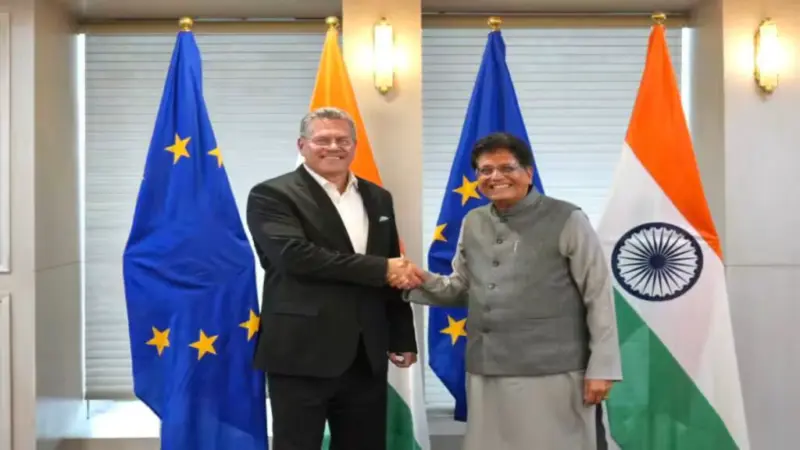

India and the European Union are set to begin the next round of negotiations on a proposed free trade agreement in Brussels on March 10, marking another significant step in efforts to strengthen economic ties between the two partners.
Officials from both sides are aiming to accelerate discussions and reach a comprehensive agreement before the end of the year. The talks are expected to address key issues related to tariffs, market access, and investment protection as India and the EU attempt to finalize what could become one of the largest trade deals in the world.
The upcoming negotiations follow a recent meeting in New Delhi between Narendra Modi and Ursula von der Leyen, during which both leaders agreed to fast-track discussions on the long-pending trade pact. During the meeting, the two sides emphasized the importance of concluding the agreement within this year and instructed their negotiating teams to intensify efforts toward a balanced and mutually beneficial deal.
The proposed free trade agreement is expected to significantly expand trade and investment opportunities between India and the European Union. By reducing tariffs and removing regulatory barriers, the agreement could enhance economic cooperation and create new opportunities for businesses in both markets.
Von der Leyen highlighted the significance of the negotiations during her two-day visit to India, describing the proposed agreement as potentially the largest free trade deal of its kind globally. She acknowledged that the negotiations would involve complex discussions but emphasized that the partnership comes at a crucial moment for both sides.
Her remarks came at a time when global trade dynamics are facing significant uncertainty. Recent tariff proposals by Donald Trump under the "America First" policy have raised concerns about disruptions to international trade and the possibility of increased protectionism in the global economy.
Negotiations focus on market access, tariffs and investment protection
The current round of negotiations will involve detailed discussions on several key sectors where both India and the European Union are seeking concessions. Negotiators will attempt to resolve long-standing differences over tariffs and market access in industries such as automobiles, alcoholic beverages, pharmaceuticals, and textiles.
The European Union has been urging India to reduce import duties on products such as cars, wine, whisky, and certain agricultural goods. European exporters argue that high tariffs limit their ability to compete effectively in the Indian market.
India, on the other hand, is seeking improved access for its own exports to the European market. Indian negotiators have emphasized the importance of lowering tariffs and easing regulatory restrictions on products such as pharmaceuticals, textiles, and apparel, which are key sectors for the country's export economy.
In addition to the main free trade agreement, both sides are also working on related agreements that could further strengthen economic cooperation. These include an Agreement on Investment Protection and an Agreement on Geographical Indications.
The investment protection agreement is expected to provide stronger legal safeguards for investors from both sides, encouraging greater cross-border investment. Meanwhile, the geographical indications agreement aims to protect region-specific products and ensure that certain goods are marketed under their authentic names.
Officials involved in the negotiations have stressed that achieving consensus will require careful balancing of economic interests. Each side is seeking to secure benefits for domestic industries while ensuring that the overall agreement remains mutually advantageous.
The negotiations are therefore expected to involve complex discussions as both sides attempt to reconcile their priorities and reach compromises on sensitive sectors.
Expanding trade partnership amid changing global economic environment
The economic relationship between India and the European Union has grown steadily over the past decade, making the proposed trade agreement increasingly important for both partners. According to recent figures, the EU has become India's largest trading partner.
Trade in goods between India and the EU reached approximately 124 billion euros in 2023, accounting for around 12.2 percent of India's total trade. The partnership therefore plays a significant role in India's international economic engagement.
Trade in services between the two sides has also expanded rapidly. In 2023, services trade between India and the EU reached nearly 60 billion euros, almost doubling compared with levels recorded in 2020.
Digital services account for a substantial share of this growth, reflecting the increasing role of technology and digital industries in the global economy. These sectors are expected to remain an important component of future trade cooperation between the two partners.
The EU's role as India's largest trading partner places it ahead of other major economies in terms of trade volume. The United States accounts for approximately 10.8 percent of India's trade, while China represents around 10.5 percent.
From the European perspective, India is currently the EU's ninth largest trading partner, accounting for about 2.2 percent of the bloc's total trade. Despite this relatively smaller share, European policymakers view India as a rapidly growing market with significant long-term potential.
Trade between India and the European Union has increased by nearly 90 percent over the past decade. This expansion reflects deeper economic integration and growing business connections between the two regions.
However, negotiations for a free trade agreement between India and the EU have faced repeated delays in the past. Talks originally began several years ago but stalled due to differences over sensitive sectors such as agriculture, automobiles, and pharmaceuticals.
These sectors remain among the most challenging areas of negotiation because they involve competing interests from domestic industries on both sides.
Despite these challenges, recent geopolitical developments and shifts in global trade policies have created new momentum for the negotiations. Both India and the European Union see strategic value in strengthening economic partnerships that promote open and stable trade relationships.
As the new round of negotiations begins in Brussels, officials from both sides will attempt to move closer toward resolving outstanding issues. If successful, the proposed agreement could reshape economic cooperation between India and the European Union and create one of the most significant bilateral trade partnerships in the world.