




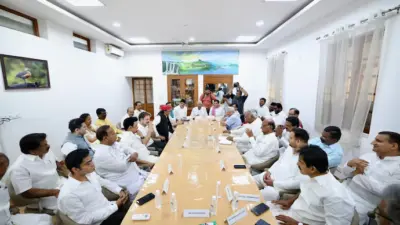

The opposition's INDIA bloc finds itself at a defining moment as leaders from more than 20 political parties gather in New Delhi for a crucial strategy meeting aimed at reviving alliance cohesion, addressing internal disagreements, and preparing for upcoming electoral battles.
The meeting, branded as the "Janbandhan" gathering, comes at a time when the alliance is facing renewed questions over its unity, electoral relevance, and long-term roadmap ahead of the 2029 Lok Sabha elections.
Held at the Constitution Club in the national capital, the meeting is expected to bring together several prominent opposition leaders, including Congress leader Rahul Gandhi, Congress president Mallikarjun Kharge, Trinamool Congress chief Mamata Banerjee, Samajwadi Party president Akhilesh Yadav, Rashtriya Janata Dal leader Tejashwi Yadav, Shiv Sena (UBT) chief Uddhav Thackeray, and representatives from Left parties and regional organizations.
However, even before discussions formally began, attention shifted toward notable absences and growing fault lines within the alliance. Questions surrounding the participation of the Dravida Munnetra Kazhagam (DMK), the Aam Aadmi Party (AAP), and the possible inclusion of newer regional forces such as the Tamilaga Vettri Kazhagam (TVK) have highlighted the challenges confronting the opposition bloc as it seeks to present a united front against the Bharatiya Janata Party (BJP).
The meeting comes nearly two years after the alliance's last major gathering ahead of the 2024 Lok Sabha elections. Since then, the political landscape has undergone significant changes, with regional election results reshaping alliances, exposing contradictions among partners, and forcing opposition leaders to reconsider their collective strategy.
Against this backdrop, the Delhi meeting is being viewed not merely as another political consultation but as a test of whether the INDIA bloc can evolve into a durable national coalition capable of challenging the BJP over the next electoral cycle.
Opposition Alliance Faces Questions Over Internal Cohesion
The INDIA alliance was originally formed with the objective of creating a broad opposition platform capable of taking on the BJP in national elections. While the coalition succeeded in generating political momentum during its initial phase, maintaining unity among parties with competing regional interests has proven to be a far more difficult task.
Several alliance partners have found themselves on opposing sides in state-level contests, creating tensions that continue to affect national coordination. Recent assembly elections further exposed these challenges, particularly in states where alliance partners directly competed against one another.
The absence of the Aam Aadmi Party from the meeting has drawn particular attention. The party has publicly distanced itself from alliance activities in recent months, raising doubts about its future role within the opposition grouping. While AAP leaders have not formally withdrawn from the broader opposition framework, their reluctance to participate in key meetings has fueled speculation about growing political differences.
Similarly, the DMK’s reported decision to stay away from the gathering has generated discussion within political circles. The development follows changing political equations in Tamil Nadu, where shifts in alliance dynamics have complicated relationships between regional parties and the Congress.
Political observers note that the opposition alliance faces a unique challenge: while all constituent parties share a common objective of countering the BJP, they often compete against each other for the same voter base at the state level. Balancing national cooperation with regional competition remains one of the alliance’s biggest hurdles.
The Delhi meeting is therefore expected to focus heavily on mechanisms for conflict resolution and alliance management. Leaders are likely to discuss ways of preventing state-level disagreements from undermining broader national objectives.
Strategy for Upcoming Elections Takes Center Stage
One of the primary objectives of the meeting is expected to be the formulation of a coordinated strategy for upcoming state elections and the eventual run-up to the 2029 Lok Sabha polls.
The BJP continues to maintain a dominant position at the national level, backed by strong organizational infrastructure, electoral machinery, and leadership popularity. Opposition parties recognize that fragmented efforts are unlikely to produce significant electoral gains.
As a result, discussions are expected to revolve around seat-sharing frameworks, issue-based campaigns, and joint political messaging. Leaders are likely to examine lessons from recent assembly elections and identify areas where opposition cooperation can be strengthened.
Particular emphasis may be placed on states where the BJP remains electorally vulnerable. Opposition strategists are expected to discuss methods of consolidating anti-incumbency sentiment and avoiding vote fragmentation among alliance partners.
Sources indicate that leaders may also deliberate on economic issues, unemployment, inflation, social welfare concerns, and institutional accountability-subjects that have increasingly featured in opposition campaigns across the country.
Political analysts believe that the success of the alliance will depend not only on arithmetic but also on narrative. While opposition parties have often criticized government policies, many observers argue that they must also present a coherent alternative vision capable of attracting undecided voters.
The Delhi meeting offers an opportunity for alliance leaders to begin shaping such a narrative well before the next general election cycle intensifies.
Regional Parties Seek Greater Influence Within the Bloc
Another significant aspect of the meeting is the growing influence of regional parties within the opposition framework. Over the years, regional leaders have emerged as key power centers, often commanding substantial voter bases and determining electoral outcomes in their respective states.
The Trinamool Congress, led by Mamata Banerjee, is expected to play a prominent role during the discussions. The party has consistently advocated for stronger coordination among opposition forces while simultaneously seeking greater influence in alliance decision-making.
Reports suggest that TMC leaders may raise concerns regarding alleged political attacks on party workers and leaders in West Bengal. By seeking support from other alliance members on these issues, the party hopes to reinforce opposition solidarity against what it describes as political intimidation.
Meanwhile, parties such as the Samajwadi Party and Rashtriya Janata Dal are expected to emphasize the importance of social justice, regional representation, and coalition flexibility. These parties remain critical components of the opposition’s electoral strategy in key Hindi-speaking states.
The possible inclusion of newer political forces such as TVK has also become a subject of interest. While no formal decision is expected immediately, discussions around expansion reflect the alliance’s desire to remain politically relevant and adaptable in a rapidly changing electoral environment.
However, expanding the coalition also brings additional challenges. More partners mean more negotiations, competing interests, and complex seat-sharing arrangements. Managing these dynamics will be crucial if the alliance hopes to maintain cohesion.
Congress and Left Differences Likely to Surface
Despite public displays of unity, differences between alliance partners remain unresolved in several areas. One issue expected to emerge during the meeting involves tensions between the Congress and Left parties following recent electoral contests.
Sources indicate that the Communist Party of India (Marxist) may seek clarification from Congress leaders regarding allegations surrounding electoral understandings during recent assembly elections. These concerns stem from differing interpretations of campaign strategies and alliance behavior in certain states.
For the Left parties, preserving ideological identity while participating in a broad anti-BJP coalition remains a delicate balancing act. Congress, on the other hand, faces pressure to maintain alliances without alienating regional partners or compromising electoral competitiveness.
Such disagreements are not uncommon within large political coalitions. However, opposition leaders recognize that prolonged public disputes could weaken voter confidence in the alliance’s ability to govern cohesively.
As a result, many participants are expected to advocate for internal mechanisms that allow disagreements to be addressed privately while maintaining a united public stance.
The Challenge of Building a National Alternative
The broader significance of the Delhi meeting lies in the opposition’s ongoing attempt to position itself as a credible national alternative to the BJP.
Since the formation of the INDIA alliance, opposition parties have argued that democratic competition requires a strong and coordinated challenge to the ruling party. However, translating that aspiration into electoral success has proven difficult.
The BJP continues to benefit from a strong organizational network, a cohesive leadership structure, and significant electoral momentum. Opposition parties, by contrast, must navigate ideological diversity, regional rivalries, and leadership ambitions.
Many political observers believe that the next few years will be critical for determining whether the INDIA bloc can transform from an electoral arrangement into a sustained political coalition.
Success will likely depend on several factors, including effective coordination, leadership consensus, policy coherence, and the ability to connect with voters on issues that extend beyond opposition to the BJP.
The Delhi meeting therefore represents more than a routine political gathering. It is an opportunity for alliance leaders to demonstrate seriousness, resolve internal tensions, and lay the groundwork for future cooperation.
Whether the discussions result in tangible breakthroughs remains to be seen. Yet the very fact that leaders from diverse political backgrounds continue to engage under a common platform suggests that opposition unity remains a strategic priority despite existing challenges.
As deliberations continue, the political significance of the meeting extends beyond immediate electoral calculations. The outcomes could shape opposition politics for years to come and influence the trajectory of India’s political landscape heading toward the next major election cycle.