
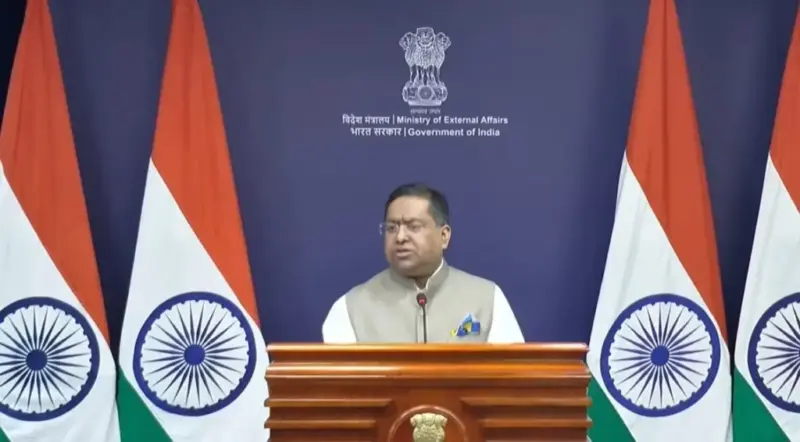

India is set to host a two-day BRICS Foreign Ministers' Meeting in New Delhi beginning tomorrow, bringing together top diplomats from member and partner countries for high-level discussions on pressing global and regional issues.
The meeting will be chaired by External Affairs Minister S. Jaishankar, and is expected to play a crucial role in shaping the future direction of cooperation among BRICS nations at a time of shifting geopolitical alignments and global economic uncertainty.
The diplomatic gathering will see participation from foreign ministers and senior delegations of BRICS member countries as well as partner nations. The visiting leaders are also scheduled to call on Prime Minister Narendra Modi during their stay, highlighting the strategic importance of the summit for India's foreign policy outreach.
The meeting comes at a time when global power structures are undergoing significant transformation, with emerging economies seeking greater influence in international governance, trade systems, and security frameworks. Against this backdrop, India's role as host places it at the center of important multilateral diplomacy.
Jaishankar's Bilateral Diplomacy Before the Main BRICS Talks
Ahead of the formal BRICS Foreign Ministers' Meeting, External Affairs Minister S. Jaishankar will hold a series of bilateral engagements in New Delhi with visiting counterparts from multiple countries. These meetings are designed to strengthen India's bilateral relations while also aligning positions on key multilateral issues ahead of the main summit discussions.
Jaishankar will begin the day with a bilateral meeting with Chile's Foreign Minister Francisco Pérez Mackenna. The discussions are expected to focus on strengthening trade relations, expanding investment opportunities, enhancing cooperation in critical minerals, and deepening engagement between India and Latin America. Both sides are also likely to discuss global governance reforms and cooperation in multilateral institutions.
Later in the day, Jaishankar will hold separate bilateral talks with South Africa's Foreign Minister Ronald Lamola and Brazil's Foreign Minister Mauro Vieira. These engagements are particularly significant given that both South Africa and Brazil are key BRICS members with strong economic and strategic ties to India.
The discussions with South Africa are expected to focus on cooperation in trade, energy security, development partnerships, and coordination within the Global South framework. With Brazil, talks are likely to center on expanding agricultural trade, strengthening investment flows, and enhancing collaboration in multilateral forums such as BRICS, G20, and the United Nations.
In the evening, Jaishankar is scheduled to meet Russian Foreign Minister Sergey Lavrov. This meeting is expected to carry strategic importance, covering areas such as energy cooperation, regional security issues, and broader geopolitical developments affecting Eurasia and the global order.
These bilateral meetings reflect India's multi-aligned foreign policy approach, which emphasizes strategic partnerships with diverse global powers while maintaining autonomy in decision-making on international issues.
BRICS Foreign Ministers' Meeting: Focus on Global and Regional Issues
The two-day BRICS Foreign Ministers' Meeting will serve as a platform for detailed discussions on global and regional issues of mutual interest. The agenda is expected to include a wide range of topics such as global economic stability, geopolitical conflicts, trade disruptions, development financing, and reforms in international institutions.
BRICS, which originally included Brazil, Russia, India, China, and South Africa, has evolved into a broader platform for cooperation among emerging economies. The grouping increasingly positions itself as a voice for the Global South, advocating for more equitable representation in global decision-making bodies.
During the meeting, foreign ministers are expected to exchange views on how to strengthen economic cooperation among member countries, reduce dependence on traditional financial systems, and promote trade in local currencies where feasible. Discussions may also include ways to enhance connectivity, digital cooperation, and innovation-driven growth among member states.
Another important aspect of the talks will be global security concerns, including ongoing conflicts, maritime security challenges, and regional instability in various parts of the world. While BRICS is not a military alliance, its member countries often coordinate positions on major international security issues in multilateral forums.
India, as host, is expected to emphasize dialogue, development, and cooperation as key pillars of BRICS engagement, while encouraging consensus-building among diverse member states with varying geopolitical interests.
Interaction with Prime Minister Narendra Modi
A key highlight of the BRICS Foreign Ministers' Meeting will be the interaction between visiting delegations and Prime Minister Narendra Modi. This engagement is expected to provide strategic direction to the discussions and reinforce India's leadership role within the grouping.
The meeting with the Prime Minister is likely to focus on strengthening multilateral cooperation, addressing global challenges such as climate change, energy transition, food security, and supply chain resilience, and enhancing coordination among emerging economies.
India is expected to reiterate its vision of a more inclusive global order, where developing nations have a stronger voice in international institutions such as the United Nations, World Bank, and International Monetary Fund.
The engagement also underscores India's growing diplomatic influence, as it continues to position itself as a bridge between developed and developing nations in global forums.
India's Expanding Role in Global Diplomacy
Hosting the BRICS Foreign Ministers' Meeting reflects India's growing stature in global diplomacy and its increasing involvement in shaping multilateral outcomes. Over the past decade, India has significantly expanded its engagement with international organizations, regional groupings, and strategic partnerships.
As a founding member of BRICS, India has consistently advocated for reforms in global governance structures to reflect the changing realities of the 21st century. The current meeting further strengthens India's role as a key voice representing emerging economies.
India's diplomatic strategy focuses on balancing relationships with major global powers while simultaneously deepening ties with developing countries across Asia, Africa, and Latin America. This approach allows India to maintain strategic autonomy while contributing to global decision-making processes.
By hosting this high-level meeting, India is also reinforcing its position as a preferred destination for international diplomacy, capable of facilitating dialogue among diverse and sometimes competing geopolitical interests.
Significance of Bilateral Engagements Alongside BRICS
The series of bilateral meetings held by S. Jaishankar ahead of the BRICS summit highlight the importance of parallel diplomacy in multilateral events. These engagements allow India to address specific bilateral priorities while also preparing coordinated positions for group discussions.
The meetings with Brazil, South Africa, Russia, and Chile reflect India's broad diplomatic outreach across continents. Each engagement is tailored to strengthen economic ties, enhance strategic cooperation, and identify new areas of collaboration.
With Brazil and South Africa, India shares strong partnerships within BRICS and other multilateral platforms, making these discussions particularly important for aligning positions on global economic governance. The meeting with Russia is expected to focus on long-standing strategic and energy partnerships, while the engagement with Chile highlights India's growing interest in expanding ties with Latin America.
These bilateral discussions are expected to contribute to smoother consensus-building during the main BRICS meeting by addressing differences and strengthening mutual understanding among member countries.
BRICS as a Platform for the Global South
In recent years, BRICS has increasingly been viewed as a platform representing the collective voice of the Global South. The grouping advocates for reforms in global institutions and seeks to address the development needs of emerging economies.
India has played a central role in shaping this narrative, emphasizing inclusive growth, sustainable development, and equitable access to global resources. The current meeting is expected to further advance discussions on how BRICS can contribute to global economic stability and development cooperation.
Issues such as climate financing, digital transformation, infrastructure development, and public health cooperation are expected to feature prominently in the discussions.
Conclusion
The BRICS Foreign Ministers' Meeting in New Delhi marks a significant moment in India's diplomatic calendar, bringing together key global players for high-level engagement on critical international issues. With External Affairs Minister S. Jaishankar leading the proceedings and Prime Minister Narendra Modi engaging with visiting delegations, the summit underscores India's growing role in shaping global diplomacy.
As global geopolitical dynamics continue to evolve, the outcomes of this two-day meeting are expected to strengthen cooperation among BRICS nations and reinforce India's position as a central voice in multilateral affairs. The combination of bilateral diplomacy and multilateral dialogue reflects India's strategic approach to international relations, balancing national interests with global responsibilities.