
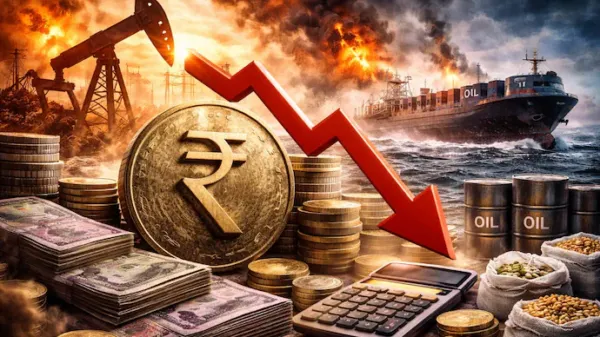

The Indian rupee slipped to a historic low against the US dollar on March 9, reflecting growing economic pressure from rising crude oil prices and global geopolitical tensions.
The currency declined sharply by 46 paise to reach 92.33 per dollar, marking its weakest level ever. The fall came amid increased demand for the US dollar in global markets as investors sought safer assets during heightened uncertainty caused by the deteriorating situation in West Asia. Economists warn that continued volatility in oil prices and global financial markets may keep the rupee under pressure in the near term.
The sudden depreciation of the rupee highlights the sensitivity of emerging market currencies to global economic developments. India, being a major importer of crude oil, is particularly vulnerable to fluctuations in international energy prices. As geopolitical tensions intensify and oil prices surge, the demand for dollars increases because oil imports are paid for in the US currency. This increased demand pushes the value of the dollar higher relative to the rupee, weakening the Indian currency.
Currency experts say that the rupee has already declined by more than two percent since the beginning of 2026, making it one of the worst-performing currencies among emerging markets this year. The ongoing geopolitical tensions in the Middle East have created uncertainty in global markets, causing investors to move their money toward assets considered safer during crises, especially the US dollar.
The weakening rupee also reflects broader financial market dynamics. When global investors anticipate instability or conflict, they often shift their investments from emerging economies into more stable currencies such as the dollar. This shift increases the demand for dollars and reduces demand for local currencies like the rupee, accelerating depreciation.
Rising crude oil prices and global tensions intensify pressure on the rupee
One of the main reasons behind the sharp fall of the rupee is the dramatic increase in global crude oil prices. Energy markets have experienced a surge due to fears of supply disruptions triggered by escalating tensions in the Middle East. Oil prices have climbed rapidly within a short period, significantly impacting countries that depend heavily on imported crude oil.
Brent crude prices recently surged to nearly 117 dollars per barrel after rising by approximately 25 percent in a single week. The increase reflects growing concerns that ongoing geopolitical tensions may disrupt global oil supply chains. Since the conflict involving Iran began, global oil prices have reportedly increased by more than fifty percent, creating further pressure on oil-importing nations.
India relies heavily on imports to meet its energy needs, purchasing a large portion of its crude oil from international markets. When oil prices rise sharply, Indian refineries and energy companies must spend more dollars to buy the same quantity of oil. This increases demand for dollars in the domestic currency market.
As the demand for dollars increases, the rupee weakens because more local currency is required to purchase each dollar. This dynamic creates a cycle where rising oil prices lead to higher dollar demand, which in turn puts downward pressure on the rupee.
Financial analysts note that geopolitical instability often triggers volatility in currency markets. When uncertainty grows, investors prefer to move their funds into assets perceived as stable and reliable. Historically, the US dollar has played this role as a global safe haven during periods of crisis.
Because of this shift toward safer assets, emerging market currencies often face strong selling pressure. The rupee's recent decline reflects this broader global trend, where investors reduce exposure to riskier markets during times of uncertainty.
The weakening currency also poses challenges for economic stability. A depreciating rupee can increase import costs for essential goods, especially energy, which affects inflation and overall economic growth. Policymakers therefore closely monitor currency movements and may intervene when necessary to stabilize the market.
Reserve bank intervention and impact of rupee depreciation on everyday life
The Reserve Bank of India attempted to stabilize the currency market as pressure on the rupee intensified. Before trading opened on Monday, the central bank reportedly intervened in the market in an effort to prevent a sharp fall in the currency. As a result, the rupee initially opened at 92.19 per dollar, slightly stronger than market expectations.
However, this early stability did not last long. As trading began, demand for dollars increased rapidly from investors and oil-importing companies. The surge in dollar buying pushed the rupee lower, eventually reaching the record level of 92.33.
Currency traders in the banking sector noted that the central bank's actions indicated it was closely monitoring the situation. However, they also acknowledged that global factors, particularly rising oil prices, continue to exert strong pressure on the rupee.
According to market experts, central bank interventions can slow down currency volatility but cannot fully reverse trends driven by global economic forces. As long as geopolitical tensions continue and oil prices remain elevated, the rupee may face persistent downward pressure.
International financial institutions have also highlighted the vulnerability of certain emerging market currencies. Analysts from Bank of America Global Research noted that countries heavily dependent on oil imports could face the greatest currency pressure if the current geopolitical conflict continues for an extended period.
India and the Philippines were identified as among the most vulnerable economies in this context. Because both countries import large volumes of energy resources, rising oil prices can significantly affect their currency stability.
The depreciation of the rupee does not only affect financial markets; it also has a direct impact on everyday life. One of the most immediate effects is on international travel and education. When the rupee weakens against the dollar, individuals who plan to travel abroad or study overseas must spend more money to convert their rupees into dollars.
This means that tuition fees, accommodation expenses, and travel costs become significantly higher for Indian students and families planning international education.
Imported goods are also likely to become more expensive. Many electronic devices such as smartphones, laptops, and advanced technological components are imported or manufactured using imported parts. Since companies pay for these imports in dollars, a weaker rupee increases their production costs.
Businesses may pass these additional costs on to consumers, leading to higher retail prices for electronics and other imported products.
Another area that could be affected is fuel pricing. If crude oil prices remain elevated for an extended period, petrol and diesel prices in India may also rise. Higher fuel costs can influence transportation expenses and logistics, which may indirectly increase the price of various goods and services across the economy.
Just a month earlier, there had been signs of relief for the rupee. Following a trade agreement between India and the United States, foreign investors had shown renewed interest in the Indian market. Their investments had helped strengthen the rupee slightly during that period.
However, the renewed geopolitical tensions in the Middle East quickly reversed this short-term improvement. As the conflict escalated, global financial markets shifted toward caution, and investors again turned to the US dollar as a safer option.
Understanding how currency values change requires examining several economic factors. A currency weakens when its value declines relative to another currency, such as the US dollar. This process is commonly referred to as currency depreciation.
Every country maintains foreign currency reserves, which are used to facilitate international trade and financial transactions. The level of these reserves can influence the stability of a nation's currency. When foreign exchange reserves increase, the currency generally becomes stronger because the country has greater capacity to manage external financial obligations.
Conversely, if reserves decline or if demand for foreign currency rises sharply, the domestic currency may weaken. The balance between foreign currency reserves and international trade payments therefore plays a crucial role in determining exchange rates.
In India's case, rising oil import costs have increased the demand for dollars, putting pressure on the rupee. Economic analysts will continue to watch global oil prices, geopolitical developments, and central bank policies to assess how the currency may move in the coming months.