
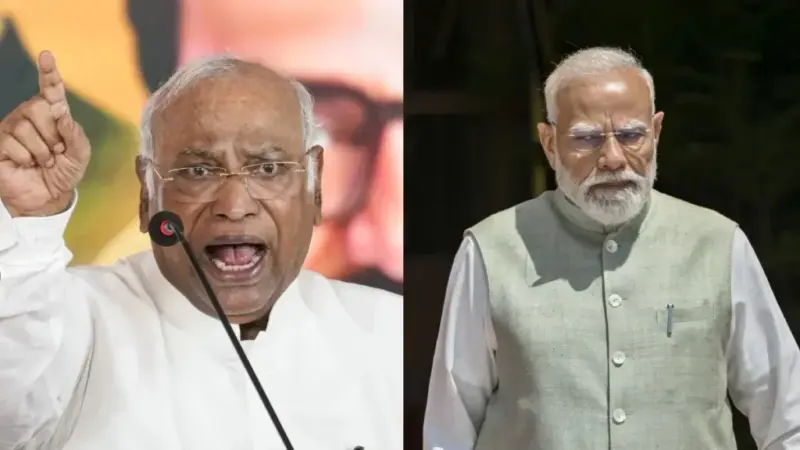

Mallikarjun Kharge sparked a major controversy after remarks on Narendra Modi, later clarifying his statement amid sharp backlash from the BJP.
A political controversy has erupted after Congress president Mallikarjun Kharge made a contentious remark referring to Prime Minister Narendra Modi during a press interaction. The statement quickly drew strong criticism from the Bharatiya Janata Party (BJP), escalating tensions between the ruling party and the opposition.
The remark was made while Kharge was addressing questions related to political alliances in Tamil Nadu. During his comments, he criticized the partnership between the All India Anna Dravida Munnetra Kazhagam and the BJP, questioning its ideological alignment and historical consistency.
In the course of his statement, Kharge used the term "terrorist" in reference to the Prime Minister, which immediately triggered a political storm. BJP leaders condemned the remark as inappropriate and offensive, calling it a direct personal attack on a democratically elected leader.
As the controversy intensified, Kharge moved to clarify his statement. He stated that his intention was not to label the Prime Minister as a terrorist, but rather to describe what he characterized as an atmosphere of intimidation created by the government.
According to Kharge, his remarks were meant to highlight concerns about the functioning of institutions and the treatment of opposition leaders. He alleged that agencies such as the Enforcement Directorate, Income Tax Department, and Central Bureau of Investigation were being used to exert pressure on political opponents.
Kharge emphasized that his words had been taken out of context and reiterated that he had not intended to make a personal allegation. Despite this clarification, the controversy continued to gain momentum, with BJP leaders maintaining their demand for an apology.
The BJP responded strongly to the remarks, accusing the Congress of using unacceptable language in political discourse. Party spokespersons argued that such statements reflect a pattern of disrespect and undermine the dignity of democratic institutions.
Union Minister Piyush Goyal criticized the comment, stating that it was not only an attack on the Prime Minister but also an insult to the electorate. He called on Congress leaders to issue a formal apology and exercise greater responsibility in public statements.
Other BJP leaders echoed similar sentiments, asserting that political disagreements should be expressed through constructive debate rather than personal remarks. The party has also used the incident to question the credibility of opposition alliances.
The controversy comes at a time of heightened political activity, with upcoming elections and ongoing debates on governance and policy issues. Statements from both sides have contributed to an increasingly confrontational political environment.
Prime Minister Narendra Modi has also been actively engaging in political discourse, recently criticizing opposition parties over their positions on key legislative issues. These exchanges have added to the intensity of political rhetoric across the country.
The Tamil Nadu political context adds another dimension to the issue. Alliances between regional and national parties play a crucial role in shaping electoral outcomes, and Kharge's remarks were made in the backdrop of these evolving political equations.
Political analysts note that such controversies often shift the focus from policy discussions to verbal exchanges. While strong criticism is a part of democratic debate, the use of controversial language can dominate public discourse and influence perceptions.
The incident also highlights the importance of clarity in communication, especially for senior political leaders. Statements made in public forums are subject to scrutiny and interpretation, and any ambiguity can lead to unintended consequences.
Media coverage has played a significant role in amplifying the controversy, bringing the issue to national attention. The rapid spread of reactions across platforms reflects the impact of modern communication channels on political narratives.
As the situation develops, further responses from both the Congress and the BJP are expected. The Congress may continue to defend Kharge's clarification, while the BJP is likely to maintain its stance and use the issue in its political messaging.
The episode underscores the evolving nature of political communication in India, where statements, reactions, and counter-reactions shape the broader narrative. It also reflects the competitive nature of politics, where parties seek to assert their positions strongly.
In conclusion, Mallikarjun Kharge's remark and subsequent clarification have triggered a significant political debate, highlighting the sensitivity of public discourse. While the clarification aimed to address the controversy, it has not fully resolved the issue, and its impact on the political landscape will continue to unfold in the coming days.