
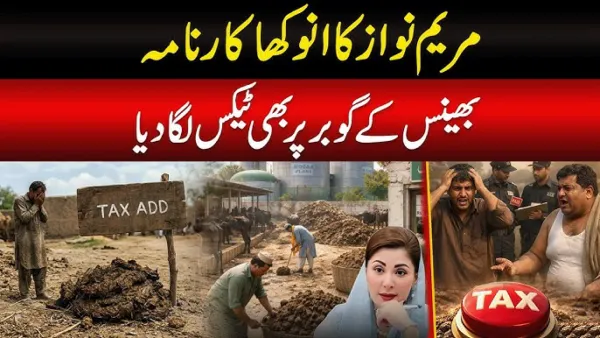

A controversial proposal emerging from Punjab has ignited a heated political and economic debate, as the provincial government led by Maryam Nawaz considers introducing what critics have dubbed a "cow-dung tax." The plan, which would impose a daily fee of around 30 Pakistani rupees per cow or buffalo, has been positioned by the government as part of a broader environmental initiative.
However, opposition parties and farmers argue that the move reflects deeper financial stress and could place an additional burden on an already struggling agricultural sector.
At the heart of the controversy is the government's attempt to integrate waste management with renewable energy production through the 'Suthra Punjab' biogas programme. Launched in December 2024, the initiative aims to convert cattle waste into biogas, thereby addressing sanitation issues while generating clean energy. Yet, the mechanism chosen to fund this effort-charging livestock owners a fixed daily fee per animal-has raised serious questions about fairness, feasibility, and intent.
Green Energy Vision or Revenue Strategy: The Policy at the Center of Debate
The proposed Pakistan cow dung tax is being framed by the government as a service fee rather than a traditional tax. Officials argue that the funds collected will be used to support the collection of animal waste, its processing, and the operation of biogas plants. By doing so, the government aims to reduce environmental pollution, improve sanitation in densely populated cattle colonies, and promote sustainable energy production.
The policy is expected to cover approximately 168 cattle colonies across Punjab, with an estimated 5 million cows and buffaloes potentially falling under its scope. In its initial phase, the scheme will be implemented in two major dairy hubs in Lahore-Harbanspura and Gujjarpura-before being expanded to other regions.
One of the key challenges in implementing such a policy is the difficulty in accurately measuring the amount of dung produced by each animal. To address this, the government has opted for a standardized fee per animal, regardless of variations in output. While this simplifies administration, it also raises concerns about equity, as farmers with fewer resources may end up paying disproportionately relative to their actual contribution to waste generation.
Supporters of the initiative argue that such a system is necessary to create a structured and sustainable approach to waste management. They point out that unmanaged cattle waste contributes to environmental degradation, water contamination, and public health risks. By monetizing waste collection and processing, the government hopes to create an ecosystem where environmental responsibility is shared by all stakeholders.
However, the framing of the policy as a green initiative has not been universally accepted. Critics question whether the environmental benefits justify the financial burden on livestock owners, particularly in a context where economic challenges are already severe.
Opposition and Farmers Push Back Amid Economic Concerns
The Pakistan cow dung tax proposal has faced sharp criticism from opposition parties, who argue that it is less about environmental reform and more about generating revenue in a time of fiscal strain. According to them, labeling the fee as part of a green energy programme is a strategic move to make the policy more palatable, while the underlying objective remains financial.
Opposition leaders have described the proposal as evidence that the provincial government is running out of viable revenue sources. They contend that instead of addressing systemic economic issues, the administration is resorting to unconventional measures that disproportionately affect farmers and small-scale livestock owners.
Farmers, who form the backbone of the rural economy, have voiced their own concerns. Many point out that they are already grappling with rising costs of fodder, electricity, and other essential inputs. Adding a daily fee for each animal could significantly increase their operational expenses, particularly for those managing multiple cattle.
For small and medium-scale livestock owners, the financial impact could be substantial. Estimates suggest that the annual cost per animal could reach around 11,000 Pakistani rupees, a figure that many farmers consider unsustainable given their current income levels. This has led to fears that the policy could discourage livestock farming, ultimately affecting milk production and rural livelihoods.
Critics have also raised questions about governance and accountability. Some industry voices argue that the burden of environmental initiatives should not fall solely on farmers, especially when there are concerns about inefficiencies and corruption within administrative systems. They emphasize the need for a more balanced approach that includes government investment and support rather than relying primarily on user fees.
Despite the backlash, government officials maintain that the policy has received a degree of acceptance among certain segments of the farming community. Zeeshan Rafiq, a local government minister, has stated that some dairy farmers are willing to pay the fee in exchange for improved waste management services. This claim, however, remains contested, with many farmers insisting that their consent has not been adequately sought.
The unfolding debate around the Pakistan cow dung tax highlights the complex intersection of environmental policy, economic realities, and political narratives. It underscores the challenges governments face when attempting to implement reforms that require public participation and financial contribution, particularly in sectors already under strain.