





PM Modi at G7 Summit 2026: Hormuz Disruptions, Indian Sailors' Deaths and Global Trade Concerns
Prime Minister Narendra Modi used the global platform of the G7 Summit in Evian, France, to draw attention to the human and economic consequences of the recent conflict in West Asia, emphasizing the safety of seafarers and the importance of securing international maritime trade routes.
Speaking before leaders of the world's most advanced economies, Modi highlighted the deaths of Indian citizens during the crisis and called for greater international cooperation to ensure stability in one of the world's most critical shipping corridors.
The issue of maritime security has emerged as one of the defining concerns of the current geopolitical landscape following months of instability in the Gulf region. The Strait of Hormuz, through which a substantial portion of the world's oil and energy supplies pass, became a focal point of international concern as military tensions disrupted commercial shipping and raised fears of a broader economic shock.
Addressing leaders during the outreach session of the G7 Summit, Prime Minister Modi stressed that the impact of the conflict extended far beyond the immediate region. He noted that disruptions to maritime trade had affected economies worldwide and underscored that many Indian nationals had paid the ultimate price amid the instability.
His remarks came at a time when world leaders are attempting to stabilize global markets, restore confidence in supply chains, and strengthen diplomatic efforts aimed at preventing future disruptions in strategic waterways.
The summit in Evian brought together leaders from the G7 nations-France, the United States, Canada, Germany, Italy, Japan and the United Kingdom-along with invited partner countries including India, Brazil, South Korea, Egypt and Kenya. The gathering is focused on a range of issues including global security, economic recovery, artificial intelligence, debt sustainability, climate resilience and international cooperation.
For India, the summit offered another opportunity to present its perspective on global challenges while reinforcing its growing role in international decision-making forums.
Modi Calls Seafarers the Lifeline of Global Commerce
One of the central themes of Modi's address was the importance of protecting seafarers who enable the smooth functioning of global trade.
Referring to the recent conflict in West Asia and its impact on shipping routes, Modi said that maritime workers connect countries through commerce and supply chains, making their safety a shared responsibility of the international community.
The Prime Minister's comments carried particular significance because India is among the world’s largest suppliers of maritime manpower. Thousands of Indian sailors work on commercial vessels operating across international waters, including routes that pass through the Strait of Hormuz and the Gulf region.
The recent conflict led to heightened risks for shipping crews, with reports of attacks, disruptions and military operations creating uncertainty throughout the region. Several Indian nationals reportedly lost their lives during the crisis, prompting concerns in New Delhi about the safety of citizens working in international maritime industries.
Modi's remarks reflected India's broader concern that geopolitical conflicts increasingly have direct consequences for ordinary civilians, workers and global supply chains.
By highlighting the human cost of the crisis, he sought to ensure that discussions about security and diplomacy remain connected to the experiences of those most affected by instability.
Strait of Hormuz Remains a Strategic Chokepoint
The Strait of Hormuz occupies a uniquely important position in global trade. Located between Iran and Oman, the narrow waterway serves as a gateway connecting the Persian Gulf to international shipping lanes.
A significant percentage of the world's oil exports and liquefied natural gas shipments pass through the strait every day. Any disruption in the region immediately raises concerns about energy prices, inflation, shipping costs and global economic stability.
During the recent conflict in West Asia, fears of interruptions to shipping traffic caused volatility in energy markets and led governments around the world to monitor developments closely.
India, one of the world’s largest energy importers, has a direct stake in maintaining freedom of navigation and stability in the region. Any prolonged disruption affects fuel imports, transportation costs, industrial production and consumer prices.
Modi acknowledged these broader implications during his address, noting that interruptions to maritime trade through the Strait of Hormuz had adversely affected the global economy.
His comments aligned with growing international consensus that protecting maritime routes is critical not only for regional security but also for worldwide economic growth.
Peace in West Asia Welcomed by India
While expressing concern about the consequences of the conflict, Modi also welcomed recent progress toward peace in the region.
The Prime Minister said India supports efforts aimed at reducing tensions and restoring stability. He noted that the conflict had resulted in loss of life and property across several friendly nations in West Asia.
India has historically maintained strong diplomatic relationships with countries across the region, including Gulf nations, Israel and Iran. As a result, New Delhi has consistently advocated dialogue and peaceful resolution of disputes.
The recent diplomatic breakthrough between the United States and Iran has generated cautious optimism among international observers. Many governments hope that reduced tensions will lower risks to shipping routes and help stabilize energy markets.
India has welcomed such developments while continuing to emphasize the importance of long-term peace and economic cooperation.
Trust Deficit Dominates Modi's G7 Message
Beyond the immediate concerns of maritime security, Modi used his address to highlight what he described as a broader shortage of trust in international relations.
According to the Prime Minister, the world today is more interconnected and interdependent than at any previous point in history. However, he argued that partnerships can only succeed when they are built on mutual trust.
Modi stated that trust has become one of the most valuable strategic assets in global affairs, suggesting that many international challenges stem not from a lack of resources but from declining confidence between nations.
His remarks resonated with ongoing debates over geopolitical competition, trade disputes, technological rivalry and conflicts in multiple regions.
The Prime Minister argued that rebuilding trust should become a central objective of international diplomacy.
He stressed that global cooperation must move beyond transactional arrangements and evolve into genuine partnerships based on shared interests and mutual respect.
India Advocates Inclusive Development
Another major theme of Modi's speech was development-oriented cooperation.
The Prime Minister reiterated India's long-standing belief in the philosophy that the world is one family. Drawing from India's development experience, he argued that sustainable progress is only possible when policies are linked directly to people's aspirations.
According to Modi, successful international partnerships are not measured solely by what one country provides to another. Instead, their true value lies in enabling societies to build their own capabilities and achieve self-reliance.
This perspective aligns with India's approach toward development partnerships in Africa, Asia and the Global South, where New Delhi has increasingly focused on capacity-building, digital infrastructure, healthcare cooperation and skills development.
The message also reflected India's broader effort to position itself as a voice for developing nations in global forums.
Expectations of the Global South
During his address, Modi emphasized that countries of the Global South have significant expectations from the international community.
He argued that developing nations require genuine partnerships rather than one-sided assistance. According to the Prime Minister, emerging economies seek equal participation in shaping global policies and institutions.
This theme has become a recurring element of India's diplomatic outreach over the past several years.
New Delhi has consistently advocated reforms in global governance institutions and greater representation for developing countries in decision-making processes.
By raising these issues at the G7 Summit, Modi sought to ensure that discussions among advanced economies take into account the priorities of nations outside the traditional centers of power.
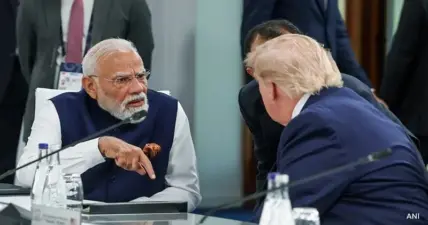
Modi and Trump Share First Major Interaction Since Washington Visit
One of the most closely watched moments at the summit was the interaction between Prime Minister Modi and US President Donald Trump.
The two leaders met on the sidelines of the summit and exchanged greetings before engaging in a brief conversation.
Photographs from the event showed Trump rising from his seat to greet Modi, with the leaders shaking hands and speaking for several minutes.
The meeting attracted attention because it represented their first significant face-to-face interaction since Modi's visit to Washington earlier in the year.
India-US relations remain among the most important strategic partnerships in the world, encompassing trade, defense cooperation, technology collaboration, education and people-to-people ties.
However, the relationship has also faced periodic challenges involving tariffs, immigration policies and trade negotiations.
Observers expect further discussions between the two leaders to address these issues while reinforcing broader strategic cooperation.
Bilateral Meetings Expand India's Diplomatic Outreach
Apart from his interaction with Trump, Modi held meetings with several world leaders during the summit.
Among those he met were Canadian Prime Minister Mark Carney, British Prime Minister Keir Starmer, UAE President Sheikh Mohammed bin Zayed Al Nahyan, Egyptian President Abdel Fattah el-Sisi, South Korean President Lee Jae-myung and Japanese Prime Minister Sanae Takaichi.
These engagements reflected India's active diplomatic strategy and its growing influence across multiple regions.
The discussions covered a range of issues including trade, investment, technology, energy security and regional stability.
For India, such meetings provide opportunities to deepen bilateral partnerships while advancing common positions on global challenges.
Why the G7 Summit Matters for India
Although India is not a formal member of the G7, it has become a regular participant in summit outreach sessions.
Prime Minister Modi has attended multiple G7 gatherings over the past several years, reflecting India's increasing importance in global economic and geopolitical discussions.
As one of the world's fastest-growing major economies and a key player in international affairs, India is frequently invited to contribute perspectives on issues ranging from climate change and digital transformation to global security and economic development.
The country's participation also reflects recognition that many contemporary challenges require cooperation beyond the traditional G7 membership.
A Broader Vision for Global Cooperation
Modi's intervention at the summit ultimately combined immediate concerns with a broader vision for international cooperation.
By raising the issue of Indian sailors lost during the West Asia conflict, he highlighted the human consequences of geopolitical instability. By discussing trust, development and partnerships, he expanded the conversation beyond security concerns to include long-term solutions for global challenges.
His message suggested that economic prosperity, maritime security and international stability are increasingly interconnected. In a world dependent on global trade routes and cross-border cooperation, disruptions in one region can rapidly affect countries thousands of miles away.
As the G7 Summit continues, India's emphasis on trust, inclusive development and shared responsibility is likely to remain central to its diplomatic engagement. For New Delhi, ensuring the safety of citizens, protecting global commerce and strengthening international partnerships are not separate objectives but interconnected elements of a broader vision for a more stable and cooperative world.