
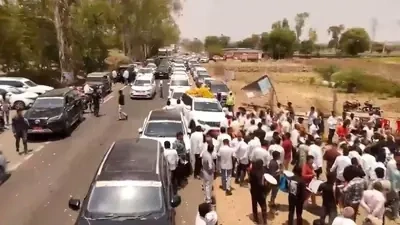

Prime Minister Narendra Modi has significantly reduced the size of his official convoy following his recent appeal for fuel conservation and responsible spending, triggering a wider movement among BJP chief ministers, governors, ministers, and senior leaders across the country.
The decision comes amid rising concerns over global energy instability linked to the ongoing West Asia crisis, which has intensified pressure on fuel prices, imports, and foreign exchange reserves. Government sources said the Prime Minister's message was not about austerity or reducing welfare expenditure, but rather about smarter resource utilisation and lowering avoidable fuel consumption.
The downsizing of Modi's convoy was implemented during his recent visits to Gujarat and Assam while maintaining all essential security arrangements under Special Protection Group protocols.
Officials also revealed that the Prime Minister encouraged the inclusion of electric vehicles in his convoy wherever feasible without making unnecessary new purchases, reinforcing the government's emphasis on energy efficiency and sustainable mobility.
Fuel Conservation Becomes Nationwide Governance Message
The Prime Minister's remarks during a Union Cabinet meeting and a public address in Hyderabad have now evolved into a broader political and administrative campaign focused on reducing fuel dependence and conserving foreign exchange.
Sources indicated that Modi urged ministers and public representatives to consciously cut unnecessary expenditure linked to fuel consumption, foreign travel, and excessive vehicle usage. He reportedly encouraged work-from-home practices wherever possible and promoted public transport, railway cargo services, carpooling, and electric mobility solutions.
The appeal has rapidly influenced several BJP-ruled states, with leaders announcing measures aimed at reducing official fuel consumption while projecting a message of responsible governance during a period of global uncertainty.
The government has clarified that these steps should not be interpreted as economic austerity measures. Officials stressed that capital expenditure, welfare schemes, subsidies, and development spending remain unaffected.
Instead, the initiative is being framed as a strategic effort to reduce avoidable imports and foreign-currency-intensive spending while improving energy efficiency.
BJP Chief Ministers Begin Cutting Convoys
Following the Prime Minister's example, Yogi Adityanath directed an immediate 50 percent reduction in the number of vehicles accompanying him and state ministers in Uttar Pradesh.
Adityanath also appealed to citizens to support fuel conservation efforts by reducing unnecessary travel and adopting efficient transportation practices.
Similarly, Mohan Yadav announced that his convoy would operate with the minimum number of vehicles required from a security perspective. He instructed ministers to follow the same approach and encouraged greater use of public transportation.
In Delhi, Chief Minister Rekha Gupta introduced limits on the use of official vehicles by ministers and MLAs while also asking residents to adopt carpooling and public transport systems.
Bhajan Lal Sharma issued similar instructions in Rajasthan, asking officials and public representatives to minimize convoy usage and avoid unnecessary fuel expenditure.
The movement has quickly expanded beyond convoy reduction, with several leaders also reviewing travel practices and encouraging broader environmental responsibility.
Electric Vehicles and Public Transport Gain Focus
The fuel conservation campaign has also accelerated political emphasis on electric mobility and public transportation.
Eknath Shinde reportedly shifted to an electric vehicle as part of the initiative, while ministers belonging to the Shiv Sena were advised to minimize non-essential travel and reduce vehicle usage during official movement.
The Maharashtra government also directed ministers to seek prior approval from Chief Minister Devendra Fadnavis before using aircraft for official travel.
In another significant move, Acharya Devvrat announced that he would travel within Gujarat using trains, buses, and public transport instead of helicopters and flights. He also committed to reducing official convoy sizes to support fuel conservation goals.
Harsh Sanghvi cancelled a planned visit to the United States after Modi's appeal to reduce foreign travel and unnecessary fuel-intensive activities.
Meanwhile, Vijay Kumar Chaudhary stated that he had reduced the number of vehicles used in his official movement by half and would limit travel to essential purposes only.
West Asia Crisis Influences Policy Response
The conservation push comes against the backdrop of increasing instability in West Asia, which has raised concerns globally over crude oil supply disruptions and rising energy costs.
India, one of the world's largest oil importers, remains particularly sensitive to fluctuations in global fuel markets. Analysts believe the government's focus on reducing avoidable fuel consumption reflects an attempt to proactively manage economic risks linked to international geopolitical tensions.
N. Chandrababu Naidu confirmed that the Andhra Pradesh government is preparing precautionary measures aimed at minimizing the potential economic impact of the West Asia crisis on the state.
Similarly, Vishnu Deo Sai said his administration would place stronger emphasis on electric vehicles and reduced convoy sizes moving forward.
The initiative has also received symbolic support from constitutional offices. Kavinder Gupta declared Lok Bhavan a "fuel conservation zone" and appealed to educational institutions to actively participate in the energy-saving movement.
Government Emphasises "Smart Spending" Over Austerity
Officials have repeatedly stressed that the Prime Minister's appeal should not be viewed as a traditional austerity drive involving spending cuts or fiscal tightening.
Instead, the initiative focuses on "spending more wisely" by minimizing wasteful fuel use, reducing dependence on imported energy, and encouraging sustainable practices across government systems.
The broader message aligns with India's ongoing push toward clean mobility, energy efficiency, and reduced import vulnerability while maintaining economic growth and welfare commitments.
Political analysts note that the campaign also carries strong symbolic value, projecting leadership-led discipline and environmental responsibility during a period of international uncertainty.
As more leaders adopt convoy reductions, public transport usage, and electric mobility measures, the fuel conservation campaign is rapidly emerging as one of the most visible governance initiatives linked to the current global energy situation.