
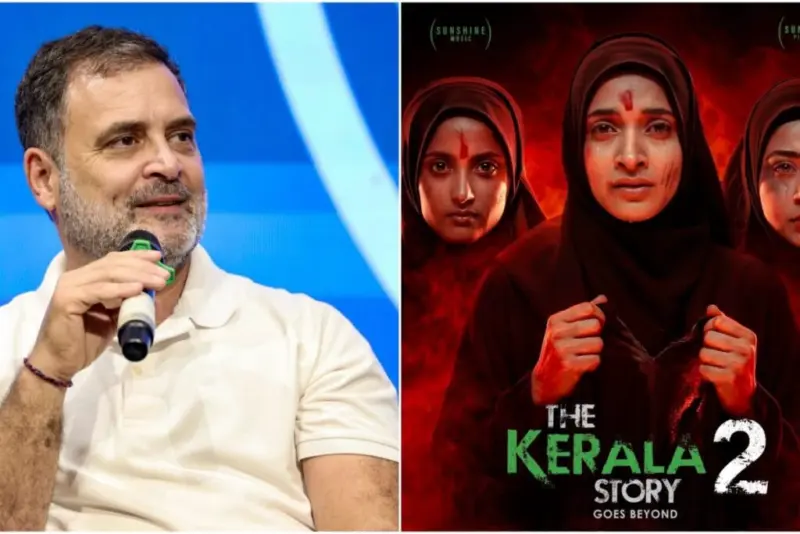

Congress leader Rahul Gandhi said it is good that not many people are watching The Kerala Story 2, adding that films, television and media are increasingly being used as tools for propaganda.
Leader of the Opposition in the Lok Sabha, Rahul Gandhi, recently addressed students during an interaction at Marian College in Kuttikkanam, located in Kerala's Idukki district. During the discussion, he commented on the role of films and media in shaping public narratives and expressed concern that these platforms are increasingly being used to spread propaganda and division within society.
The interaction took place on Friday when Gandhi was responding to questions from students about politics, education, global issues and the influence of media. One student asked him specifically about the role of films in promoting certain narratives and whether cinema can sometimes be used as a propaganda tool.
Responding to the question, Rahul Gandhi referred to the film The Kerala Story 2: Goes Beyond. He said it was "good news" that the film was not attracting large audiences, suggesting that viewers were not connecting with the narrative presented in it. According to him, the film felt hollow and did not resonate with many people.
Gandhi also said the response to the film reflects how complex and diverse Kerala's society, culture and traditions are. In his view, many people outside the state may not fully understand the social fabric and cultural identity of Kerala.
His remarks came in the context of a broader discussion on how media platforms, including cinema and television, influence public perception and political narratives.
Rahul Gandhi questions growing use of films and media for propaganda
During the interaction with students, Rahul Gandhi expressed concern that films, television and other forms of media are increasingly being used to promote specific narratives and ideologies. According to him, these platforms have the power to shape public opinion, and in some cases they are being used to spread division rather than encourage understanding.
He suggested that media content can sometimes be used to create hostility between communities or to target certain groups. Gandhi argued that such narratives can lead to social divisions where some groups benefit while others are unfairly portrayed or marginalized.
The Congress leader emphasized that storytelling through films and media should ideally reflect the diversity and complexity of society rather than simplify or distort it for political purposes. He said that when narratives are shaped to promote hatred or division, it undermines the spirit of democratic dialogue.
His remarks also touched on the importance of critical thinking among audiences. Gandhi indicated that viewers should approach media content thoughtfully and be aware that certain narratives may be influenced by political or ideological motivations.
The discussion highlighted a broader debate in India about the role of cinema and digital media in political discourse. In recent years, films and web series have increasingly become part of political conversations, with some productions praised for raising social issues while others have been criticized for promoting particular viewpoints.
According to Gandhi, the response of audiences to films like The Kerala Story 2 shows that viewers are capable of evaluating narratives and deciding whether they find them credible or meaningful.
He also suggested that Kerala's social structure and cultural traditions are often misunderstood by people who are not familiar with the state. The complexity of its society, he said, cannot easily be represented through simplistic narratives.
The interaction at Marian College became a platform for Gandhi to discuss broader themes related to media influence, education and political awareness among young people.
Discussion with students covers education, technology and global politics
Apart from commenting on films and media, Rahul Gandhi also spoke about several other issues during the interaction with students. The discussion covered topics such as education policy, artificial intelligence, global conflicts and personal interests.
One of the issues Gandhi raised was the influence of ideology within India's education system. He claimed that certain ideological groups are increasingly influencing universities and academic institutions.
According to him, several vice-chancellors at universities have been appointed because of their association with a particular ideological background, including links with the Rashtriya Swayamsevak Sangh. Gandhi argued that education should encourage diverse perspectives rather than promoting a single viewpoint.
He stressed that universities should remain spaces where different ideas and debates are encouraged. Limiting education to a single ideological framework, he said, can restrict intellectual freedom and critical thinking among students.
Another topic discussed during the session was the global race in artificial intelligence. Gandhi said India still has significant ground to cover when compared with countries such as the United States and China in the development of AI technologies.
He emphasized that data plays a crucial role in the advancement of artificial intelligence. According to him, the United States has access to vast amounts of global data, which strengthens its technological capabilities.
China, on the other hand, maintains strict control over domestic data, allowing it to build strong internal technological systems. Gandhi suggested that if India wants to compete effectively in the field of artificial intelligence, it must develop strategies to manage and control its own data resources.
The conversation also turned to global geopolitical developments, particularly conflicts in West Asia. Gandhi said that while the situation in the region may appear to be a confrontation between countries like Israel and Iran, the reality involves a broader set of global powers.
He pointed out that major geopolitical players such as the United States, China and Russia are also deeply connected to developments in the region. Since West Asia is a major hub for global energy production, conflicts there can have widespread economic and political consequences across the world.
Energy markets, trade routes and geopolitical alliances are all influenced by developments in the region, making it an area of strategic importance for many countries.
In addition to political and global issues, Gandhi also spoke about his personal interests and lifestyle. He told students that he does not watch many films in general, preferring other activities during his leisure time.
Among his hobbies, he mentioned playing chess and practicing martial arts. He also shared that he maintains his fitness through regular exercise, including swimming, running and other physical activities.
When speaking about Kerala, Gandhi reflected on his experience representing the Wayanad constituency for several years. He said that despite spending five years as a Member of Parliament from the state, he still feels that he is in the process of fully understanding Kerala's society and culture.
He referred to the Wayanad landslide tragedy as an example of the resilience and solidarity of Kerala's people. According to him, the way residents supported and helped each other during the disaster demonstrated the strength of the state's social fabric.
The interaction with students in Idukki offered Gandhi an opportunity to discuss a range of issues affecting India and the world, while also engaging directly with young people about politics, society and the role of media in shaping public narratives.