
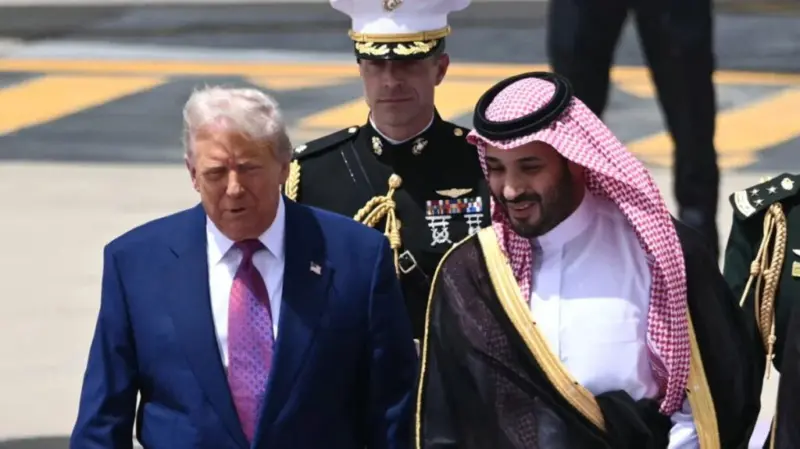

Saudi Crown Prince Mohammed bin Salman arrives in Washington with a confidence shaped by recent geopolitical tests, a shifting Middle Eastern balance, and a renewed willingness from the United States-under President Donald Trump-to negotiate access to some of America's most guarded technological assets.
The visit underscores a fundamental shift in US-Saudi relations, as the kingdom moves from traditional defence purchases to sophisticated, multi-layered cooperation spanning nuclear technology, advanced AI infrastructure, strategic defence guarantees, and fifth-generation fighter platforms.
The crown prince's wishlist reflects a new, more assertive Saudi posture. Riyadh seeks a defence pact with Washington that surpasses Qatar's US-guaranteed security arrangement, access to advanced drones and AI chips, and potentially the stationing of American nuclear weapons on Saudi soil. The breadth of the request highlights a kingdom that sees itself as central to a multipolar world, yet increasingly aligned with Washington as it recalibrates partnerships after years of regional volatility.
For Washington, the timing is equally significant. President Trump views foreign sales as a key economic lever and has shown a willingness to bypass traditional bureaucratic resistance-particularly on technology concerns related to China-to offer major deals to a nation that remains one of the world's few cash-rich economies despite budget pressures. The visit therefore becomes not only a diplomatic engagement but a direct negotiation between two leaders looking to reshape their strategic toolkits.
The Saudi goal is clear: a long-term, legally durable security arrangement that provides reliable US backing. The memory of September 2019, when Iran's attack on Saudi Aramco facilities did not trigger an American military response, deeply influenced Riyadh's thinking. A unilateral US executive order offering Qatar protection after the Israeli strike in Doha did little to reassure Saudi Arabia, especially because such orders can be reversed by future administrations.
Saudi defence planners want something stronger-an arrangement more substantive than memorandums of understanding, yet not requiring Senate ratification, which is politically improbable. Riyadh wants a credible, enforceable commitment, reflecting its view that symbolic assurances no longer align with its strategic needs in an increasingly unstable neighbourhood.
The nuclear dimension remains one of the most sensitive elements of the crown prince's agenda. The kingdom is believed to be exploring the possibility of being included under the US nuclear umbrella, an arrangement that would symbolically and strategically elevate its position in the regional hierarchy. This comes weeks after Riyadh signed a defence pact with Pakistan, the Muslim world's only nuclear-armed state, raising concerns in Washington about the future shape of the region's nuclear security.
US officials have privately acknowledged that a nuclear umbrella for Saudi Arabia could serve a dual purpose: anchoring Riyadh more firmly to Washington and reducing its reliance on Pakistan's capabilities. Analysts suggest that the coming days may see carefully structured language pointing to closer Saudi linkage with the US nuclear arsenal. Such a step, while politically sensitive, echoes periods during the Cold War when Washington stationed nuclear weapons in various allied states across Europe and Asia.
Simultaneously, Riyadh seeks clarity on its ability to enrich uranium. The United States has long insisted that Middle Eastern civilian nuclear programmes adhere to the "gold standard," banning enrichment as the UAE agreed to in 2009. But Saudi Arabia argues that with abundant uranium resources, enrichment is not only an economic opportunity but a matter of national sovereignty and technological prestige.
The kingdom has openly stated its intention to develop the uranium cycle-mining, yellowcake production, and potentially enrichment. The question for Washington is what concessions can convince Riyadh to limit or coordinate enrichment activities. Some analysts believe that if the US were to offer nuclear umbrella protection, it might strengthen its case for a more restrictive civilian nuclear agreement. Others argue that the Saudis will settle for nothing less than a pathway to eventual enrichment rights.
Against this backdrop, the Saudi pursuit of nuclear technology is not only about energy security or economic diversification. It represents a broader strategic vision to position the kingdom as a technologically sophisticated power capable of competing with regional rivals and maintaining autonomy in a rapidly shifting geopolitical landscape.
A New Defence Landscape: F-35s, Advanced Drones, and High-Tech Localisation
Saudi Arabia's defence delegation of 1,000 officials travelling on 18 aircraft underscores the scale and determination behind the visit. This trip marks Crown Prince Mohammed bin Salman's first return to the White House since 2018, a symbolic moment that reflects his renewed global stature after years of controversy, strategic recalibration and diplomatic repositioning.
Under Trump, Washington and Riyadh announced $142 billion in defence sales, and discussions surrounding the inclusion of F-35 fighter jets have accelerated. The potential sale of up to 48 F-35s represents a major shift, as Israel remains the only Middle Eastern nation currently operating the aircraft. While previous deals for the UAE stalled under President Biden due to concerns over Chinese access to sensitive technology, Trump appears more willing to move forward provided security assurances are met.
The F-35 issue intersects with longstanding debates in Washington and Tel Aviv over maintaining Israel's qualitative military edge. Historically, Saudi Arabia received downgraded versions of American aircraft, including the F-15S in the 1990s. But the F-35's architecture, which includes remote disabling capabilities, gives Washington confidence that it can maintain oversight even after delivery. Israel has also set precedents by modifying its F-35I Adir variant with US approval-demonstrating that the aircraft can be tailored without undermining core American controls.
For Riyadh, the F-35 is not merely a platform but a symbol of deeper integration into US-led defence networks. It aligns with the kingdom's broader strategy to develop a sophisticated, domestically anchored military industry. Saudi officials emphasise what they call "localisation of content"-a targeted effort to build domestic capacity in manufacturing, research, and high-tech defence systems. Without American assistance, analysts argue, Saudi Arabia's state-owned Saudi Arabian Military Industries cannot realistically achieve its aspirations of becoming a major global defence player.
Alongside fighter jets, the kingdom is exploring a new generation of unmanned platforms. Talks with US manufacturer Shield AI reflect growing Saudi interest in mid-sized, AI-supported drones capable of operating in contested environments, partnering with crewed fighter aircraft, and conducting maritime surveillance across the Red Sea and Persian Gulf.
The MQ-9 Reaper remains part of the discussion, but Saudi defence officials are increasingly selective, emphasising drones that offer both autonomy and adaptability. The V-Bat and VTOL-capable systems under consideration align with the kingdom's goal to modernise and diversify its security architecture, particularly in light of evolving regional threats from Iran, Yemen, and asymmetric actors.
Simultaneously, AI technology and data infrastructure form the second major pillar of Saudi Arabia's strategic vision. The kingdom is positioning itself as a future global hub for AI development, capitalising on low energy costs and vast land availability to build high-capacity data centres. Companies such as Humain and Datavolt, backed by the Public Investment Fund, are developing facilities across Riyadh, Dammam and the Red Sea, collectively aiming for several gigawatts of processing capability.
During Trump's visit to the Gulf earlier in the year, deals for advanced Nvidia Blackwell chips were announced with great fanfare, though deliveries have been delayed. Some US officials fear that Chinese entities could gain access to American AI technology through Saudi infrastructure-a concern that has slowed implementation. Riyadh is expected to push for accelerated timelines during its meetings in Washington, arguing that delays undermine its economic diversification strategy and impede broader US-Saudi cooperation.
The crown prince views AI as a foundational technology, not only for defence but for energy management, smart cities, cybersecurity and industrial automation-pillar sectors of Saudi Vision 2030. He aims to build a regional technological powerhouse capable of rivaling or partnering with global innovation hubs, a goal that requires seamless access to cutting-edge hardware and strategic support from Washington.
Saudi Arabia's ability to decouple US discussions from Israeli expectations is an emerging diplomatic success. While Washington previously tied certain defence agreements to the possibility of Saudi-Israel normalisation, Riyadh has deliberately separated the two tracks. With the Gaza crisis still unfolding and no credible movement toward a Palestinian state, Saudi leadership maintains that normalisation cannot proceed without concrete progress, a stance affirmed by both Arab and Western diplomats.
This decoupling has allowed the kingdom to pursue its strategic interests independently. Whether in nuclear cooperation, defence architecture, AI development, or fifth-generation aircraft procurement, Riyadh is focused on long-term national priorities rather than external political expectations.