
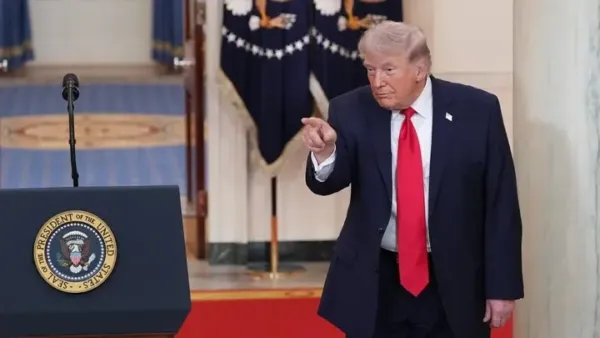

Fresh controversy has erupted in global politics after Donald Trump publicly mocked Emmanuel Macron, making personal comments about the French leader's relationship with his wife.
The remarks have not only reignited discussions about political rhetoric but also raised serious questions about the limits of personal attacks in international diplomacy. At a time when global alliances and leadership decorum are under constant scrutiny, Trump's statements have once again blurred the line between political critique and personal commentary.
The incident has drawn widespread attention across diplomatic circles, media platforms, and public discourse, with many questioning whether such remarks undermine the dignity expected of global leaders. Trump's comments, which targeted Macron's personal life rather than his policies, have been viewed by critics as inappropriate and reflective of a broader trend of personalization in modern political narratives.
Personal remarks spark diplomatic unease and global reaction
Trump's criticism reportedly included a remark suggesting that Macron is treated poorly by his wife, a comment that quickly went viral and triggered strong reactions internationally. While Trump has often used provocative language in his political communication style, this instance has been seen as particularly controversial because it ventures into the personal domain of a sitting head of state.
Observers argue that such remarks risk straining diplomatic relationships, especially between key allies like the United States and France. Macron, who has maintained a relatively measured and formal tone in international engagements, has not publicly responded in detail, but the controversy has nonetheless added a layer of tension to the already complex dynamics of global politics.
The episode has also reignited debate over how political figures use humor, sarcasm, and personal commentary as tools of influence. While some supporters of Trump defend his style as candid and unfiltered, critics contend that such rhetoric diminishes the seriousness of political discourse and can lead to unnecessary friction between nations.
Experts in international relations note that diplomacy traditionally relies on mutual respect and restraint, even in the face of disagreement. Personal attacks, particularly those involving family members, are generally considered outside the acceptable boundaries of political engagement. In this context, Trump's remarks are being viewed as a departure from established norms.
The growing normalization of personal attacks in politics
This controversy highlights a broader shift in political communication, where personal narratives increasingly overshadow policy discussions. The rise of social media and 24-hour news cycles has amplified this trend, encouraging leaders to adopt more direct and sometimes provocative forms of expression to capture public attention.
Trump, known for his unconventional approach to politics, has often leveraged this style to connect with his base. However, incidents like this raise questions about the long-term impact of such communication strategies on democratic institutions and international cooperation.
For Macron, who represents a contrasting leadership style rooted in formality and diplomatic tradition, the remarks underscore the challenges of navigating a political landscape where personal attacks can quickly dominate headlines. The incident also reflects the broader cultural differences in political expression between leaders and nations.
Public reactions to the controversy have been mixed. While some view the remarks as trivial or humorous, others see them as indicative of a deeper erosion of respect in political discourse. Social media platforms have been flooded with commentary, memes, and debates, further amplifying the issue beyond traditional diplomatic channels.
The incident also raises questions about accountability and the role of public figures in shaping discourse. As leaders with significant influence, their words carry weight not only within their own countries but also on the global stage. Statements that may appear casual or offhand can have far-reaching implications for international relations and public perception.
In an era where political communication is increasingly scrutinized, the controversy surrounding Trump's remarks serves as a reminder of the delicate balance between free expression and responsible leadership. It underscores the importance of maintaining a level of decorum that reflects the seriousness of global governance, even amid ideological differences and political rivalry.