
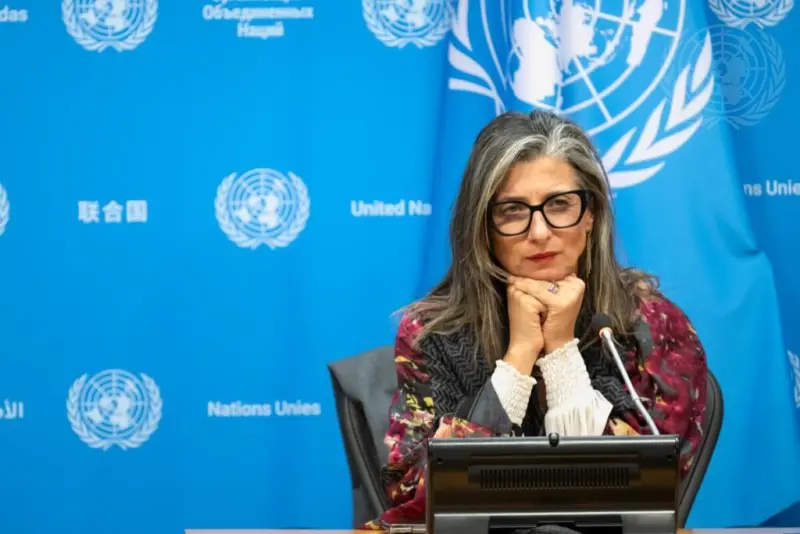

United Nations Human Rights Council report by Francesca Albanese raises concerns over India's ties with Israel during the Gaza conflict, sparking global debate.
A fresh controversy has emerged at the international level after a United Nations Special Rapporteur alleged that India may have violated international law through its support for Israel during the ongoing Gaza conflict. The remarks were made by Francesca Albanese in a report presented at the United Nations Human Rights Council, focusing on conditions in Gaza and the broader implications of global alliances.
The report, which examines humanitarian and legal dimensions of the conflict, has triggered widespread discussion about the responsibilities of countries maintaining strategic ties with Israel. It suggests that nations providing military or strategic assistance could face legal and ethical scrutiny under international law.
According to Albanese, states have an obligation to avoid actions that may contribute to violations of international humanitarian law. In this context, she indicated that India's alleged involvement in arms-related support to Israel could raise concerns regarding compliance with global legal standards.
She further emphasized that international law is not limited to legal obligations but also includes moral expectations. In her view, countries with a historical commitment to non-alignment and justice are expected to uphold humanitarian principles in times of conflict.
The report places particular focus on India's growing strategic partnership with Israel. Over the years, the two countries have strengthened cooperation in areas such as defense, technology, and diplomacy. Albanese highlighted this relationship as a factor influencing the current debate.
References were made to high-level engagements, including visits by Narendra Modi to Israel, as indicators of deepening ties. The report suggests that such partnerships, in the context of ongoing conflict, may have broader implications for international norms and accountability.
Albanese also warned that continued support from global partners could weaken established legal frameworks designed to prevent human rights violations. She argued that geopolitical alignments often influence responses to conflicts, making it difficult to achieve consensus at the international level.
The report presents a detailed account of the humanitarian situation in Gaza, describing it as severe and deteriorating. It highlights shortages of essential resources such as food, medical supplies, and sanitation facilities, pointing to the impact on civilian populations.
According to the findings, living conditions in Gaza have worsened significantly, with high population density and limited access to basic services. The report describes an environment of extreme hardship, where civilians face daily challenges related to survival and safety.
It also raises concerns about alleged attacks on healthcare workers, journalists, and humanitarian personnel. These developments, according to Albanese, further intensify the crisis and complicate relief efforts.
Beyond physical conditions, the report discusses what it describes as systems of control and surveillance. These include the use of advanced technologies such as drones and monitoring systems, which are said to affect daily life and restrict movement.
Albanese argued that such measures create continuous psychological pressure on affected populations. She suggested that these practices, when widespread, indicate systemic patterns rather than isolated incidents.
The report also points to the use of restrictions on essential resources as a means of exerting pressure. According to Albanese, limiting access to food and services can have long-term effects on communities, weakening resilience and stability.
International responses to the situation have been varied. Some countries have raised concerns and called for action at global forums, while others have taken a more cautious approach. Differences in political and strategic interests have made it difficult to reach unified positions.
The report acknowledges these challenges, noting that powerful geopolitical dynamics often shape decision-making processes. This has resulted in divisions within the international community, affecting the effectiveness of collective responses.
India's position in this context remains under scrutiny following the allegations. While the report raises questions about its role, it is important to note that such findings represent the perspective of an independent UN rapporteur and do not necessarily reflect an official UN stance.
India has traditionally followed a balanced foreign policy approach, engaging with multiple partners while advocating dialogue and peaceful resolution of conflicts. The current allegations, however, have brought renewed attention to its strategic choices and international commitments.
Experts highlight that reports by UN rapporteurs can influence global discourse even when they are not binding. They contribute to debates on international law, accountability, and the responsibilities of states in conflict situations.
The controversy underscores the complexity of modern geopolitics, where strategic interests, legal frameworks, and humanitarian considerations intersect. It also reflects the challenges of maintaining consistency in international policy amid evolving global dynamics.
As discussions continue, the report is likely to generate further reactions from governments, international organizations, and civil society groups. The coming weeks may see additional clarifications, responses, and diplomatic engagement on the issue.
In conclusion, the allegations raised by Francesca Albanese have added a new dimension to the global conversation on the Gaza conflict. While they have sparked debate over India's role and international responsibilities, they also highlight broader questions about accountability, legal norms, and the challenges of achieving consensus in a complex geopolitical environment