




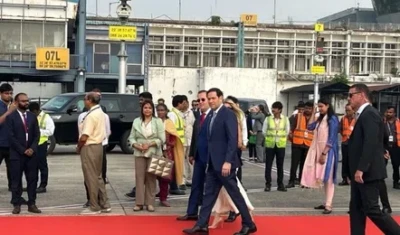

In a significant diplomatic development highlighting the growing strategic partnership between India and the United States, US Secretary of State Marco Rubio arrived in India on Saturday for his maiden four-day official visit.
The high-profile trip is expected to deepen cooperation between the two democracies across critical sectors including defence, trade, advanced technology, energy security and Indo-Pacific strategy.
Rubio landed in Kolkata early Saturday morning, marking the beginning of a visit that carries substantial geopolitical importance amid rapidly evolving global power dynamics. The visit also comes ahead of the crucial Quadrilateral Security Dialogue (Quad) Foreign Ministers' Meeting hosted by India, where leaders from the United States, India, Japan and Australia are expected to discuss regional security and strategic cooperation.
The visit is being closely watched by diplomatic observers and international policy experts as it signals Washington's continued focus on strengthening ties with India, which is increasingly viewed as a central partner in maintaining stability and balance in the Indo-Pacific region.
US Ambassador to India Sergio Gor welcomed Rubio upon his arrival. According to official statements from the US Department of State, the Secretary of State's itinerary combines diplomatic engagements with symbolic cultural visits designed to highlight people-to-people relations between the two countries.
During his stay in Kolkata, Rubio is scheduled to visit the historic Mother House, the headquarters of Missionaries of Charity founded by Mother Teresa. He is also expected to visit a children's home operated by the organization, reflecting a humanitarian dimension to the diplomatic tour.
Later in the day, Rubio will travel to New Delhi, where he is scheduled to meet Prime Minister Narendra Modi and senior Indian officials for high-level discussions focused on strategic cooperation.
India-US Partnership Enters A New Strategic Phase
The four-day visit comes at a time when relations between India and the United States are expanding rapidly across multiple domains. Over the past decade, bilateral ties have evolved from a primarily economic relationship into a broad strategic partnership encompassing defence collaboration, technological innovation, intelligence sharing and regional security coordination.
Diplomatic experts believe Rubio's visit signals Washington's intention to further institutionalize cooperation with India as geopolitical competition intensifies in the Indo-Pacific. The region has emerged as one of the most strategically sensitive zones globally due to increasing military activity, maritime disputes and expanding economic influence among major powers.
The United States has repeatedly emphasized the importance of India as a democratic partner capable of contributing to a "free and open Indo-Pacific." India, meanwhile, has strengthened its own engagement with like-minded nations while maintaining its policy of strategic autonomy in global affairs.
Officials familiar with the visit indicated that discussions between Rubio and Indian leaders are expected to focus heavily on defence modernization, emerging technologies, semiconductor cooperation, cyber security, artificial intelligence, supply chain resilience and maritime security.
Trade relations are also expected to feature prominently during the meetings. India and the United States have steadily expanded bilateral trade in recent years, with cooperation increasing in sectors such as pharmaceuticals, clean energy, digital services, defence manufacturing and electronics.
Energy security remains another major pillar of the relationship. Both countries have increased collaboration on renewable energy investments, nuclear cooperation and long-term energy diversification strategies aimed at ensuring stability amid volatile global energy markets.
Quad Meeting Expected To Dominate Strategic Discussions
One of the most important aspects of Rubio's India visit will be his participation in the upcoming Quad Foreign Ministers' Meeting scheduled to take place in New Delhi on Tuesday.
The Quad, formally known as the Quadrilateral Security Dialogue, includes India, the United States, Japan and Australia. Over the past several years, the grouping has evolved into one of the most influential strategic partnerships in the Indo-Pacific region.
Alongside Rubio, Australian Foreign Minister Penny Wong and Japanese Foreign Minister Toshimitsu Motegi are expected to participate in the discussions hosted by India's External Affairs Minister S. Jaishankar.
The meeting is expected to review progress on ongoing Quad initiatives covering maritime security, vaccine partnerships, critical technologies, infrastructure development, disaster response and regional connectivity.
The grouping has increasingly gained prominence amid concerns over regional security challenges and the need to maintain freedom of navigation and rules-based international order in the Indo-Pacific.
Although the Quad is not officially a military alliance, its growing coordination on strategic issues has attracted global attention. Analysts believe the platform now plays an increasingly important role in shaping regional diplomacy and collective responses to emerging geopolitical developments.
The External Affairs Ministry stated that the meeting would align with the Quad's shared vision of a free, open and inclusive Indo-Pacific region. Discussions are also expected to cover broader international developments and ongoing global conflicts affecting economic and security stability.
Rubio's Diplomatic Debut In India Carries Symbolic Importance
Marco Rubio's maiden visit to India as Secretary of State is being viewed as both diplomatically significant and symbolically important. Rubio, who has long advocated stronger strategic engagement in Asia, is expected to use the visit to reinforce Washington's commitment to deeper cooperation with India.
Political analysts note that first official visits often serve as indicators of future diplomatic priorities. By choosing India as a major destination early in his tenure, Rubio appears to be underscoring the strategic importance Washington places on the bilateral relationship.
Prior to his departure for India, Rubio described India as a "great ally and partner," emphasizing that both countries have substantial areas of mutual cooperation ahead. His remarks were widely interpreted as an acknowledgment of India's growing influence in global affairs.
Observers also point to the broader global context surrounding the visit. Geopolitical tensions, shifting economic alignments, technology competition and supply chain concerns have encouraged closer coordination among democratic nations across the Indo-Pacific.
India's role within these evolving dynamics has expanded significantly due to its economic growth, strategic geography, military capabilities and diplomatic influence. The United States increasingly sees India as a crucial balancing power capable of contributing to long-term regional stability.
Focus On Technology, Defence And Economic Collaboration
One of the central themes of Rubio's engagements in India is expected to be advanced technology cooperation. Emerging technologies such as artificial intelligence, semiconductors, quantum computing and cybersecurity have become critical components of modern geopolitical competition.
Both India and the United States have intensified efforts to strengthen technological collaboration through joint initiatives, research partnerships and private-sector investment. American technology companies continue expanding their presence in India, while Indian firms are playing a growing role in global digital ecosystems.
Defence cooperation is also expected to remain high on the agenda. India and the United States have significantly increased military exercises, defence procurement agreements and intelligence-sharing mechanisms over the past several years.
The relationship has evolved beyond traditional arms sales into broader strategic collaboration involving co-production, defence innovation and operational interoperability. Military exercises involving naval, air and ground forces have become increasingly frequent and sophisticated.
Economic engagement remains another key pillar of bilateral ties. Despite occasional trade disagreements, both nations continue to expand commercial partnerships across industries ranging from manufacturing to clean energy and digital infrastructure.
Experts believe stronger India-US cooperation could also influence broader global supply chains, especially as countries seek alternatives to overdependence on single manufacturing hubs.
Cultural Diplomacy And Public Engagement
Rubio's itinerary also reflects the importance of cultural diplomacy in modern international relations. His visit to Mother House and the Children's Home in Kolkata highlights efforts to incorporate humanitarian and social engagement into official diplomatic programs.
Such visits often serve to reinforce shared democratic values and humanitarian cooperation while creating broader public goodwill. Kolkata itself holds historical significance in India-US engagement due to its intellectual, cultural and educational legacy.
Following meetings in New Delhi, Rubio is also scheduled to visit Agra and Jaipur before returning to the capital for the Quad summit discussions.
These visits are expected to showcase India's cultural heritage and tourism diplomacy while allowing broader engagement beyond formal policy discussions.
Growing Expectations From India-US Relations
As Rubio's India visit unfolds, expectations surrounding the future trajectory of India-US relations remain high. Both countries increasingly view each other as indispensable strategic partners amid rapidly changing global realities.
The relationship today extends far beyond conventional diplomacy. It now encompasses economic transformation, technological innovation, defence cooperation, educational exchange, climate initiatives and regional security coordination.
For India, stronger ties with the United States provide opportunities for investment, technology access and strategic balancing. For Washington, India represents a critical democratic partner with the capacity to influence the future geopolitical architecture of the Indo-Pacific.
The outcomes of Rubio's meetings and the upcoming Quad summit are likely to shape diplomatic momentum in the months ahead. Analysts believe the visit could pave the way for expanded agreements and deeper strategic coordination across multiple sectors.
As global politics continues shifting toward a more competitive and multipolar environment, the India-US partnership is increasingly emerging as one of the defining international relationships of the 21st century.