

Tamil Nadu has entered a dramatic phase of political uncertainty after the 2026 Assembly election delivered a fractured mandate and placed Tamilaga Vettri Kazhagam leader Vijay at the centre of intense government formation negotiations.
The actor turned politician, whose party emerged as the single largest force in the Assembly, is now struggling to secure the support required to cross the majority mark and formally stake claim to form the next government.
The political developments over the past two days have triggered sharp reactions across party lines, raised constitutional questions regarding the Governor's role and intensified speculation about possible realignments among regional parties. The focus now remains firmly on whether Vijay can secure the support of 118 MLAs required for a majority in the 234 member Tamil Nadu Assembly.
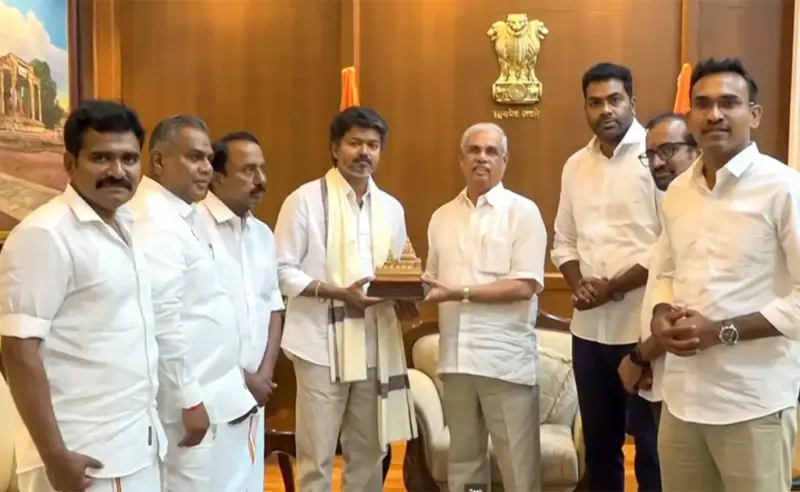
Vijay visited Lok Bhavan in Chennai for the second consecutive day to meet Governor Rajendra Vishwanath Arlekar. During the meeting, the Governor reportedly informed the TVK chief that he would need to demonstrate the support of at least 118 legislators before he could be invited to form a stable government in the state. Sources indicated that Vijay submitted letters of support from 113 MLAs, falling short of the majority mark by five legislators.
TVK secured 108 seats in the Assembly election and emerged as the single largest party in the state. The Congress has extended support through five MLAs, taking the alliance tally to 113. However, the Governor has insisted that additional support must be formally demonstrated before any swearing in ceremony can take place.
The situation has sparked a major constitutional and political debate in Tamil Nadu. Opposition leaders and constitutional experts have argued that as the leader of the single largest party, Vijay should first be invited to form the government and then be asked to prove his majority on the floor of the Assembly within a stipulated period. Supporters of the Governor's position maintain that constitutional stability requires assurance of a workable majority before administering the oath of office.
The developments have also created a fresh political battleground between the BJP and opposition parties. Congress leaders accused the Governor of acting under pressure from the BJP leadership and deliberately delaying the government formation process. Congress MP Manickam Tagore alleged that national level political considerations were influencing Raj Bhavan decisions despite the BJP having only marginal electoral presence in Tamil Nadu.
Rajya Sabha MP Kapil Sibal strongly criticised the Governor's approach and claimed that constitutional conventions were being ignored. He argued that the largest party in a hung Assembly traditionally receives the first opportunity to form the government and prove its majority later on the Assembly floor. Sibal further alleged that delays in inviting Vijay were intended to create time for political manipulation and alliance engineering.
The Communist Party of India and the Communist Party of India Marxist also raised concerns over the ongoing delay. Leaders from both parties stated that the Governor should invite Vijay to form the government in accordance with democratic norms. However, neither party has yet formally announced support for the TVK government proposal.
Viduthalai Chiruthaigal Katchi leader Thol Thirumavalavan similarly argued that Vijay should be given the constitutional opportunity to prove his majority after assuming office. At the same time, VCK leaders clarified that support to TVK would depend on assurances that the new government would remain independent from BJP or RSS influence.
These political calculations have significantly complicated the government formation process. While several opposition parties have expressed sympathy for Vijay's constitutional claim, many remain cautious about formally joining the alliance without clarity regarding policy direction and political stability.
Adding to the uncertainty are reports of possible backchannel negotiations between the DMK and AIADMK. Media reports suggested that discussions may be underway regarding a possible arrangement under which AIADMK could attempt to form the government with outside support from the DMK and smaller parties. Although no official confirmation has emerged, the mere speculation has shocked political observers because the two Dravidian rivals have historically remained bitter opponents.
MDMK leader Durai Vaiko described such reports as surprising and difficult to believe, though he acknowledged hearing similar discussions from journalists and political contacts. If such a political arrangement were to materialise, it could completely reshape Tamil Nadu politics and prevent Vijay from taking office despite leading the single largest party.
The AIADMK has further intensified speculation by shifting 28 MLAs to a private resort in Puducherry amid fears of poaching and cross voting. Party chief Edappadi K Palaniswami held internal consultations with legislators while remaining publicly silent about future strategy.
Meanwhile, TVK leaders have accelerated outreach efforts toward smaller parties and regional groups. Party representatives met leaders of CPI, CPM, VCK and IUML in Chennai seeking additional support for government formation. TVK leaders also clarified that they were not exploring any discussions with the BJP led NDA alliance.
Congress leaders openly supported Vijay's claim to power and emphasised ideological alignment on secular politics. Congress MP Christopher Tilak stated that Vijay strongly believed in secular democratic values and argued that supporting TVK was necessary to prevent ideological expansion of Hindutva politics in Tamil Nadu.
Tamil Nadu Congress leaders have now announced statewide protests accusing the Governor and the Union Government of undermining constitutional principles by delaying the invitation to Vijay. Demonstrations are scheduled across district headquarters as political tensions continue escalating.
Supporters of TVK also staged protests near Marina Beach and outside Lok Bhavan demanding the immediate swearing in of Vijay as Chief Minister. Several supporters who had gathered at Chennai's Nehru Indoor Stadium expecting a swearing in ceremony returned disappointed after learning that the event had been postponed indefinitely.
Within the DMK camp, frustration has also surfaced over alliance tensions. Congress leaders criticised the DMK for allegedly excluding alliance partners from governance discussions despite electoral cooperation. Congress leader Udit Raj stated that party workers in Tamil Nadu were disappointed and confused over their treatment after the election.
The DMK, meanwhile, passed several resolutions during its legislative party meeting, including authorising party chief MK Stalin to take necessary political decisions considering the evolving situation in the state.
The Governor's office has so far maintained that constitutional procedure and stability remain the primary considerations. BJP leaders also defended the Governor's position and argued that no confusion existed regarding constitutional norms. BJP spokesperson Narayanan Tirupathy stated that whichever formation could demonstrate stable majority support would naturally receive the opportunity to govern.
Despite intense political manoeuvring, Vijay and his supporters remain confident that the numbers can eventually be secured. TVK district leaders publicly expressed optimism regarding government formation and suggested that negotiations with regional parties were progressing positively.
The coming days are expected to determine whether Tamil Nadu witnesses the rise of a new political force under Vijay or whether rival parties succeed in forging alternative equations to block the TVK government. With no side currently possessing a clear majority, every MLA now holds extraordinary political importance in shaping the state's next government.
The political crisis has already become one of the most closely watched state developments in the country. Beyond the immediate question of government formation, the unfolding drama may redefine alliance politics, constitutional conventions and leadership equations in Tamil Nadu for years to come.
As negotiations intensify and constitutional debates deepen, the state remains in suspense awaiting the final decision on who will ultimately lead the next Tamil Nadu government.