


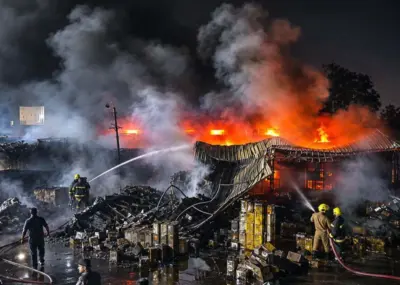

For the second time in a short span, Jammu has watched its commercial heart go up in flames. The latest was at Kamla Market in the Warehouse area on Diwali night, and before that, it was Shiv Market, opposite the railway station.
The locations differ, but the script is eerily identical: a devastating blaze, traders in ruins, allegations of a tardy Fire and Emergency Services response, an official denial, and assurances that fade once the smoke clears.
The Fire Brigade's defence is that the first fire tender was dispatched immediately and reinforcements followed. It also points out that Jammu district recorded 35 fire incidents in 24 hours, 16 of them within five hours of 7 PM, which stretched resources thin. That may be true. But it cannot explain the Shiv Market episode, when no such surge of incidents existed, and the complaint of delayed response was made all the same. A single exceptional night may excuse one failure; it cannot excuse a pattern. There is a crucial distinction between an isolated fire and one in a congested market storing combustibles. Both markets trade in precisely the goods that turn a spark into an inferno: blankets, gas cylinders, edible oil and ghee, cotton, ropes and plastic. Where such stock is packed tightly, a fire spreads before the first tender arrives. Speed is therefore not a courtesy but the whole game. Yet the department's own timeline, even if accepted, shows a gap of twenty minutes after the call.
Fires involving oil and ghee cannot be tamed by water alone; water can spread burning oil and worsen matters. Such fires demand foam or other chemical agents. In both blazes, it appears the department relied almost entirely on water. The questions write themselves. Does the department possess adequate foam and chemical-suppression capacity? If not, why not? If it does, why was it not deployed? Either answer is damning, and it casts a long shadow over the prevailing fire-fighting system.
The Warehouse market is a vast wholesale hub supplying household goods across Jammu and Kashmir, yet it sits on land allotted by the JDA in conditions that invite disaster. Double-storey structures on one side, opposite the petrol pump, have already been declared unsafe and slated for demolition. Relocation has been debated for years. Traders have sought at least 500 kanals, on payment, to build proper covered godowns. Anyone visiting on a busy day sees an area unable to bear the load of trade and storage from the same premises. Much stock simply lies in the open under plastic sheets. Basic safeguards are absent. There is no fire hydrant in the area. Even the modest, mandatory fire extinguishers that might contain a fire in its first minutes are missing from shops. For a city that has trumpeted its Smart City works for years, this is a sobering indictment.
Nor was the Diwali preparation any better. The Administration customarily reviews safety arrangements before the festival, and tenders were pre-positioned at Gole Market, Gandhi Nagar and Gangyal, where firecrackers are sold. Yet the Warehouse, holding every ingredient of a catastrophe, was left out of the calculus. Risk assessment should follow combustibility, not merely the sale of crackers.
The aftermath compounds the injury. Traders are asking for adequate compensation, and the Government could commit to nothing on the spot. Even after considerable time, Shiv Market shop owners are without relief. Mere sympathy does not rebuild a business. Ideally, an initial amount should have been announced immediately, with a detailed assessment to follow.
What is needed now is conclusive action rather than another committee. The focus must now be on fair compensation and sound planning. The Warehouse market should be relocated, with the traders' consent, to a suitably large and safe site. That will take time, and in the interim certain steps cannot wait: fire hydrants installed, extinguishers made mandatory in every shop, insurance cover made compulsory and facilitated, and other safety norms enforced. An independent audit of the Fire and Emergency Services must also be commissioned, with its recommendations implemented without delay. Without stringent measures, Jammu will see another inferno and another round of recrimination. The city simply cannot afford that. The onus lies squarely with the Government.