





Dr. D.K. Giri
Prime Minister Narendra Modi just concluded the five-nation tour (15-20 May) with quite a few goodies in his bag as well as at least one monkey on his back.
In this column last week, I had mapped the possibilities before the tour. Today, we will assess the outcomes. Notably, the optic in Norway should define the outcomes domestically.
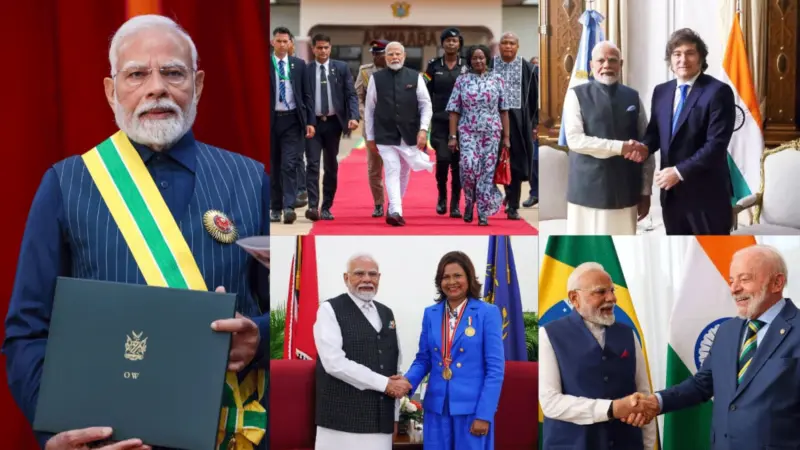
Prime Minister Modi certainly embarked on crisis diplomacy wearing an aviator's jacket. He covered five countries with 24.5 hours of flying securing four new strategic partnerships. The context was the threat in Strait of Hormuz, oil at $120 and Rupee at a record low. The overriding tour objective was the quest for energy and technology. In current geo-politics, these two imperatives define the national security of any country.
Analysing country-by-country, what actually landed on the trip are the following. In UAE, on 15 May, Modi secured Energy Insurance Policy. He ensured the strategic petroleum reserves which was long overdue. In addition, LPG supply pacts were signed; plans for 8-exaflop supercomputing facility in India were formulated; a ship repair cluster at Vadinar in Gujarat was established. Master Application for International Trade and Regulatory Interface (MAITRI) corridor was operationalised. UAE announced 5b USD fresh investment in India's financial and infrastructure sectors. Abu Dhabi has taken an independent and strong stand on Iran. As the relations between India and UAE are deepening in a few hours' stopover, Modi firmed up the alliance with UAE.
The Netherlands was the next stop of Prime Minister where semi-conductors, green hydrogen and defence deals were expected. Modi bagged chips, water and Chola copper. Talks were conducted on semi-conductors, AI, maritime security and clean energy. A historic development was the return of Chola copper plates. Netherlands agreed to hand back Anaimangalam Chola copper plates, 21 plates, the Chola dynasty legacy. We could say from ASML to Anaimangalam - a single visit secured India's tech future and its civilisational past.
The partnership with Sweden was enhanced. It was elevated to strategic partnership with a joint action plan 2026-2030. India-Sweden Joint Innovation Partnership 2.0 was launched. Also, India-Sweden Technology and Artificial Intelligence Corridor (SITAC) was endorsed. The trade was agreed to be doubled in five years. On top it, Prime Minister Modi was conferred with Royal Order of the Polar Star, and Degree Commander Grand Cross. In fact, Stockholm is where 'Make in India' meets 'invent in Sweden'. India-Sweden relations go back a long way in multiple sectors - academia (remember, Gunar and Alva Myrdal), civil society-defence, development and politics. Olof Palme the former Swedish Prime Minister remains popular in the memory of Indians. A road in Delhi is named after him.
The visit to Norway was historic since it was the first Indian Prime Minister to visit Oslo in 43 years. The relations were elevated to "Green Strategic Partnership". In all, 12 agreements were signed consisting of sectors like climate, maritime, tech, space, digital infra. Modi attended the third India-Nordic Summit in Oslo. All five Nordic countries - Sweden, Finland, Denmark, Norway and Iceland - participated in the summit titled 'Green Technology and Innovation Strategic Partnership'. After the summit, the Nordics made a commitment of investment of 100b USD plus creation of 1 million jobs under India-EFTA Trade and Economic Partnership Agreement.
The last stop was Italy between May 19-20. Modi met with his counterpart Prime Minister Georgia Meloni and the President Sergio Mattarella. The relationship was elevated to a Special Strategic Partnership. It was agreed that there would be Annual Heads of Govt Summits. The bilateral trade was targeted at 20b Euro by 2029; currently the volume of trade stands at 16.77b USD and FDI at 3.66b USD. More important, Rome becomes the front door of IMEC and Modi seems to have got the keys.
A particular incident in Norway became the domestic peg. Hence, it should be addressed. After joint statements with Prime Minister Jonas Gahr Store, Modi, as his wont, left without addressing the press. Helle Lyng, a journalist from Dagavisen almost yelled, "Why don't you take some questions from the freest press in the world?" She was in one sense right. Norway ranks number 1 in Press Freedom Index whereas India is 157.
The Norwegian Prime Minister stayed back and took questions from the press. Modi did not address press in India and sought to avoid them abroad. For a leader of the largest democracy, it certainly looked odd. Modi told Nordics we share rule of law values. The question was on human rights and persecution of minorities. So, the rule of law certainly includes answering the press, the fourth estate. One cannot lecture on rule-based order and dodge the rules of engagement.
Taking a Realist approach, diplomacy is not played out in press conferences. Modi focused on substance over spectacle securing four strategic partnerships in six days and rapid increase in bilateral trade. He stuck to the same format in UAE, Netherlands, Sweden and Italy. This would be a fair defence of Modi's style put up by the government. Sibi George, the Secretary, Ministry of External Affairs (West) formidably laid out India's position in his press conference. He asserted that India is a civilisational country of 5,000 years with citizens' rights enshrined in a written Constitution. To a question on trust, he elaborated the services provided by Government of India to about 120 countries during Covid, supplying relief and vaccinations etc. He also pointed out the joint statement issued by G-20 Summit in India in 2023 which was a rare achievement. Such leadership and altruism wins confidence of other countries.
On balance, the optics in Norway did not leave a good taste in the mouth. Prime Minister appeared to be running away from the journalists. If Modi does not answer a foreign journalist, he hands out a video clip to his critics and the Opposition. The Chola plates came home but did the democratic optics land well. The Helle Lyng moment will linger for a while. Whatever may have been her motivation, to embarrass Modi or seek clarity on a question, Modi with his usual charm and wit could have disarmed her. That was not to be.
In 2014, Modi promised 'minimum government, maximum governance'. In 2026, India and the world are asking for 'minimum speeches, maximum answers'. Modi secured the fuel in Abu Dhabi, but in Oslo, we saw the price of silence. The five-nation tour gave us strategy, but the one question (not answered) gave us the story. Could the Prime Minister Modi do otherwise? -INFA