




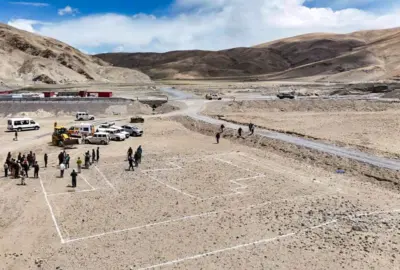

For decades, a village on India's border was, in every meaningful sense, a village at the edge of the state's imagination. Roads petered out into dirt tracks, if they existed at all.
Hospitals, schools and banks were distant rumours rather than accessible institutions. Officials rarely visited, and almost never after dark. These settlements were spoken of, tellingly, as the "last villages" of the country - an administrative afterthought rather than a national priority. That framing is now being deliberately and publicly overturned. Addressing the Border Roads Organisation's Strategic Infrastructure Conclave in New Delhi this week, Defence Minister Rajnath Singh set out the Government's intent in unambiguous terms: border villages, once dismissed as the last outposts of the republic, are being rebuilt as the country's first villages under the Vibrant Villages Programme. It is a phrase with real substance behind it. The shift is not merely rhetorical; it reflects a considered recalibration of how the state understands security, arguing that a road built towards the frontier is as much an act of national defence as the soldier who eventually walks it.
That recalibration places the BRO at the very centre of the story. Over six and a half decades, the organisation has evolved from a modest road-building outfit into one of the country's most capable strategic infrastructure agencies, credited with feats such as the Atal Tunnel, the Sela Tunnel and the high-altitude Umling La Pass. Fifty projects dedicated to the BRO's 66th Raising Day - thirty bridges, seventeen roads and several other assets, built at a cost running into thousands of crores - illustrate the scale of ambition. These works span some of the country's most difficult terrain, from Ladakh's high passes to the shelling-scarred belts of Jammu, and increasingly draw on modern techniques such as advanced road-surfacing methods and durable, climate-resilient engineering suited to fragile mountain ecosystems. Crucially, the BRO's mandate is understood in dual terms: every bridge or tunnel serves both the soldier moving towards the frontier and the villager trying to reach a market, a clinic or a school.
The consequences of this sustained push are visible on the ground. Piped water now reaches homes, schools and community bunkers that once relied on precarious, self-managed supplies. Agricultural and small-business credit is extended to families who, for generations, survived on subsistence farming alone. Self-help groups are giving women in these communities an economic footing they never previously had. Housing schemes are providing a measure of dignity long withheld from border populations, while playgrounds and youth programmes offer a quiet but important counter to the risks of drug abuse and radicalisation among young people in militarily sensitive zones. Compensation mechanisms for land affected by shelling and clearer rights over land cultivation are addressing grievances that had festered for decades.
Security, too, has visibly improved. Locals now serve in Border Battalions and as Special Police Officers, giving residents a direct stake in protecting the land they inhabit. Reservations in education and Government employment acknowledge, in concrete terms, a debt owed to communities that endured cross-border shelling not as combatants but as civilians who refused to abandon their homes. Meanwhile, tourism - once unthinkable in conflict-prone belts - is emerging as a genuine economic opportunity, gradually reshaping how these regions are perceived, from zones of danger to destinations of natural and cultural richness.
None of these developments, however, should invite complacency. The scale of the task remains formidable: hundreds of villages spread across multiple, difficult borders, each requiring sustained financial commitment long after the ribbon-cutting ceremonies conclude. Infrastructure built in high-altitude, climate-vulnerable terrain demands continuous maintenance, not one-off construction. Skill-building tied to construction and maintenance work, support for entrepreneurship, and genuine investment in border tourism are the way forward. The intent driving this transformation is clear, and the early results are, for the first time in living memory, tangible to the people who live through them. But intent must be matched by endurance. A developed India cannot be complete while its border villages remain unfinished business. The mission to turn the country's last villages into its first is progressing well; it must not be allowed to rest until every household, in every border hamlet, has received the full measure of what has been promised.