


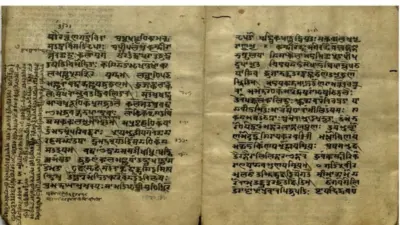

When UNESCO's Memory of the World Committee for Asia and the Pacific, meeting in Jakarta, inscribed Kalhana's Rajatarangini, the Mahabharata and the Arthasastra in its regional register, it honoured more than three manuscripts.
It recognised the intellectual architecture of a civilisation. For India, and particularly for Jammu and Kashmir, this is a moment of legitimate pride. Each of these works is the only one of its kind. Together they set out, in black and white, the political, moral and administrative thought of successive eras of the subcontinent. That matters because they were composed in times when writing was not yet a settled habit and memory, oral recitation and tradition carried most knowledge. That anyone chose to commit such vast material to script is itself remarkable. What was written down was spared the erosion that befalls what is merely remembered.
The Rajatarangini deserves special attention. Composed by Kalhana between 1148 and 1150 CE, it is regarded as one of the earliest systematic histories of the subcontinent. Its 7,826 verses in eight Tarangas, written in Sanskrit in the Sharada script on birch bark, reach back well before Kalhana's own lifetime. He did not simply flatter kings. He weighed earlier chronicles, inscriptions, coins, monuments and land records and offered a critical, even ethical, account of power. UNESCO itself noted this early historical consciousness, rare in South Asia of that period. The Mahabharata needs little introduction, yet its inscription is no mere formality. Beyond the contest between Kauravas and Pandavas lies an enduring reflection on duty, justice and human frailty, with the Bhagavad Gita at its heart, a philosophy that remains among the most sacred and influential in Hindu thought. The Arthasastra, attributed to Kautilya, or Chanakya, is equally alive. Its counsel on governance, taxation, diplomacy, security and intelligence still speaks to a modern, digital state, proof that sound ideas about administration outlast the societies that first produced them.
Credit is due to the Indira Gandhi National Centre for the Arts, which prepared the nomination dossiers. The authorities should treat this moment as a mandate: to fund digitisation, climate-controlled storage, trained conservators and wider public access, so that students and scholars can engage with these texts directly. Civilisations survive by recording themselves honestly and carefully. Our ancestors understood that putting things in writing was an act of trust in the future. UNESCO's recognition honours that trust, and it falls to this generation to keep it.