




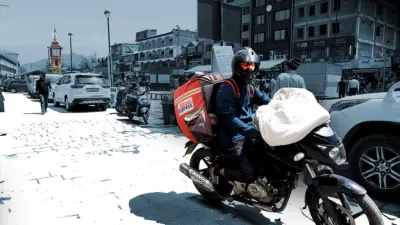

On a crisp spring morning, Srinagar is only just waking up. Shop shutters rise in uneven rhythm, a baker arranges stacks of warm girda (bread) on a wooden counter, and the faint scent of blossoms drifts across the street.
A thin stream of traffic moves cautiously, as if the city is still deciding how quickly to begin the day.
Delivery agent Aijaz adjusts the strap of his faded delivery bag and checks his phone. A notification flashes. He taps the screen, glances briefly at the map and nods. "Rajbagh," he says. "Easy start." He kicks the motorcycle into motion.
In another city, that would be all there is to it - a routine beginning to a routine job. Here, it is the start of a workday shaped not only by distance and time, but by a set of conditions that rarely appear on any app: checkpoints, narrow lanes, uncertain addresses and disruptions that cannot be predicted.
For decades, Kashmir has been defined by conflict - its streets shaped as much by security deployments as by seasons, its economy constrained by cycles of disruption that limited both movement and opportunity. Work, for many, was often dictated by circumstances beyond their control, shaped by shutdowns, curfews and an uncertain business environment that rarely allowed consistency.
In recent years, however, a measure of relative calm has begun to alter the texture of everyday life. Markets stay open longer, public movement is more predictable, and the steady spread of India's expanding digital economy is beginning to find a foothold in the Valley. What was once seen as too uncertain for platform-based work is gradually being absorbed into a wider national economic network.
Yet the question that lingers is simple but unresolved: can systems built on speed, predictability and algorithmic precision function in a place where uncertainty is still a significant part of daily life?
It is within this transition - quiet but significant - that app-based delivery work has taken root in Srinagar, reshaping itself to geography, history and unpredictability in ways that are still unfolding.
To understand what that looks like on the ground, I spent a day with those at the centre of this shift - delivery workers navigating a city where routine is still negotiated rather than assumed.
A job that arrived late
Gig-based delivery work came relatively late to Kashmir. While courier services have long operated in the region, app-based food delivery began gaining traction only around 2018-19, when platforms like Swiggy and Zomato expanded cautiously into Srinagar. E-commerce logistics, driven by Amazon and Flipkart, grew faster, particularly during the pandemic, when dependence on online ordering increased sharply.
Even now, the ecosystem remains different from metropolitan India. Food delivery is only one part of the system; parcels, medicines and essential goods often make up a significant share of daily orders. The pattern reflects both consumer demand and the Valley's dependence on goods sourced from outside.
There is no official consolidated dataset on gig workers in Srinagar. Local industry estimates, including inputs from delivery aggregators and ground-level supervisors, suggest the number lies between 2,000 and 4,000 workers, though this remains an approximation rather than a formally verified count.
What exists, therefore, is a workforce that is visible across the city, yet statistically underrepresented.
More than just a sign-up
For workers, entering this system is not as seamless as in larger cities. In Bengaluru or Delhi, onboarding is largely digital - identity verification, licence uploads and automated background checks that are often completed within a few days.
In Srinagar, the process is slower and more layered.
Workers say that while standard documentation is required, onboarding in certain categories - particularly logistics involving inter-district movement - is often followed by police verification. The practice is not uniform, but commonly reported.
A senior police official in Srinagar, speaking on condition of anonymity, clarified that there is no blanket policy mandating verification for all delivery workers. "Depending on the nature of assignments, companies may seek verification as a precautionary step," he said.
It also remains unclear whether such verification practices are applied uniformly across platforms or are limited to certain categories, such as logistics and inter-district deliveries. Companies have not publicly clarified their policies on this aspect. This creates a system that operates in a grey zone - neither formally mandated nor absent, shaped instead by operational discretion and local sensitivities.
For workers, it translates into waiting. "There is more scrutiny here," Aijaz says. "You don't start quickly. Sometimes you just keep waiting for approval."
Why this work?
The reasons for entering this line of work are rarely framed in terms of choice.
Jammu and Kashmir continues to record persistently high unemployment compared to national averages. Estimates from CMIE's Consumer Pyramids Household Survey and the Periodic Labour Force Survey indicate that unemployment in the region has remained in double digits in recent years, and has at times crossed 20 per cent depending on methodology and reference period.
At the same time, official Labour and Employment Department records show over 3.5 lakh educated youth registered with employment exchanges. While this reflects administrative data rather than real-time unemployment, it points to a large pool of job seekers struggling to find opportunities.
The gap between education and employment is visible in everyday decisions.
Aijaz, a graduate, spent years preparing for government exams before turning to delivery work. Danish, another worker, alternates between parcel delivery and food orders depending on demand.
"Here, you take what you get," Aijaz says.
Unlike in metro cities, where gig work often supplements income, in Srinagar, it frequently becomes the primary livelihood. It offers immediate entry but little long-term security.
The economic contrast with cities like Bengaluru is striking. In metros, higher-order density and structured incentive systems allow workers to complete more deliveries and earn more per shift. Daily earnings can range from ₹800 to ₹1,500 depending on peak hours, bonuses and surge pricing.
In cities like Bengaluru, structured incentive systems - such as peak-hour bonuses, surge pricing, and per-order boosts - significantly enhance earnings during high-demand periods. Workers in Srinagar say such incentives are either limited or inconsistent, reducing their ability to increase income through longer working hours alone. Fuel prices, however, remain largely comparable, further narrowing real earnings.
In Srinagar, workers describe a more constrained system. Orders are fewer, distances longer and incentives limited. Daily earnings typically fall between ₹500 and ₹700 before fuel costs, leaving narrow margins once expenses are deducted. While housing costs may be lower than in larger cities, other essentials - fuel, groceries and maintenance - remain comparable, reducing the advantage. "We don't have those extra benefits," Danish says. "There are no big bonuses. It is just work."
The easy city
As we move through the city, the gap between digital systems and physical realities becomes more visible. The first delivery in the posh uptown area of Rajbagh is smooth - clear address, wide roads, minimal delay. For a brief moment, Srinagar resembles any other city where gig work functions seamlessly.
But this predictability is fragile. By afternoon, we enter the old city, where navigation becomes an exercise in interpretation rather than precision. The address reads: "Near masjid." There are several. Aijaz calls the customer. Directions are given in fragments - left after the shop, right near the lane, ask someone if needed. We circle once, then again, before stopping to ask a passerby.
In cities like Bengaluru, digital addressing has reduced such uncertainty. Here, delivery still relies heavily on human knowledge. "This is normal," Aijaz says. The delay does not register fully in the system. But it shapes the experience.
Cautious approach
Further ahead, another layer of reality comes into view. As we approach a checkpoint, Aijaz slows instinctively, long before being signalled. A soldier gestures for us to stop. The bag is checked, and IDs are glanced at. Sometimes, workers say, vehicles are inspected as well.
Such checks were more frequent in earlier years. Workers say their intensity and frequency have reduced, reflecting what they describe as an improvement in the overall security situation. But unpredictability remains.
On some days, it is a quick pass. On others, it takes time. The app does not adjust for this.
Workers say delays caused by such checks are not always factored into delivery timelines, and can sometimes affect ratings or future order allocation. "Customers don't know what happens here," Aijaz says. "They just see the delay."
Workers say delivery timelines on apps do not visibly adjust for such interruptions, and repeated delays - regardless of cause - can affect customer ratings, which in turn influence future order allocation. There is no clear mechanism to account for security-related disruptions within the system. Safety remains an underlying concern. Workers say they avoid late-night deliveries in certain areas due to uncertainty. Some mention occasional questioning at checkpoints or discomfort during inspections, though such interactions are usually brief.
While workers interviewed did not report frequent serious incidents, they pointed to underlying risks - ranging from navigating poorly lit areas at night to concerns about theft, road accidents or confrontations during tense situations. The absence of formal safety assurances or insurance awareness adds to this uncertainty. "You learn which areas to avoid, which times to work," Danish says.
Fragile earnings
Aijaz completes around 15 to 20 deliveries on a good day. The income - ₹500 to ₹700 after fuel - leaves little room for savings.
"There are no big incentives," Danish says. "And if there is a shutdown, you earn nothing." He recalls a day when a sudden security operation halted movement. Roads were blocked without warning. He waited for nearly two hours before the order was cancelled. "No payment," he says. In such moments, the fragility of the system becomes evident. When movement stops, income stops instantly.
Between empathy and friction
Some customers are considerate, especially during winter, offering tea or asking workers to rest for a moment. Others are less patient. Delays - whether caused by traffic, navigation or security checks - can lead to cancellations, refusals or arguments. "Some are kind, some are not," Aijaz says. "Both exist." Across this landscape, one absence is striking.
There are virtually no women delivery workers in Srinagar. Workers and local observers cite mobility constraints, safety concerns and prevailing social norms as key barriers. Platforms have not introduced visible initiatives to address this gap.
Internet shutdowns
During Internet shutdowns or service disruptions, app-based delivery work stops entirely. Orders freeze, navigation fails, and earnings disappear. Workers say there is no compensation mechanism during such periods. "If the Internet is gone, the work is gone," Danish says.
In recent years, platforms like Swiggy, Zomato and Amazon have expanded cautiously in the Valley, responding to improving conditions and growing demand. But how they are adapting to the region's unique operational challenges - ranging from security checks to connectivity disruptions - remains unclear. There is no publicly available framework outlining how onboarding timelines, verification practices or compensation policies are calibrated for conflict-affected areas such as Kashmir.
What exists instead is an informal adjustment - workers adapting themselves to a system that does not formally adapt to them. Whether this model is sustainable in the long term remains an open question. As gig work expands into regions with distinct operational constraints, the absence of clearly defined safeguards raises questions about how resilient such systems can be without local adaptation.
As evening settles over Srinagar, the city slows again. The light softens, traffic thins, and the rhythm of deliveries begins to taper off. Aijaz checks his phone one last time. No new orders. The day ends much like it began - not with certainty, but with adjustment. Gig work in Srinagar exists in a space between structure and uncertainty. It is enabled by technology, but shaped by terrain, history and conditions that resist standardisation. Each delivery is more than a transaction. It is an act of negotiation - between checkpoints and doorsteps, between efficiency and delay, between aspiration and constraint.
Whether this system evolves into a stable source of livelihood, or remains a fragile workaround shaped by forces beyond its control, will depend not just on the workers who sustain it, but on whether the platforms they power begin to recognise - and respond to - the ground realities they operate within.
For now, Srinagar moves forward - one delivery at a time.