
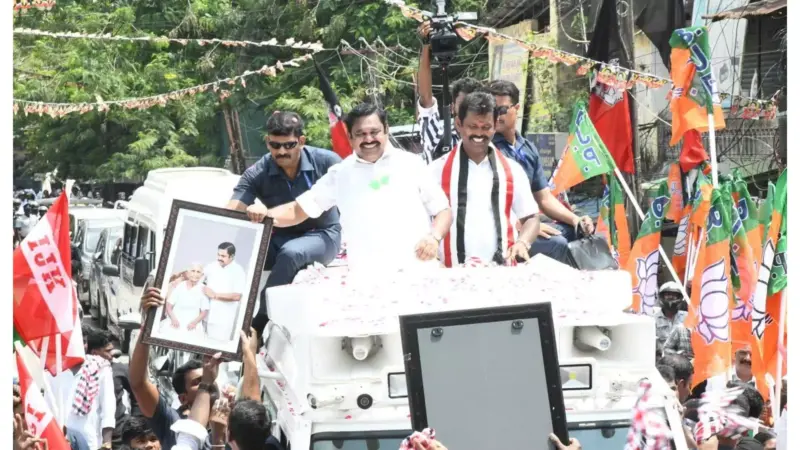

Edappadi K. Palaniswami's push for infrastructure as an engine of growth offers a lens to evaluate both past performance and the state's current development trajectory.
Public policy debates in Tamil Nadu have often revolved around welfare delivery, social justice, and identity politics. But alongside these themes, the state's electoral and economic trajectory has also been shaped by how governments build and sustain the physical foundations of growth.
As Tamil Nadu moves closer to its next electoral contest, infrastructure has emerged as a key lens through which governance records are being assessed. Beyond traditional campaign themes, voters are increasingly weighing questions of jobs, industrial growth, urban mobility, and regional connectivity, all issues that are closely tied to the quality and continuity of public infrastructure. In that sense, roads, power networks, industrial corridors, and transit systems are not merely development markers; they are also becoming political indicators of administrative performance.
It is within this context that Edappadi K. Palaniswami's tenure as Chief Minister from 2017 to 2021 merits closer examination. His administration placed visible emphasis on infrastructure-led development, framing it as both an economic necessity and an administrative priority.
At the core of this approach was a relatively straightforward premise: that sustained public investment in physical infrastructure can enable economic activity, boost private investment, and create a foundation for long-term growth. This model is neither new nor unique to Tamil Nadu, but its application under Palaniswami offers a case study in how a state can attempt to balance political stability with developmental outcomes.
Palaniswami's governance approach can be understood through three underlying assumptions. First, physical infrastructure reduces transaction costs and improves efficiency, thereby making regions more attractive for investment. Second, public spending can act as a catalyst, encouraging private sector participation by reducing uncertainty and improving baseline conditions. Third, that visible, tangible projects like highways, bridges, and industrial parks serve not only economic purposes but also political ones, reinforcing the credibility of a government.
One of the more prominent aspects of this period was the expansion of road and transport infrastructure. Projects such as the completion of Phase II of the Chennai Outer Ring Road sought to decongest urban traffic while facilitating smoother freight movement, particularly towards ports in northern Tamil Nadu. Similarly, the Chennai Peripheral Ring Road project was conceptualised as a larger logistical corridor, linking multiple national highways and industrial clusters.
Beyond highways, there were efforts to expand public transport capacity, including the addition of thousands of buses and plans to introduce electric mobility solutions. Regional connectivity also received attention, with road upgrades, bridges, and highway expansions aimed at linking smaller towns with industrial hubs.
Urban transit proposals, such as the Coimbatore Metro Rail project, reflected an attempt to extend infrastructure planning beyond Chennai. While such projects remained at the proposal or planning stage, they indicated a broader ambition to decentralise urban development.
Energy security has historically been a critical concern for industrial states like Tamil Nadu. During this period, the government undertook steps to expand generation capacity and strengthen transmission infrastructure. The development of large-scale thermal projects, alongside investments in solar power, such as the photovoltaic park in Ramanathapuram, highlights a dual approach combining conventional and renewable energy.
Upgrades to substations and investments in grid infrastructure were also undertaken to improve reliability. These measures contributed to the perception of Tamil Nadu as a power-surplus state for parts of this period, a factor often cited as important for industrial stability.
Infrastructure development during these years was closely tied to industrial policy. The creation and expansion of industrial estates, logistics parks, and sector-specific corridors such as the Tamil Nadu Defence Industrial Corridor were intended to strengthen the state's manufacturing base.
The emphasis was not only on land allocation but also on integrating infrastructure with logistics. Improved highway connectivity, port access, and warehousing facilities were designed to reduce turnaround times for goods, particularly in export-oriented sectors. Investments announced through memoranda of understanding and project foundations suggested a continued effort to attract both domestic and global capital.
Supporters of this model point to the completion of specific projects and the operationalisation of previously announced schemes as evidence of administrative effectiveness. The extension of Chennai Metro services and the rollout of transport and road infrastructure are often cited as examples where policy commitments translated into implementation.
At the same time, infrastructure development is inherently cumulative, often spanning multiple administrations. Many projects initiated during one tenure are completed in another, making attribution complex. This raises broader questions about continuity in governance and the extent to which successive governments build upon or diverge from existing frameworks.
An equally important question is whether the momentum of large-scale infrastructure creation has been sustained in the years since. Although infrastructure projects have a long gestational period, but the current government's lack of focus and thrust on completion of these key projects has slowed down progress, raising concerns over continuity in the state's development trajectory.
The AIADMK's stated vision for the future continues to emphasise infrastructure as a central driver of growth. These projects align with broader national priorities around connectivity, digital infrastructure, and energy transition.
While the long-term impact of these investments depends on sustained implementation and integration, Palaniswami's time in office offers insight into how state-level leadership can shape development trajectories through targeted public investment.
The article is authored by Rajeev Ranjan, a senior journalist and columnist.