




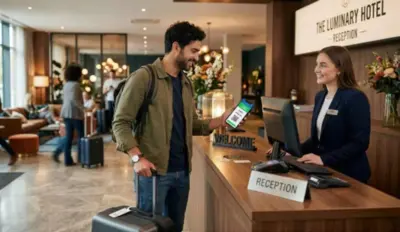

As India's hotel sector rebounds, the smartphone is becoming as vital as the keycard. Domestic tourism is now the strongest and most consistent pillar of India's hotel market, and travellers expect the same mobile-first convenience they enjoy elsewhere.
Globally, leading chains and technology providers are responding by linking every step of the stay, from pre-arrival messages to mobile room access, digital payments, in-stay chat and one-touch checkout, rather than treating each step as a silo.
Digital expectations collide with real-world stays
Hotel technology companies are redefining themselves around the guest journey rather than just back-office functions. For example, SiteMinder reports that hotel website bookings averaged US$519 per stay in 2024, over 60% higher than comparable OTA bookings, underscoring how direct channels can upsell effectively. Its platform handled 125 million reservations worth about US$50 billion that year. Similarly, Cloudbeds notes its unified platform now serves hoteliers in 150 countries. Mews says it powers over 12,500 hotels worldwide, an 85% growth year over year. These vendors increasingly highlight guest-focused features in their positioning and product development.
Major chains have made similar bets. Marriott's mobile app, launched in 2013, had over 1 million app-based check-ins by 2015, proving early guest adoption. Hilton reports that 12.3 million Honors members downloaded digital room keys between January and August 2023, reducing the need for staff to issue plastic cards. Hilton has described digital keys and mobile check-in as some of the most-used functions of its app. Other global brands such as Hyatt, Accor and IHG are likewise pushing mobile check-in, keyless entry and in-app payments as standard services.
India embraces the connected stay
In India, these global shifts coincide with a tourism boom. Domestic travellers led hotel demand in 2025, meaning a huge volume of guests with high-tech expectations. Indian chains are beginning to respond. Indian Hotels Co., owner of Taj and Vivanta, launched I-ZEST in 2020, a zero-touch digital suite offering mobile pre-check-in, optional phone-based room keys, QR-code menus and contactless billing. IHCL describes I-ZEST as a way to minimise contact while maximising service. The company has not published impact figures, but reducing front-desk bottlenecks was clearly one of the aims.
Among the newer Indian builders in this space is Kunal Kushwaha, whose work through Ananas reflects a practical strand of hospitality innovation. Rather than attempting to recreate the entire hotel software stack, he focuses on the layer hotels often struggle with most: the live guest relationship. Ananas' platform allows guests to check in online, order meals, and book amenities through a simple phone link with no app download, no account creation, and no waiting in queues. On the hotel side, every request, reply, and service update flows through WhatsApp, a system hospitality staff are already familiar with, eliminating the need to learn new software. The platform has already been piloted with Roseate Hotels, one of India's premium chains, supporting over 1,000 daily guest interactions, with early deployments showing a 4% improvement in RevPAR, offering a meaningful signal that high-service properties are willing to test operationally aware, lighter technology solutions to enhance the guest experience.
Even on the booking side, Indian companies are innovating. In late 2025, Oyo's corporate owner Prism launched CheckIn, an app for its premium hotels and homes. CheckIn aggregates brands like Sunday Hotels, Clubhouse and Palette into one platform, promising curated options. Marketed as a global house of brands, it signals that seamless mobile access to hotel inventory is now part of the guest experience, not just the in-hotel journey.
Snags in the digital stay
However, on-the-ground challenges remain. Most hotels still run on legacy property management systems and fragmented modules. A recent industry analysis found that fewer than one in four hotels have fully integrated core systems. In practice, staff often juggle multiple screens, or even handwritten logs, to coordinate bookings, payments and service requests. One expert bluntly called the typical hotel tech stack a messy pile that makes advanced automation and AI very difficult.
Integration is therefore a top concern. In a survey of hotel IT leaders, 70% listed easy integration as their highest priority for new tools. Without real-time connectivity between booking channels, the PMS, point-of-sale systems and guest apps, any single improvement risks breaking the workflow. Data privacy adds another layer of complexity. Many Indian hotels use WhatsApp or SMS to chat with guests, but these consumer channels can expose personal data or create regulatory risks if not carefully managed.
Staff and culture are also factors. Some employees worry that new technology will replace the personal touch. Industry research shows hotels trust AI more than they rely on it. Many use some AI tool, mostly chatbots, yet still lack the data support needed for broader automation. The consensus advice is to solidify basic automation first, invoicing, room assignments and cleaning lists, and then layer on AI. In other words, fix the data and process issues before pursuing more complex machine learning.
Hotels that succeed tend to focus on concrete friction points. They automate routine front-desk paperwork, or give guests in-room tablets or apps for standard orders, allowing staff to focus on exceptions. Even small time savings add up. Shorter check-ins and faster turnarounds improve satisfaction. The key is practical wins rather than technology for its own sake.
Case studies: small tech, big impact
Some properties already report measurable improvements. Sunborn London, a luxury hotel housed on a docked yacht, implemented a unified system for front desk, food and beverage, and payments. The result was that check-in time dropped by over 80%, from as much as 8 minutes to about 1 minute. Food orders now flow directly to the kitchen, and housekeeping updates go instantly to staff devices. According to the hotel's operations manager, the new system dramatically reduced check-in times. Guests enjoy faster service, and staff can greet arrivals instead of processing paperwork.
In India, Ginger, IHCL's budget chain, provides a local example. Ginger hotels have self-service check-in kiosks. Instead of queueing, guests scan their ID and receive a keycard instantly. The chain has said that reception lines can virtually disappear during peak periods, though exact figures have not been disclosed. Receptionists now mainly verify IDs and luggage, greatly reducing arrival delays. Similarly, some Indian resorts in Goa have adopted WhatsApp-based room service. Managers there say missed orders have dropped and response times have improved, though these estimates remain informal.
Other international examples point in the same direction. Hilton's broad adoption of digital keys, with 12.3 million downloads in 2023, likely saves each hotel thousands of plastic cards every year. Marriott's early mobile check-in adoption showed that a large share of guests were willing to skip the front desk, and that behaviour has only grown since. In nearly all of these examples, companies point to smoother operations and better guest satisfaction, even if precise return-on-investment figures are rarely published.
Implications for Indian hoteliers and global talent
The combined lesson for India's hotels is clear: integrate the full guest journey or risk falling behind. Guests now expect frictionless service, and hotels that deliver it will gain market share. A modest improvement, such as shaving a minute off check-in or boosting upsell conversions by 10%, can have a noticeable effect on revenue and ratings. SiteMinder's data suggests that direct-booking guests spend materially more per stay, implying that making those channels smoother can pay off.
For India's technology ecosystem, this also points to a genuine opportunity. India, already a global leader in fintech and e-commerce software, is now emerging as an innovator in hospitality technology as well."Multi-country platforms like Cloudbeds and SiteMinder already serve thousands of Indian hotels, while investment continues to flow into Indian travel tech. Kunal Kushwaha's Ananas is one example among several Indian-founded startups building the experience layer of hospitality technology, connecting guest interaction to hotel operations. He is not the only figure in this story, but part of a wave showing that solutions built in India can work globally.
In short, India's digitisation of the stay is timely and potentially far-reaching. Hoteliers face a clear choice: continue with manual silos or embrace the mobile-driven guest journey. The direction of travel suggests the latter will increasingly matter. And the talent building these tools, from Mumbai to Bengaluru, is beginning to attract a wider audience. That is why Kunal and his peers are being noticed. They reflect how Indian innovation can shape a global hospitality industry, from check-in to check-out.