
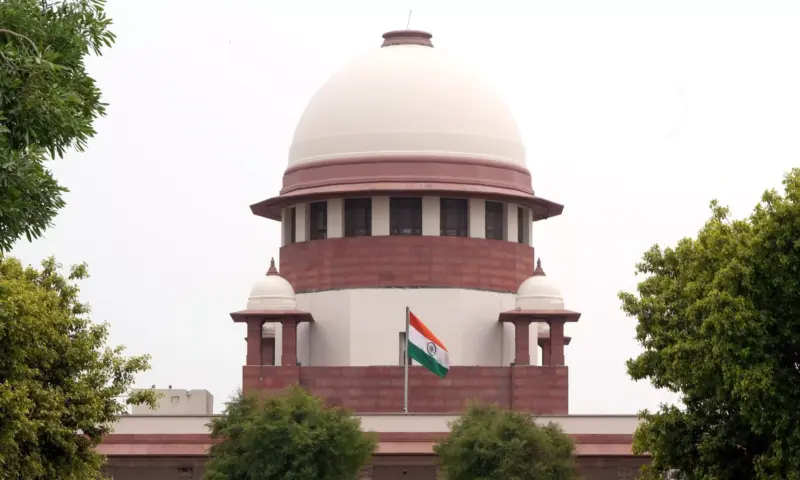

New Delhi: Underscoring that roads cannot be blocked in the name of religious activities, the apex court said a denomination has autonomy in the manner of worship and the court cannot sit in judgment over its religious affairs, but if a secular activity was being affected, the government can interfere with its rights.
A nine-judge Constitution bench headed by Chief Justice of India Surya Kant made the observation while hearing pleas related to discrimination against women at religious places, including the Sabarimala Temple in Kerala, and on the ambit and scope of religious freedom practiced by multiple faiths. The hearing will resume on Wednesday.
Besides the CJI, the bench comprises Justice B.V. Nagarathna, Justice M.M. Sundresh, Justice Ahsanuddin Amanullah, Justice Aravind Kumar, Justice Augustine George Masih, Justice Prasanna B. Varale, Justice R. Mahadevan, and Justice Joymalya Bagchi.
Appearing for Peerzada Syed Altamash Nizami, direct ancestral descendent in the Chisti Nizami lineage associated with the dargah of Hazrat Khwaja Nizamuddin Aulia, advocate Nizam Pasha submitted that a dargah was a place where a saint is buried.
"Within Islam, there are differing views regarding the status of saints after death, but in the Sufi system of belief, there is deep reverence attached to the place where a saint is interred."
"The Sufi system of belief in India consists of several major orders, including the Chishtiya, Qadriya, Naqshbandiya and Suhrawardiya. The present case concerns the Chishtiya order. This system, I submit, clearly constitutes a religious denomination. If one looks at the teachings attributed to Hazrat Nizamuddin Auliya, there is emphasis on adherence to Islamic practices such as roza, namaz, haj, zakat, and above all, faith," Pasha said.
He contended that the right to regulate entry in a religious institution was part of management.
Justice Amanullah said the right to manage cannot mean absence of structure and for everything, there has to be a modality.
"There cannot be anarchy. Take a dargah or a temple. There will be elements associated with the institution, the manner of worship, the sequence in which things are done. Somebody has to regulate that. It cannot be that everyone says I will do whatever I want, or that the gates remain open at all times without any control. So the question is, who is that body which manages. That is where protection comes in, because regulation is necessary. At the same time, it cannot transgress constitutional limitations. There cannot be discrimination on the broad constitutional parameters," Justice Amanullah said.
He added that every institution must have norms and it cannot be individually determined by each person.
Advocate Akshay Nagarajan, representing the Hindu Dharma Acharya Sabha in the court, submitted that the government cannot interfere with a religious denomination's rights by citing grounds under Article 25(2)(a). The statute empowers the State to regulate or restrict any economic, financial, political or other secular activity associated with religious practices.
Nagarajan said the protection under Article 25 is not confined merely to matters of religious belief and extends equally to outward manifestations of faith, including rituals, observances, ceremonies and practices associated with the worship of a particular deity.
Justice Nagarathna said: "Suppose there is a temple, they want to have an annual festival, like you have the annual cart or chariot festival. You cannot block all the roads around the temple. That has nothing to do with religion. You do your religious activity, but not by blocking the roads. The state can always step in to regulate."