




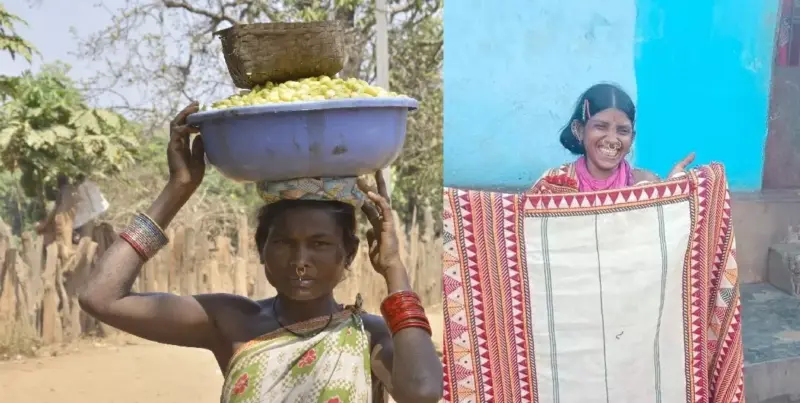

Kalahandi (Odisha) : The death of a 19-year-old woman from Kalahandi at a brick kiln in Telangana in December 2025 is not an isolated tragedy.
It is a stark reflection of a deeper, structural crisis that continues to push thousands from Odisha's tribal heartlands into unsafe and exploitative work far from home.
Across districts such as Kalahandi, Rayagada, Nuapada and Bolangir, distress migration has become a persistent reality. According to data presented in the Odisha Assembly in December 2025, at least 518 migrant workers from the state have died while working outside over the past five years. The true toll is likely higher, hidden in undocumented cases and unreported suffering.
At the root of this crisis lies a complex web of economic vulnerability and developmental gaps. In Melenda village under Parsali Gram Panchayat in Rayagada district, perched atop the Niyamgiri hills, deprivation is an everyday reality. Of its 12 families, half have migrated in search of livelihood. Those who remain struggle with acute shortages of drinking water, healthcare, education and roads. Even accessing basic rations requires a journey of nearly 12 kilometres. Here, migration is not a choice-it is a compulsion.
Agriculture, once the backbone of rural sustenance, is no longer dependable. Nearly 62 per cent of Odisha's cultivable land is rain-fed, making farmers vulnerable to erratic monsoons. Frequent droughts, unseasonal rainfall, and soil erosion in hilly terrains have further reduced productivity. With over 80 per cent of farmers owning small or marginal landholdings, scaling up production or adopting modern techniques remains out of reach. Limited access to markets, institutional credit and extension services compounds the distress, forcing families to seek survival elsewhere.
What makes this reality more striking is the paradox that defines the region. Southern and western Odisha are endowed with abundant reserves of bauxite, limestone and dolomite-resources that hold the promise of economic transformation. Yet, this potential remains largely untapped or unevenly utilised. Industrial activity has often been extractive in nature, generating limited employment for local communities.
Infrastructural deficits-poor connectivity, inadequate logistics, and unreliable electricity supply-continue to deter large-scale investment in remote pockets. The absence of industrial clusters and a shortage of skilled manpower further alienate local youth from emerging opportunities. As a result, regions that could have been engines of growth remain locked in cycles of poverty and migration.
Experience shows that when harnessed effectively, the mining sector can be a powerful driver of economic growth. In 2021-22, Odisha's mining sector generated nearly Rs 50,000 crore in revenue, helping the state navigate pandemic-induced economic challenges. Through the District Mineral Foundation (DMF), a portion of this revenue is earmarked for improving healthcare, education, drinking water and infrastructure in mining-affected areas.
Yet, the journey from potential to progress has often been hindered by delays, protests and policy uncertainties. Projects stalled over prolonged periods-such as POSCO in Jagatsinghpur or the impasse over mining in Niyamgiri-have left a vacuum where neither industrial growth nor alternative development has fully materialised. Communities are left caught between the fear of displacement and the absence of opportunity.
This raises critical questions about the balance between development, rights and sustainability. Safeguarding tribal interests and protecting the environment are non-negotiable. However, the lack of transparent communication and sustained engagement has often deepened mistrust. Development narratives shaped by partial information have left communities uncertain about both risks and benefits.
Experts argue that governance holds the key. Policy intent must translate into timely execution. From land acquisition and compensation to rehabilitation and grievance redressal, administrative efficiency can determine outcomes. Equally important is inclusive dialogue-engaging communities from the planning stage and ensuring they are informed participants in decision-making.
There is also a growing recognition that development must deliver visible, immediate benefits to local populations. Employment opportunities, skill development, improved connectivity and access to essential services must accompany any large-scale project.
Voices from the ground reflect both urgency and aspiration.
"We need jobs. The government should focus on creation of opportunities for the youth so that we would not be forced to leave our home and hearth to eke out a living," said Arjun Majhi, a local resident.
"Our demand is good roads, good schools, good hospitals etc. We need development at any cost. Mineral resources should be utilised for the gain of the local populace. We can't miss this opportunity," said Bisambar Naik from Rayagada.
"Mining activities are on in other parts of Odisha and India. Have the local people not gained out of it? Then why are lies being spread that mining will harm us?" questioned Chitrasen Majhi of Biswanathpur in Kalahandi district.
"Odisha stands today at a critical juncture. It has the resources, the policy framework and the economic potential to transform its high-migration regions into centres of opportunity. What remains is the resolve to act-decisively, inclusively and without delay," said Chandrasekhar Panda, a development activist.