




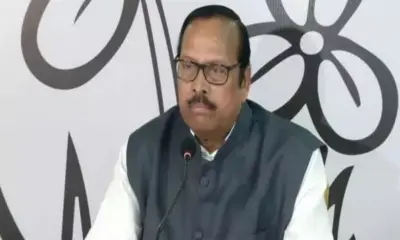

New Delhi: As the Trinamul Congress reels from a crushing electoral defeat and a spiralling internal crisis, one of its seniormost leaders launched a searing attack on the party's high command.
Speaking to this newspaper, Rajya Sabha MP Sukhendu Sekhar Roy came out with all guns blazing, accusing the TMC high command of presiding over a regime steeped in "terror and corruption", and predicted an imminent collapse of the party.
Without naming names, Roy likened a powerful leader at the apex of the organisation to "Duryodhana", the arch-villain of the Mahabharata, whose "ambition and lust for power" engineered the party's downfall. "Mark my words, the TMC will disintegrate within two years," he declared.
The veteran parliamentarian argued that the TMC's collapse has thrown West Bengal's battlefield wide open. While the Congress still retained a significant footprint in the state, the Left's revival would depend on rebuilding its shattered organisational network. The fight for West Bengal's minority vote bank, he suggested, would now be fought primarily between the Congress and the Left.
Turning his guns on the TMC's election strategist I-PAC, Roy held the outfit responsible for the party's electoral debacle. "As far as the nominations were concerned I-PAC had the final say. And the results are in front of you," he said. Roy claimed that within a few years, I-PAC had effectively become the party's policy-making authority, while TMC's organisational committees were reduced to little more than names on paper. "From three-tier panchayats, municipalities, corporations, the Assembly and even Parliament, candidate selection increasingly rested with I-PAC," the TMC leader said. It was learnt that following I-PAC's takeover, the organisation ceased to matter as decisions were outsourced. In the process, Roy alleged that "enormous wealth was amassed by those linked to and running the outfit". The senior TMC leader refuses to believe that the party leadership "was unaware of what was happening".
Roy also recounted what he described as a campaign of intimidation unleashed against him after he criticised the police on X and demanded a CBI probe into the R.G. Kar rape and murder case. He revealed that the state machinery was turned against him, with the police repeatedly targeting and harassing him despite his frail health and being virtually confined to his bed. Later, after he approached the courts, the police contacted him and assured him they would withdraw the case only if he deleted the post. "I was tired and exhausted and had no option but to do what they wanted me to," Roy said.
The senior TMC leader claimed that the party's descent began after its second consecutive victory. According to him, "power went to the heads of the top leadership". What followed, he alleged was the systematic dismantling of internal democracy, with dissent crushed through a network of party strongmen and lumpen elements. There was "zero tolerance" for criticism, Roy said.
He also launched a scathing attack on the political credibility of the leaders at the top of the TMC pyramid. Refusing to identify any particular leader, Roy said the TMC has become "politically untrustworthy". He recalled the party's history of repeatedly abandoning allies and recalled how it had "betrayed" the NDA twice and the Congress thrice.
Roy maintained that the transformation of the TMC leaders from street-fighters to entrenched rulers marked the beginning of the party's alienation from the people. The pro-people movement that had propelled the TMC to power, he argued, gradually gave way to the culture of "arrogance", "entitlement" and "unchecked authority".
Consumed by "hubris" and convinced of its "invincibility", the party high command ignored the growing public anger simmering beneath the surface, Roy said. For him, after the R.G. Kar rape case, there were clear signs that the people of West Bengal wanted to break free. A mass revolt was brewing. All that was needed was an opportunity. "And when that opportunity came, the floodgates burst open, sweeping away the Trinamul Congress and its leaders."