
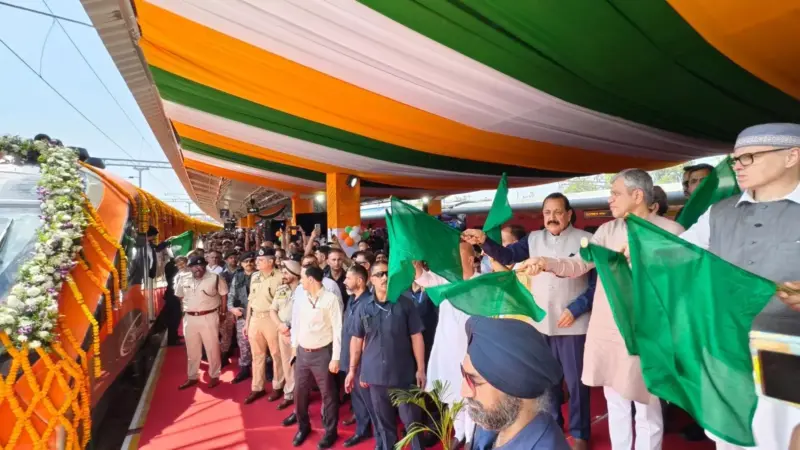

SRINAGAR: In a significant boost to Jammu and Kashmir's rail connectivity, the Vande Bharat Express linking Jammu and Srinagar-was formally flagged off from Jammu Tawi Railway Station by Railway Minister Ashwini Vaishnaw on Thursday.
"The launch of the extended Vande Bharat Express service marks a defining moment in Jammu and Kashmir's transportation history, bringing the Union Territory's two capitals closer than ever before," officials said.
The event was celebrated as a milestone in strengthening connectivity, boosting tourism, and improving year-round accessibility across the Himalayan region and beyond. The ceremony drew a prominent gathering, including Chief Minister Omar Abdullah, Union Minister of State Jitendra Singh, J&K BJP chief Sat Sharma, and several lawmakers, all waving green flags as the flower-decked train began its journey toward Katra.
The Vande Bharat Express, which previously operated only between Srinagar and Shri Mata Vaishno Devi Katra, will now run directly to Jammu Tawi-J&K's winter capital and its busiest railway hub. According to Northern Railway officials, the train flagged off by Vaishnaw from Jammu Tawi Railway Station halted at Katra and that the regular services on the Srinagar-Jammu stretch will begin on May 2, offering pilgrims, tourists, traders, and local commuters a seamless high-speed travel option.
Before the flag-off, Vaishnaw underscored the importance of robust maintenance practices for safety and highlighted the next major priority-increasing capacity on the Jammu-Srinagar corridor through track doubling, particularly between Qazigund and Srinagar, to accommodate more trains. He noted that the same advanced technologies used in Europe are now deployed in J&K, enabling efficient cargo movement-citing the transport of two crore kilograms of apples to Delhi and dedicated bogies for cherry shipments.
The Union Minister also emphasised the success of the Vande Bharat service on the Jammu-Katra-Srinagar route, pointing to its 100 percent occupancy, over 5.5 lakh passengers carried so far, and its ability to operate reliably in extreme winter conditions. He explained that the upgraded 20-coach rake incorporates higher-specification electronics and nearly 3,000 microchips, ensuring smooth functioning even at temperatures as low as minus 10 degrees Celsius. The train also features regionally inspired onboard cuisine, including Dogri and Kashmiri dishes.
Chief Minister Omar Abdullah, addressing the gathering, praised the expansion of the service and the conversion of the original eight-coach train into a 20-coach configuration capable of carrying 1,400 passengers. He highlighted the economic benefits already visible-cement, cars, and fruit now move more efficiently between Jammu, Srinagar, and other states. Abdullah reiterated the need for a dry port and customs clearance facilities within J&K to further streamline exports.
Union Minister Jitendra Singh credited the completion of the long-pending Kashmir rail link to sustained efforts by the central leadership, recalling that while Jammu received its first train in 1972, the extension to Katra took 42 years, and the final push to Srinagar came only in recent years.
The decision to expand the Vande Bharat rake from eight to twenty coaches follows months of overwhelming passenger demand since the train's inauguration on June 6 last year. Northern Railway officials confirmed that the service will halt at seven stations along the Srinagar-Jammu route and that the enhanced capacity will ease reservation pressure, especially during peak tourist and pilgrimage seasons. J&K officials added that the rail link reduces dependence on the landslide-prone Jammu-Srinagar National Highway (NH44), shortens travel times, and ensures predictable movement of people and goods throughout the year. Local businesses expect improved access to markets, while residents anticipate more reliable travel options across seasons.
The direct Jammu-Srinagar service represents the culmination of decades of planning under the Udhampur-Srinagar-Baramulla Rail Link (USBRL) project, conceived to integrate the Kashmir Valley with India's national rail network. Sanctioned in the late 1990s and executed in phases, the ₹43,780-crore project spans 338 km and includes major milestones such as the Baramulla-Srinagar-Qazigund-Banihal sections, the Katra-Sangaldan stretch, and the final link inaugurated in June 2025. Its goals-reducing travel time, boosting tourism and trade, and providing a dependable alternative to the highway-are now being realised.
Beyond passenger convenience, the rail link carries deep strategic and economic significance. Faster, more reliable transport lowers costs for construction materials and agricultural produce, expands markets for Kashmiri horticulture and handicrafts, and supports local industries through predictable logistics. The line also strengthens defence preparedness. In December last year, the Indian Army successfully moved tanks, artillery, and engineering equipment from Jammu to Anantnag using a Military Special Train, demonstrating the corridor's ability to support rapid deployment in challenging terrain.
The USBRL's engineering achievements are among the most remarkable in the world. The Chenab Rail Bridge-the highest railway arch bridge globally-and the Anji Khad Bridge-India's first cable-stayed rail bridge-stand as symbols of innovation and perseverance. Along with the Pir Panjal tunnel and hundreds of viaducts, these structures overcame extreme Himalayan geology and seismic challenges to make all-weather rail connectivity a reality. Following the flag-off, the Union Minister inspected both the Anji and Chenab bridges, underscoring their importance to the project.
With the expanded Vande Bharat service, Northern Railway has announced that two pairs of trains will now operate across the 266-km corridor. This ensures both morning and afternoon travel options from either end on most days, giving passengers greater flexibility in planning their journeys. The start of these services marks not just an infrastructural upgrade but a transformative shift in how the Kashmir Valley connects with the rest of India-economically, socially, and strategically.