
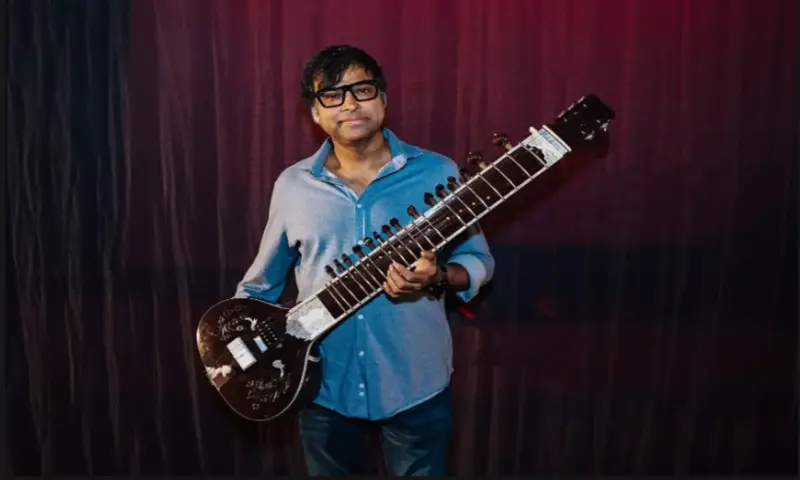

For Purbayan Chatterjee, Indian classical music is not something frozen in time. It is alive, restless and constantly reshaping itself through the musician who performs it.
Sitting down for a conversation ahead of his upcoming India tour with flautist Rakesh Chaurasia, the sitar maestro speaks with the ease of someone deeply rooted in tradition yet entirely open to the sounds of the present.
"The beauty of raga music is that every time an artist performs a raga, it is a reimagination of sorts," he says thoughtfully. "Usually what happens is this is Gurmukhi Vidya. It is taught in the Guru Shishya Parampara. The guru tells you these are the phrases. But the right guru, the Sadguru, will tell you to find your own phrases within the parameters of the raga."
To explain the idea, he reaches for a simple analogy. "It is a little bit like the Hansel and Gretel story. Everybody tells that story. The story does not change, but every person has a different way of telling the same story."
That search for individuality within tradition has shaped his own musical journey. Even after performing with Rakesh Chaurasia for nearly three decades, he says familiarity has never turned into repetition. "We can approach the same Yaman or the same Bihag and yet it will sound different on a different day. That freshness is what I admire about him as a musician."
The chemistry he speaks about extends into his collaborations beyond the classical space too. His recent work 'Feathered Creatures' with guitarist Mark Lettieri began not in a studio but during a casual backstage interaction after performing with the Grammy-winning band Snarky Puppy in Mumbai.
"He was sitting in the vanity van and asked me to show him some things on the sitar," Chatterjee recalls with a laugh. "Then I asked him to show me something on the guitar. We instantly became good friends."
For Chatterjee, that friendship is not incidental to collaboration. It is the foundation of it. "To create good music together, you have to have good chemistry together as people. How else will you have an effective dialogue on what you want to create?"
At the time, he was already composing 'Feathered Creatures' with Nakul, but it was Snarky Puppy frontman Michael League who nudged the project in a new direction. "Michael told me, 'I think your album needs some guitars.' So I thought, great, let me ask Mark. That's how one thing led to another."
Even while experimenting, Chatterjee remains deeply anchored in his classical training. He speaks of his early talim under his father, Parthapratim Chatterjee, Ustad Ali Akbar Khan and Pandit Ajoy Chakrabarty as something that continues to simmer within him. "All that learning is constantly churning in you," he says. "At the same time, I live in today's world. I hear guitar players, I see their techniques. Somewhere unconsciously, it makes me synthesise and think differently."
That intersection between tradition and technology is also reflected in his use of the electric sitar. Though he uses it sparingly in 'Feathered Creatures', the instrument has helped him connect with younger listeners in surprising ways.
"The electric sitar is just another sound. It is another way of expressing the same raga through something electrified," he explains.
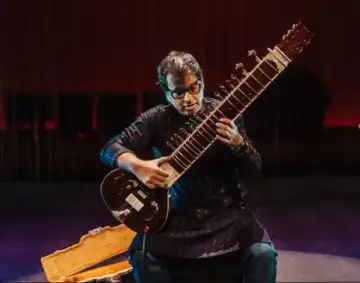
He points to 'Garaj Garaj' from Bandish Bandits as an example of how sound can bridge generations. "That overdriven rock sitar sound made it relatable to young people. The song existed in the first season too, but in the second season it really went viral because the younger generation connected with that sound."
At the same time, he is careful not to romanticise either the past or the present. Asked about the current music landscape shaped by social media, AI and short-form content, Chatterjee avoids dismissive criticism.
"People often ask me whether musicians who play in one-minute reels are incapable of playing for one hour. It's not that they are incapable. It is just a different skill set."