

What is home, really? It's no fixed point in geography or history. It exists beyond: a construct of the mind, shaped by the delicate hand of memory.
The city you once loved - the streets that sang to you, the air that carried your childhood - may no longer exist, does not exist, for it lives not in streets or structures. The city - the one you knew - is gone. Yet it persists in you. It lives in you. It is you.
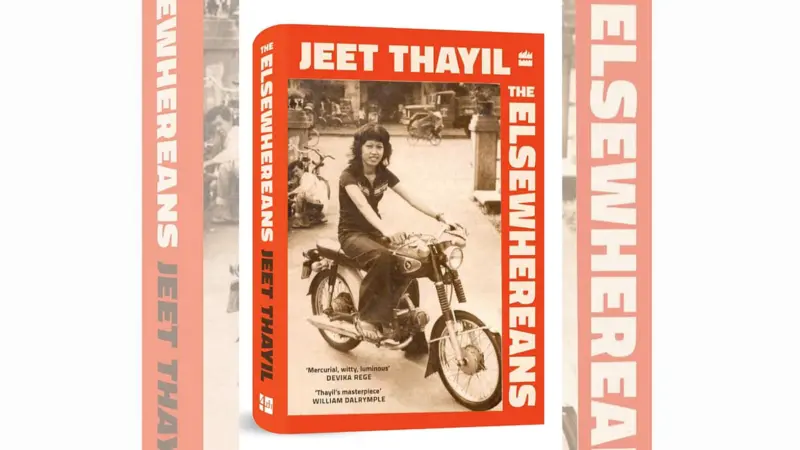
Jeet Thayil's Elsewhereans is "a documentary novel" that exists as much in the valleys of our internal selves as in the world around us, here as well as there, in presence and absence, in fact and in fiction, in the past and the present, was, is, and shall remain, this which exists nowhere and everywhere.
Built on the foundation of lived lives and experiences, Elsewhereans weaves itself into a novel, a dance of memory and narrative. After all, aren't our memories the greatest storytellers, moulding and reshaping our experiences, bending and blending the past and present through the prism of time and perspective until truth wears a new jacket at every ceremony? And indeed, the novel begins, "If memory could speak, what would it say? Only lies. Beautiful lies quietly said with a straight face and a pure heart. And in the saying, the lies, of every colour and size and degree of intent, all the lies would be true."
Through the corridors of his memory, then, Thayil conjures ghosts to bring the past alive - Jeet's father, George; his mother, Ammu; his cousin, Chachiamma; his uncle, Markose. These people, also characters, their lives mapping a panorama where each city, with its contrasting realities, leaves its own imprint of light and shadow.
Bombay is described as, "to Ammu, the city is too big to visualise except as a collection of pictures: night streets lit yellow by sodium lights, the sea like a circus attraction…" In Kerala, "it's a kind of happiness to endure darkness in the afternoon with the expectation of rain." In the Paris air, "a smell of roast meat and woodsmoke, the kind of smell that drives the destitute to crime."
'Travels In The Other Place' book review: Journeys beyond geographyThrough these lanes, time passes by, but remains unchanged. "...twenty years after Indian independence, a new nationalism makes foreigners out of neighbours. You don't have to be from the British Isles or Central Asia to be an outsider." In Vietnam, some citizens are more citizens than others, abandoned by society, by the government. In Germany, a man tells our narrator, "all you people know is how to break things and kill yourselves." In India, a man is lynched by a mob for the unforgivable crime of wearing a skullcap.
"Some imagine they are powerless. They imagine a villain into existence. A minority community with its own dietary and marriage laws. Having found an imaginary villain, imaginary justice is enacted. A man is lynched. The lynching becomes a spectacle. The body is displayed on a rural road where the killers pose with their trophy. The image is shared a hundred times, a thousand times, a hundred thousand times. The leaders of the nation are pleased. The killers are rewarded. The cycle continues."
Through time, through cities, through the faces of strangers and the fog of memory, this novel traces the contours of a searching self. This is a novel of countless miracles, of seas that warn of rains, of women who multiply money, of men who speak on paper, of navy men riding buses, of communists changing religions, of lesbians marrying men, of capturing memories, of letting them go.
"Over half a century later, Ammu and George will return to the chosen place, a return they've imagined time and again in the years they've been away. But by then, Kerala has changed, and they have too. There is no sense of belonging or welcome. They've lived Elsewhere too long: they've become Elsewhereans."
Thayil's Elsewhereans exists suspended between loss and memory, a novel about times lost and lost within time itself. It's a love letter to the wanderers. To the perpetually lost. To those who've learned that home is no fixed point. That the cities we love live only within us now. That we've become what we've lost. That we are elsewhere, always.
It's a love letter to those who belong nowhere because they've belonged everywhere.