




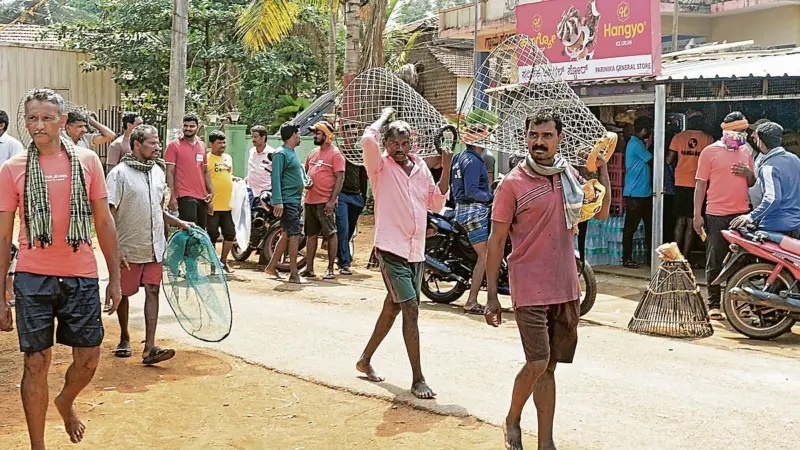

It was 9 am and by the time we entered the government school grounds along the bund road leading to Chittur Lake in Sorab taluk of Shivamogga district, the village was abuzz with activity around the day's event.
The road to the lake was crowded with bikes, autorickshaws and people carrying fishing baskets, sieve nets and sacks. Bhaskar Gendla from Sorab hurried us along. "Come quickly. People are already getting ready to enter the lake," he said.
We had travelled from Shivamogga through Shiralakoppa and Udugani-Tadagani, the birthplace of Akkamahadevi, just to witness the event, and the enthusiasm at Chittur made the journey feel worthwhile.
The banks were packed with people preparing for Kere Bete, a traditional community fishing event held in some Malnad and semi-Malnad villages of the state during summers when the water-level is low and fish population is abundant. Traditionally, lakes were central to village life, serving as sources of water, livelihood and food. Over time, community fishing became part of rural culture itself.
"From a distance, Kere Bete may look like a battle. But it is not an attack, it is a group competition," said folklore researcher Mohan Chandragutti.
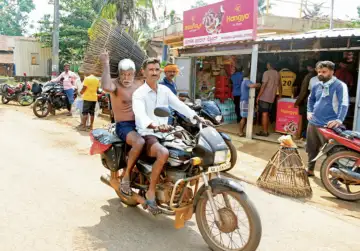
Kere Bete participants rush towards the venue. DH Photo/Shivamogga Nagaraj
At Chittur, some stood in shorts while others wore folded dhotis. Some had wet nets slung across their shoulders, while others sat on the muddy ground preparing themselves before entering the water. But every eye was fixed on the lake.
Ice cream sellers and sugarcane juice vendors moved through the crowd, while a vehicle belonging to the organisers was making announcements over a crackling loudspeaker. "No quarrels will be entertained. No one can enter the lake without permission from the village committee. Sticks and knives are prohibited. A registration fee of Rs 600 is compulsory."
Near the bund stood a police reserve vehicle, its presence a reminder that the gathering of thousands required careful monitoring.
At the edge of the lake stood T P Ashok from Karekoppa, holding a sieve net. "Kere Bete is being held in this lake after 15 to 16 years. Fishing here is a festival for fisherfolk," he said.
He explained how larger fish remain in deeper sections of the lake. "The sieve net cannot reach very deep. Smaller fish get caught near the surface. Bigger fish rise only after getting exhausted. That's when they are trapped."
For Nagaraj from Kuppugadde, Kere Bete is a passion of sorts. "Whether we catch fish or not, we have to come for the bete," he says.
But not everyone there had come to fish. Rathnakar from Chittur stood watching from the bund. "We don't eat fish, but we have come to watch our village festival," he said.
"There are no prizes here. But photos of those who catch the most fish circulate on social media. At the next bete, people recognise them instantly. That itself is the reward," he said.
As the morning advanced, participants prepared in different ways. Some tightened the knots of their nets, others rubbed mud onto their feet for grip. A few tied towels around their heads while scanning the lake's depth.
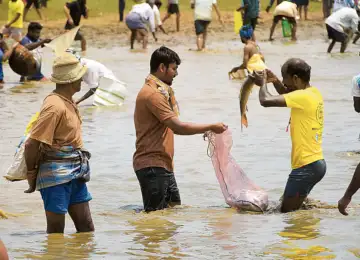
A man puts his catch in his sack during the Kere Bete. DH Photo/Shivamogga Nagaraj
Then, for a brief moment, the crowd fell silent before roar broke out.
"Hoiii…!"
The 'battle' begins
Thousands rushed into the lake at once, turning the calm water muddy within minutes. The scene resembled a battle.
Fish hiding in deeper sections darted towards the banks as people surged forward. Smaller fish floated close to the edges where children caught them with bare hands and stuffed them into bags. Women gathered fish in the folds of their sarees.
At one point, a large fish leapt out of the water. A man trying to grab it lost his grip and the fish landed in someone else's hands. "Ayyo, bad luck!" people nearby remarked.
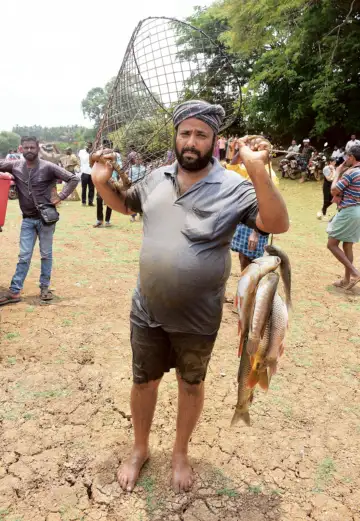 A man poses with the fish he caught in the Chittur Kere Bete. DH Photo/Shivamogga Nagaraj
Soon, successful catches began emerging from the water. Sudeep from Sagar taluk walked out carrying more than 10 kg of roni fish. People surrounded him, recording videos and taking photos.
Manikantha carried a huligende fish on his shoulder. Participants from Thyagarthi returned with sacks filled with jabbu, kuchchalu and murugodu fish. Shivamurthy had caught a large catla fish. "There are five people at home. This is enough," he said, adding that the entire village would feast on fish curry, fry, chutney, gojju, kebabs, for an entire week.
Near the bund stood Revannappa, head of the Kere Bete organising team. "This is the second-largest lake in Sorab taluk, spread across 102 acres," he said.
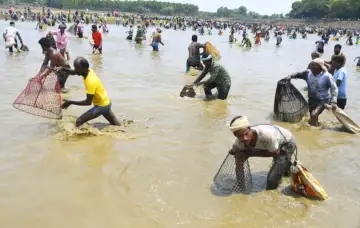 Participants catch fish during Kere Bete organised at Chittur Lake in Sorab taluk of Shivamogga district. DH Photos/Shivamogga Nagaraj
The lake is connected to the Kumudvathi stream. Whenever the Kumudvathi overflows, fish enter this lake. Every year, fishing rights were auctioned for normal fishing. But this year, villagers insisted on a Kere Bete. According to the organisers, 2,300 participants from Sirsi, Siddapur, Hosanagar, Ripponpet, Hangal, Ranebennur, Shivamogga and other places registered for the event, generating Rs 13.80 lakh.
Selfie with the catch
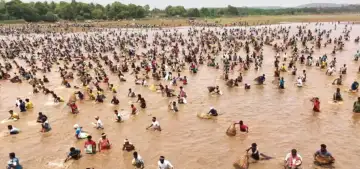 Participants catch fish during Kere Bete organised at Chittur Lake in Sorab taluk of Shivamogga district. DH Photos/Shivamogga Nagaraj
By afternoon, the lake had turned brown with churned mud. Some participants posed for selfies with their catch. Others filmed reels for social media. Those carrying large fish walked away proudly while those who caught nothing returned quietly. Slowly, the crowds began to disperse. Wet footprints, torn nets and muddy water remained after the frenzy faded.
While the lake fell silent, the echo of that collective "Hoiii…" still seemed to hang in the air.
(Translated from Kannada by Divyashri Mudakavi)