






Mary Austin
A six-minute song with no chorus, divided into distinct movements and drawing freely on ballad, rock and operatic forms, 'Bohemian Rhapsody' bore little resemblance to the conventions governing early 1970s hit singles.
It would take the kind of ambitious, symphonic thinking found in the albums of bands such as King Crimson and Genesis and place it, improbably, at the centre of the singles charts. Not only that, but it was also the most expensive song ever recorded, was instrumental in popularising the music video, and would go on to permanently alter expectations of what a rock single could achieve. It is Queen's crowning achievement.
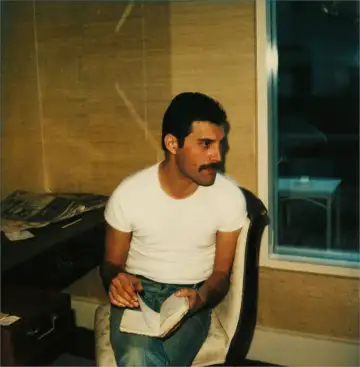
Freddie. Pics courtesy: Mary Austin
The song is thought to have begun life in 1968. Having written the line 'Mama, just killed a man' while still a student at Ealing Art College, Freddie held on to it for years, uncertain where it belonged. The lyric suggested a cinematic, Old West atmosphere, and he informally referred to the unfinished piece as 'The Cowboy Song'. At this stage, there was only this fragment. But what the Garden Lodge pages demonstrate is how that one line evolved from a loose idea into something that demanded an entirely new framework. From the outset, the ambition was unusual.
Much of the song existed on Freddie's new piano before it existed anywhere else. Visitors remember hearing sections played long before the band entered the studio, and producer Roy Thomas Baker was introduced to an early version during a visit to the flat, where Freddie demonstrated the ballad opening, hinted at the structural shifts to come, and announced, with evident relish, the arrival of an operatic section.
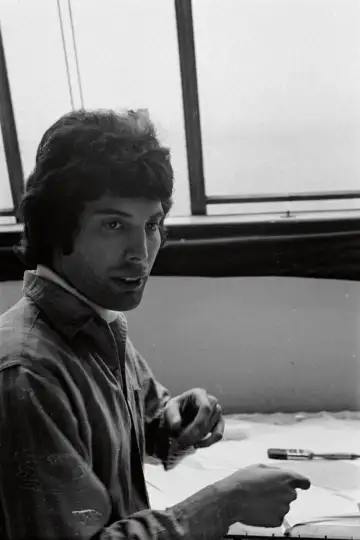
Freddie. Pics courtesy: Mary Austin
Bharatanatyam-jazz retelling of Shakuntala opera premieres in BengaluruThe composing process was different from this one. Before, his writing environment was more relaxed; I'd come in, he'd stop, we'd drink tea and talk, then get on with our evening. With 'Bohemian Rhapsody', that didn't happen. In came a new seriousness - even greater focus. When I returned home to find him in that space, I'd offer him a cup of tea, set it down quietly, and leave him to it. He didn't even stir when I came in; he was so focused that his whole posture even seemed altered. I'd occasionally think he'd left the room, only to realise he was still at the piano, lost in silent thought.
There was a moment around this time when he became frustrated because he'd dreamed something - lyrics, or part of them - and woken up unable to remember what they were. It really bothered him. He was so concerned about losing ideas that we kept a notebook and pen by the bed. Freddie got into the habit of deliberately waking himself in the middle of the night and writing things down. In the morning, there'd be words on the paper.
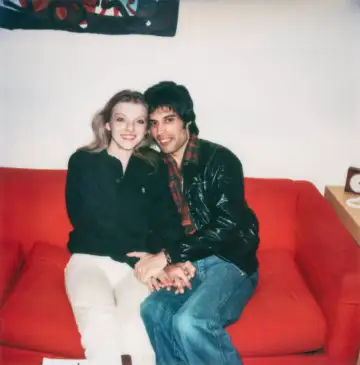
Freddie. Pics courtesy: Mary Austin
That was the only time I know of when the writing happened like that, almost in a dream. He was so preoccupied with 'Bohemian Rhapsody' that even his sleep seemed to be involved.
He'd also begun using a tape recorder by then, which became absolutely essential. Before that, ideas were just sung or hummed and risked being forgotten. With 'Bohemian Rhapsody', there was simply too much material moving at once, so the tape recorder allowed him to catch fragments as they came - chord sequences, vocal lines, harmony ideas - and return to them later.
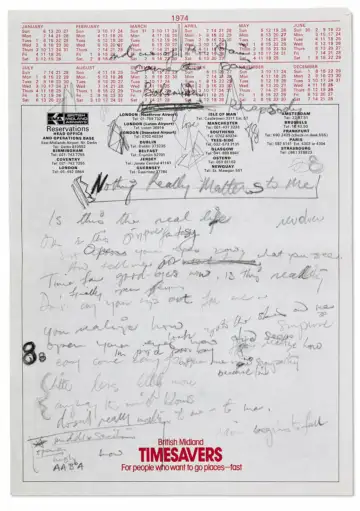
Lyrics. Bohemian Rhapsody' Words and Music by Freddie Mercury © 1976. Reproduced by permission of Queen Music Ltd/Sony Music Publishing Ltd, London N1C 4DJ
After that, the tape machine never left him. He used it constantly, right up until his death. He could operate it without looking, pressing the buttons blindfolded. He'd take the tapes into the studio and say, 'These are my thoughts,' and everything would begin from there. Once he realised how much he could lose without it, he never worked without one again.
Around this time, Freddie was playing Joni Mitchell constantly - her album Court and Spark, or possibly For the Roses. I remember feeling almost jealous, which sounds ridiculous now, but true, nonetheless.
Joni Mitchell was the only woman I was ever jealous of! There were other things feeding in, too. I always assumed that Freddie had gained his knowledge of classical piano from school, and one day he mentioned to me that I might like Chopin's Preludes.
Sure enough, I bought a record and loved it, and I can see now how that music opened another door for both of us. Mozart as well. Whether that came directly into 'Bohemian Rhapsody', I don't know - but it was in the air.
Another thing I've often wondered is whether his search for the piano itself played a part. When you visit a piano showroom, you're surrounded by sound. You're hearing instruments played, perhaps classical music in the shop. I don't know if that's where some of the operatic thinking came from, but it's possible. There's no doubt about it - something unlocked when he took delivery of that piano.
The surviving manuscripts chart the song's evolution in unusually fine detail. Written on British Midland Airways stationery dated 1974 (Freddie's father worked for the airline), they show him working through titles, structures and lyrics with meticulous care.
Elsewhere, lines are tested and abandoned, including an unused opening - 'Time for good-byes now, is this reality' - and an entire discarded ballad verse beginning 'Mama, there's a war began, / I've got to leave tonight'. Other phrases appear early only to find their place much later; 'Nothing really matters to me' is written down long before it settles into its final position. Taken together, the pages reveal a process of refinement rather than spontaneity, with ideas reshaped until they found a place in the song.
The drafts show not just lyrics but detailed attention to vocal architecture. Entire pages are given over to harmony lines, particularly for the operatic middle section and the outro. Words such as 'Galileo', 'Bismillah', 'Fandango' and 'thunderbolt and lightning' appear almost as visual markers, anchoring musical ideas rather than narrative ones.
Musically, the influences feeding into the song were unusually broad, with opera being the most obvious. These sections were not conceived as formal opera, and Freddie was explicit about that; his ambition was not to replicate opera, but rather to appropriate its drama and scale for a rock context.
Recording began on 24 August 1975 at Rockfield Studio 1, near Monmouth in South Wales, following rehearsals first at Ridge Farm in Surrey, and then at Penrhos Court in Herefordshire. Queen did not arrive intending to focus on a single track, but 'Bohemian Rhapsody' quickly became the central concern of the sessions.
Then, of course, came Rockfield. Usually, I stayed out of the studio when they were recording, so going up to Rockfield, where they were making A Night at the Opera, felt out of the ordinary straight away. I had taken time away from my job at Biba to be there, and that alone made it different.
Rockfield was farm accommodation, really - a yard surrounded by converted stables was at its core - and overall, I really liked it: there was a good atmosphere, good food, the other partners were there as well, and it all felt warm and quite convivial, even familial.
During the days, I strolled into the village, which was a long walk through the countryside. I'd buy food, do a bit of shopping, just meander, sometimes alone, sometimes with Chrissie and Veronica.
At night, we'd all eat together at a large table, after which the band would usually go back into the studio. As far as I know, they hadn't intended to record only one song; they went to make an album. But although they might have had the odd half day on other material, mostly they were either rehearsing or recording 'Bohemian Rhapsody'.
As far as I know, they hadn't intended to record only one song; they went to make an album. But although they might have had the odd half day on other material, mostly they were either rehearsing or recording 'Bohemian Rhapsody'. The song would be divided into three distinct parts: the opening ballad, the operatic middle section and the closing rock passage. The first section was recorded with piano, bass and drums, in a relatively familiar way. At that stage, the operatic section was left deliberately incomplete, with blank tape set aside on the reel for material that would be added later.
The final rock section was treated almost as a separate recording, captured as a loud, heavy track in the style of the period. Even here, the arrangement was unusual. The basic backing track was recorded without a lead vocal, allowing space on the tape for the extensive backing vocals that would be layered on later. This approach went against standard practice but was necessary given the limitations of the available equipment.
Needless to say, recording the operatic middle section proved especially time-consuming, especially as what had originally been conceived as a short passage grew exponentially during the process. During a series of punishing days, Freddie, Brian and Roger recorded vocal overdubs continuously, aiming to build a dense choral arrangement from individual performances.
In all, nearly two hundred of these vocal overdubs were recorded, with Roger providing the highest parts, Brian the lower ones, and Freddie singing across the middle and lower registers. (John chose not to participate, feeling that his vocals were not up to scratch.) With only twenty-four tracks available, the production team were forced to bounce vocals down into successive sub-mixes, reusing tracks again and again. By the end of the process, some sections existed on eighth-generation tape.
The physical reality of this process was visible on the reels themselves. Tape was spliced repeatedly as new ideas were added, with sections cut and reassembled into the correct order. The tape became so worn from repeated use that light could pass through it. The operatic section, which had begun as a small idea, grew into a sprawling centrepiece through this cumulative process.
Following the Rockfield sessions, Queen moved between different London studios, including Roundhouse, Scorpio Sound, Wessex Sound Studios, and SARM Studios. At SARM, the band had access to a then-state-of-the-art 24-track facility. Engineers Mike Stone and Gary Langan worked alongside Roy Thomas Baker, with Freddie putting the finishing touches on the track. Brian added guitar elements during this phase, including a carefully composed solo recorded on a single track rather than built up from multiple layers.
The final mixes introduced another layer of complexity. Manual mixing moves, tape saturation and the cumulative effect of repeated overdubbing contribute to the way the sound thickens and strains as the song progresses.
The ballad opening remains clean and clear, but as the operatic section builds, the vocals become increasingly saturated - not as an added effect, but as a natural result of pushing the recording process to its limits.
With the song finished - the entire recording having taken three weeks, a length of time that many groups would have spent on an entire album - the band wanted it released as a single.
However, its length - at nearly six minutes - ran directly against the conventions of radio and record marketing of the time.
To discuss the release, they held a meeting at eMi, from which Freddie returned looking really worried. The record company had said the song was too long and wanted it cut down, but he'd told them that was how it had to be - and then walked out. If he'd sounded firm to them, he certainly wasn't so sure in the privacy of his own home. Back at the flat, he said he wasn't certain he'd done the right thing. He was worried that he'd torpedoed his own career and that of the band. It was unusual for him; I'd never seen him that concerned before.
When the record company dug its heels in, Freddie found an ally in Kenny Everett, who was then a top DJ at Capital Radio (and went on to become a massive TV star). I wasn't aware of any great friendship between them beforehand, and I couldn't tell you exactly how they'd been introduced - it may have been through someone he knew at eMi, possibly John Reid, perhaps their publicist, Eric Hall - I honestly don't know, but what mattered was that Kenny understood the song instinctively and didn't want to see it 'edited' as the record company were suggesting.
Given a copy of the record, I think there was an understanding that he might play it once, maybe twice. But telling Kenny Everett to do something within limits was always a lost cause. He took that as a challenge. His show was at the weekend, and once he started, he played it over and over. He began by teasing it, and then he aired the whole thing, time and time again, and by the end of that weekend, it felt as though it was everywhere.
That was also when I heard it properly for the first time. I remember thinking how strange it must sound to people hearing it cold. It was so unlike anything else - you didn't quite know what you were listening to at first. But it carried you with it. There was such joy in it, such confidence, that it didn't matter if you couldn't immediately make sense of every part. And clearly Kenny felt that, too, because listeners responded straight away. Capital Radio was flooded with requests for a single that didn't even exist yet.
Freddie was jubilant. I think he felt that someone had finally stood alongside him rather than trying to cut his work down to size. That whole struggle - from the song beginning at the piano, through Wales, through months of work, doubt and turmoil - suddenly tipped the other way. It was as though he'd landed where he'd been trying to get to all along.
I remember a real change in him then. When I think of that time, I see someone centred and happy. He was joyful, of course, but more than that, he seemed newly assured - as though he'd found a space he hadn't quite been in before, and knew he belonged there. There was such joy in it, such confidence, that it didn't matter if you couldn't immediately make sense of every part. Airplay in both the UK and the US forced the record company's hand.
When the unedited single was finally released, backed by the Roger Taylor composition 'I'm in Love With My Car', it rapidly climbed the charts. By Christmas 1975, it was number one in the UK, where it would remain for nine weeks.
Although it was initially less dominant in the United States, the song's long chart run and later re-releases cemented its status there over time. Elsewhere, its impact was immediate. It reached the top of the charts across much of Europe, Australasia and beyond, becoming a number one record in countries as far apart as the UK, Australia, Canada, Ireland and the Netherlands.
Its return to the charts in subsequent years only reinforced what had already become clear: this was not just a hit in one territory or one moment, but a genuinely global success, and one that would endure.
In time, it came to stand as one of the most successful and recognisable recordings of the twentieth century.
Excerpted with permission from A Life in Lyrics: The Official Creative Legacy of Freddie Mercury by Mary Austin, published recently by HarperCollins.
Feedback: Like this story? Write to us at dhonsunday@deccanherald.co.in