




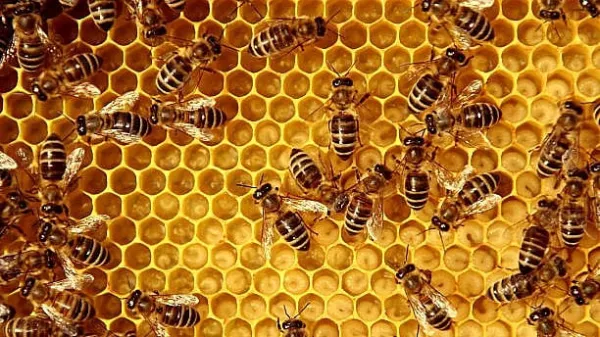

World Bee Day is celebrated on May 20 to raise awareness about the crucial role of honeybees as the primary agents of pollination, which helps preserve the health of the planet and its inhabitants.
This year, the theme is 'Bee Together for People and the Planet', emphasising the linkages between bees and humans for food and livelihoods.
I received messages on social media about celebrations across India and different parts of the world. Ironically, on this day, I had to clean hundreds of dead honeybees from the bee boxes in our farm. I had six colonies ready for honey harvest.
The bees had gone foraging, and when they returned to their colonies, they brought contaminated, toxic pollen. As they are sensitive insects, hundreds of them died - some swirling, trembling, and losing their senses.
The sight was shocking. It looked like a war, waged by humans on bees.
The reason was clear. Someone from the neighbouring farm sprayed pesticides on areca trees to control the dropping of areca buds and increase the yield. Unaware of this toxic trap, the bees visited the areca trees for foraging. When they returned, they carried this toxic pesticide residue, leading to their deaths.
Our farm is situated in the Malenad region of Sirsi, on the edge of evergreen forests. This region is known for the cultivation of horticultural crops, especially spice and areca gardens. It has a history of crops evolving alongside the bees that help pollinate and increase yields. For decades, the farmers of the region followed organic practices. However, in recent years, cultivation methods have seen a major shift, with increased use of chemical inputs and pesticides for better yields.
There is no scientific evidence suggesting a positive impact of pesticide application on areca yields. Ironically, the Horticulture Department, which promotes bee-keeping, also advises spraying pesticides on horticulture crops, which leads to bee deaths. This contradiction is not limited to horticulture crops; indiscriminate spraying of pesticides is posing a major threat across the country.
India imports huge quantities of neonicotinoids that are added as seed coating to crops like soya and corn to reduce spraying.
However, it has been proven that this causes extensive damage to bee populations across the world. The European Union has banned these pesticides, but they are exported to countries like India. Without strong regulations on their use, they place bee populations and human health under threat.
NHAI to develop 'bee corridors' to reduce ecological stressA study conducted in Odisha showed how pesticides adversely impact the local Apis cerana bees. It highlighted how pesticide exposure damages the honeybees' brains, leading to memory loss, and impacts their neuro-physiological processes that have critical consequences for the survival of the bees.
India has established a National Bee Board to promote bee-keeping and honey production, under the National Beekeeping and Honey
Mission. It aims to promote the country as a global leader in honey and bee products. However, policy lags behind the reality of pesticide use and the bee deaths it causes.
The governments, both in the Centre and the states, promote bee-keeping through various schemes. However, these initiatives don't have linkages to the wider implications of threats posed to bee populations in domesticated spaces and in the wild.
The farmers appear to have declared war on the bees, but more striking are the flawed state policies that offer no solution. Every year, 65,000 tons of pesticides are sprayed on our crops. In recent years, the extensive use of glyphosate, a weed-killer, has had a devastating impact on bees. Across most urban areas, it is common practice to spray pesticides on colonies of giant rock bees (Apis dorsata) that build hives on buildings.
Honey is a byproduct of a larger system. It is the bees, playing an invisible role as pollinators, that help sustain our food production and preserve the health of our planet. According to the Food and Agriculture Organisation (FAO), almost 80% of the pollination for food and horticultural crops depends on honeybees and other insects. The decimation of bee populations will therefore directly impact the world's food security.
We need to change our attitude towards the creatures around us, especially the bees. The government must acknowledge their significance to life and ban pesticides that threaten their survival.
(The writer is a farmer, environmentalist, and convener of Save Honeybees Campaign)