




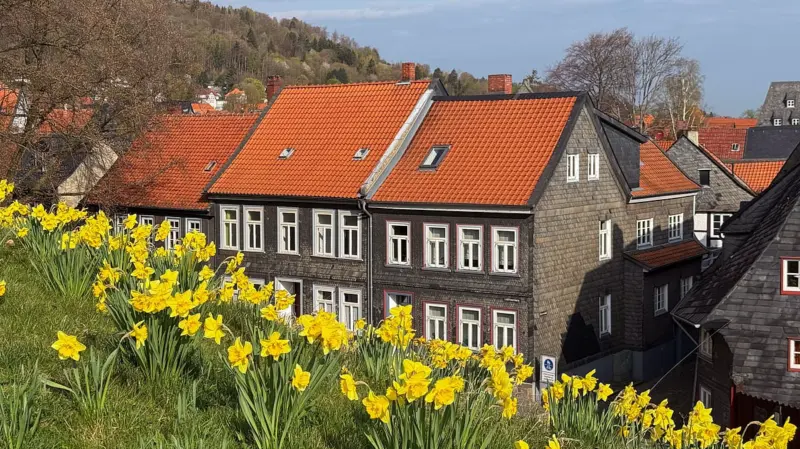

Goslar, the thousand-year-old imperial town at the edge of Germany's Harz Mountains, feels especially alive in summer. Long northern evenings stretch the day well past dinner, while forests, reservoirs, and mountain trails become easier to explore.
Though winter brings snow-covered forests, Christmas markets, and cross-country skiing, summer remains a particularly rewarding season to experience the region.
Walking through Goslar's UNESCO-listed old town, what strikes me most is its texture. Beneath steep slate roofs and Romanesque church towers, more than 1,500 timber-framed houses stand. Narrow cobbled lanes give way to hidden courtyards and quiet squares, while substantial stretches of the medieval walls and gates still survive. The town prospered through silver extracted from the Rammelsberg mine, and that wealth transformed Goslar into one of the Holy Roman Empire's most important centres.
The grandest expression of that prosperity remains the Kaiserpfalz, or Imperial Palace, built between 1040 and 1050 under Emperor Henry III and later used as a seat of the Saxon kings.
Walking through the reconstructed Romanesque complex, I am struck by how closely imperial ambition once depended on the mountain beside the town. Inside, large 19th-century murals depict scenes from medieval and imperial German history. Attached to the palace complex is the Chapel of St Ulrich, significant for housing Henry III's heart in a gilded octagonal reliquary beneath the floor. Modern sculpture appears throughout Goslar, including Henry Moore's Goslar Warrior in the gardens behind the palace, reflecting the town's ongoing engagement with contemporary art. Elsewhere, Goslar's mining history surfaces in smaller details, such as symbolic bronze miners' handprints set into stone around the town, commemorating generations of miners. Near the Rathaus, the Glockenspiel's mechanical figures emerge several times a day to re-enact scenes from local mining life.
By early evening, I find myself back at the market square at Brauhaus Goslar, where traditional Gose beer is still brewed beneath dark timber beams.
Christmas in Vienna: A winter wonderland of markets, music and lightsUNESCO-listed heritage site
Just outside town lies the Rammelsberg World Heritage Site, part of the UNESCO-listed "Mines of Rammelsberg, Historic Town of Goslar and Upper Harz Water Management System." The former mine now serves as a museum, offering guided underground tours through tunnels, shafts, ore-processing plants, and old machinery rooms that reveal how thoroughly mining shaped the Harz over centuries.
Ashort drive from Goslar, the Burgberg cable car above Bad Harzburg rises through the forest to the ruins of the 11th-century Harzburg castle built under Heinrich IV. Nearby, the Baumwipfelpfad treetop walkway passes through the spruce, pine, birch, fir, and beech canopy before landing at a viewing platform. Visitors can descend by foot, cable car, or zipline above the canopy, before heading to a spa, known for its mineral-rich thermal waters. The long summer light leaves enough time for walks through woodland trails, reservoirs, and mountain routes across the Harz. Steam-hauled narrow-gauge railways still climb through forests towards the Brocken, northern Germany's highest peak, associated with German folklore and witches' legends.
What lingers is the coexistence of worlds. Above ground stand medieval towns; beneath lies an older world of tunnels, machinery, rock, and darkness.