
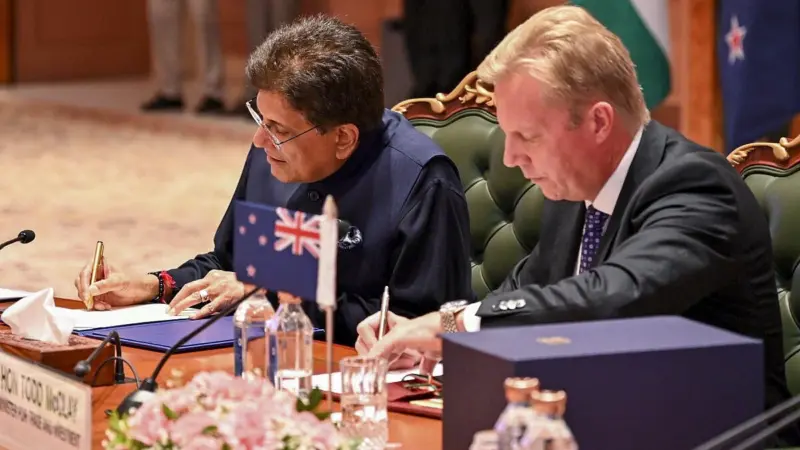

India's free trade agreement (FTA) with New Zealand, formalised in New Delhi on Monday, extends a global pattern of rising bilateral trade.
The rule-based multilateral trading order has been rendered irrelevant by the weakening of the World Trade Organisation (WTO). Countries are increasingly pursuing bilateral agreements suited to their needs and pegged to mutual areas of interest. Negotiations for the agreement with New Zealand commenced in March 2025 and concluded in December. The deal was signed by India's Commerce and Industry Minister Piyush Goyal and New Zealand's Trade and Investment Minister Todd McClay. Prime Ministers of both countries hailed the signing as a "historic" step towards deepening trade, investment, and people-to-people ties. The FTA will be operationalised this year after ratification by the New Zealand parliament.
The agreement will see New Zealand removing tariffs on all goods imported from India, while India will remove or reduce tariffs on 95% of imports from that country. Among the imports from New Zealand that have been exempted or marked with reduced tariffs are wool, select electrical and mechanical machinery, wine, pharmaceutical products, and iron and steel articles. However, many items remain excluded, such as dairy and agricultural products, sugar, artificial honey, and gems and jewellery. India has been sensitive to the import of products that could adversely impact domestic sectors like dairy and agriculture, which are sources of livelihood for millions of people. Unrestricted dairy imports from New Zealand, where the sector is very advanced, would go against the interests of India's farmers. Notably, India has been cautious about these domestic interests in its trade agreements with other countries. It is also one of the sticking points in its negotiations with the United States ahead of a proposed trade deal.
As a developed and high-value market, New Zealand offers opportunities to Indian manufacturers in sectors such as agriculture, textiles, pharmaceuticals, engineering goods, services, including IT and ITES, education, and healthcare. New Zealand's commitment of a $20-billion investment in India over the next 15 years will augment efforts to develop industrial infrastructure and manufacturing ecosystems in the country. The FTA also includes provisions relating to the mobility of working professionals and students from India. New Zealand is emerging as a favoured destination for education and employment. The agreement envisages a doubling of bilateral trade by 2031. It has been welcomed widely in both countries and will hopefully provide a boost to India's exports, which have recently seen a slowdown.