
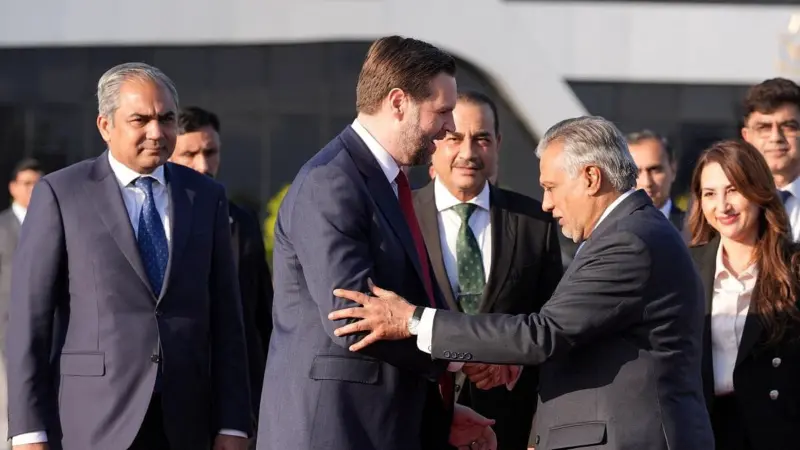

The much anticipated peace talks in Islamabad broke down as US Vice President J D Vance declared that both US and Iran failed to reach an agreement regarding the West Asia conflict.
"We have been at it now for 21 hours, and we have had a number of substantive discussions. That's the good news," said Vance.
"The bad news is that we have not reached an agreement. We have made very clear what our red lines are, what things we are willing to accommodate and what things we are not willing to accommodate," the US vice president said, adding that the Iranian delegation had "chosen not to accept our terms".
Same hotel, different rooms: Inside US-Iran 'proximity talks' in IslamabadWhen asked to elaborate on the main sticking points, Vance refused to go into specifics, but said the nuclear issue was one of them.
"I won't go into all the details because I don't want to negotiate in public after we have negotiated for 21 hours in private," he said.
"But the simple fact is that we need to see an affirmative commitment that they will not seek a nuclear weapon and that they will not seek the tools that would enable them to quickly achieve a nuclear weapon," he said.
"We haven't seen that yet, we hope that we will," Vance added.
On the other hand, Iranian state broadcaster IRIB said that the US put forth "unreasonable demands" that scuppered the talks.
"The Iranian delegation negotiated continuously and intensively for 21 hours in order to protect the national interests of the Iranian people; despite various initiatives from the Iranian delegation, the unreasonable demands of the American side prevented the progress of the negotiations. Thus the negotiations ended," IRIB said on Telegram.
The Pakistan-brokered talks -- the first direct, high-level engagement between the two sides since the 1979 Islamic Revolution -- were watched globally amid increasing expectations of a breakthrough.
"We talked about a number of issues. But again, we just could not get to a situation where the Iranians were willing to accept our terms," Vance said.
The US delegates were "quite flexible" and "accommodating", but "unfortunately, we were unable to make any headway", the US vice president said.
He also said that they had been in touch with President Donald Trump and other top US officials.
"We were constantly communicating with the team because we were negotiating in good faith. And we leave with a very simple proposal: a method of understanding that is our final and best offer. We will see if the Iranians accept it," said Vance, who left for Washington after the talks, not hinting at extension of discussions.
The two sides travelled to Islamabad on Saturday for the talks, four days after Iran and the US announced a two-week ceasefire.
The US delegation also included Special Envoy Steve Witkoff and Jared Kushner, President Donald Trump's son-in-law, while the Iranian side was headed by Parliament Speaker Mohammad Bagher Ghalibaf, and included Foreign Minister Abbas Araghchi, among others.
The expert-level discussions covered economic, military, legal, and nuclear issues, with written proposals exchanged.
The key sticking points included Iran's nuclear programme, sanctions relief, frozen assets, and Israeli attacks in Lebanon, sources said.
Iran had laid out a 10-point plan for the talks that included demands for the withdrawal of US forces from West Asia, the lifting of sanctions against Iran, and allowing it to control the Strait of Hormuz.
Pakistan led the diplomatic push to bring the two sides to the table, which became possible after an appeal by Prime Minister Sharif earlier this week, leading to a pause in the fighting.
The conflict began after the US and Israel launched attacks on Iran on February 28, paralysing global energy markets and disrupting trade.
The negotiations were closely watched globally, for their likely far-reaching implications for West Asia's security, global energy markets, and international diplomacy.
(with PTI inputs)