
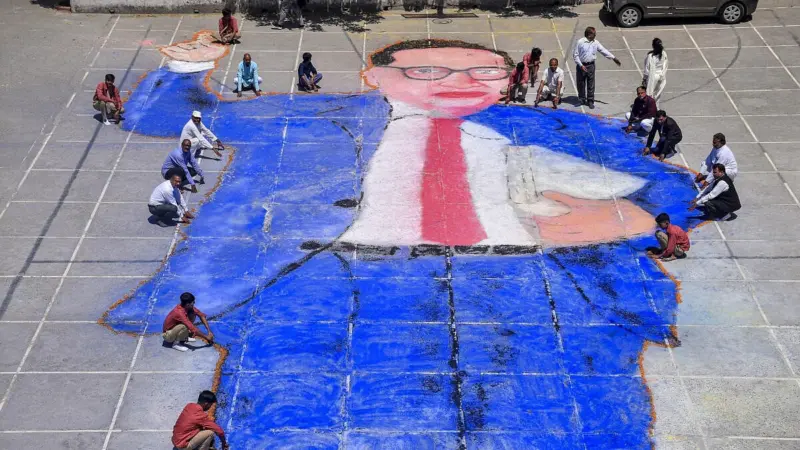

Amid swathes of saffron, green and red that has enveloped the nation, there comes a day when a deep, dark, oceanic blue resonates with the pulse of the country and brings people together from all walks of life.
Impeccably dressed in his three-piece suit and never without his august blue coat, B R Ambedkar's birth anniversary has become a pivotal day in Indian society.
Whilst it is definitely marked by honouring the legacy of the man who wrote our Constitution, this day also paves way for differing opinions and intellectual conversations to come to the fore. It gives an opportunity for many to learn about Dalit history and engage with ideas of justice and equality.
As the conversations run deeper, there comes a point when one starts anaylsing the significance of the colour blue. The statue of Ambedkar donning a blue coat, holding India's constitution in hand is erected across the length and breath of this country-from remote villages to the bustling cities.
Today, the colour blue is a powerful symbol of Dalit identity. It has come to define movements and protests and is synonymous with the term of equality.
While many believe (and rightly so) that blue becoming synonymous with equality was due to it being the colour of the sky-for under the sky everyone is believed to be equal-there is a little bit more than what meets the eye.
Ramchandra Guha-the renowned historian-put pen to paper and wrote about the significance of the blue suit. He put forth the theory that Ambedkar's wearing of three-piece blue suit was itself an act of defiance.
According to him, had Ambedkar clad himself in a dhoti or any of the other Indian traditional cloth it would not have been considered a 'revolution'. It would just have been considered an act of banality.
Guha wrote, "He is a Dalit...what else should he wear?"
However, he "escaped his fate" by wearing a suit. Guha wrote, " By the canons of tradition and history this man was not supposed to wear a suit, blue or otherwise"
Today, Ambedkar is fervently remembered wearing his blue suit and many sociologists and political scientists have tried to find a deeper connotation for the use of this colour.
As aforementioned, the most popular theory making the rounds is that of all of us being equal under the sky. There is no caste and no discrimination.
Others have said that the colour blue describes a very specific form of struggle-a fight for equality. Some have also traced the colour to Buddhism.
In a bid to reject the dominance of caste system, Ambedkar converted to Buddhism in Nagpur. The Buddhist flag does feature the colour prominently.
This very colour can be found the in the flag of Ambedkar's party, Scheduled Castes Federation which was founded in 1942.
Though, Ambedkar has never explicitly stated or written his favouritism for the colour blue, it has still become a very important symbol of Dalit movements. Even his choice of clothes helped him break social barriers and challenge the prevalent system.