




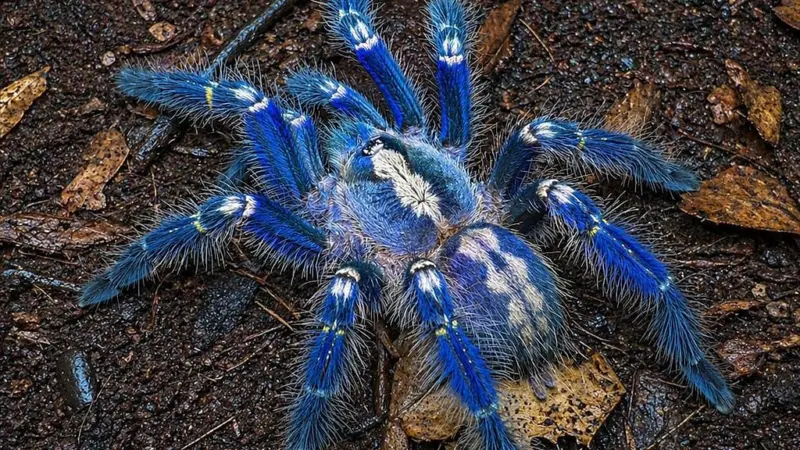

Hyderabad: Deep within the forests of Andhra Pradesh lives one of the world's most visually remarkable spiders, the Peacock Tarantula (Poecilotheria metallica).
Known also as the Gooty Ornamental Sapphire Tarantula, this strikingly beautiful arachnid is the only blue species of the genus Poecilotheria, its legs adorned with brilliant metallic blue hair that makes it unmistakable among tree crevices. For the first time, this critically endangered spider will be the subject of a dedicated conservation survey.
The Andhra Pradesh Forest Department, in collaboration with the Eastern Ghats Wildlife Society, has launched a comprehensive conservation status survey of the species within the Nagarjunasagar Srisailam Tiger Reserve (NSTR) one of the largest tiger reserves in India. The initiative marks a significant shift in conservation priorities, moving beyond flagship wildlife toward lesser-known yet ecologically vital species.
Big cats of insect world: Scientists discover two new army ant speciesFirst discovered in Gooty, Andhra Pradesh, in 1899, the Peacock Tarantula holds the unenviable distinction of being listed as Critically Endangered on the IUCN Red List. Its entire known range is confined to a small forest patch between Nandyal and Giddalur in the Eastern Ghats one of the most restricted distributions of any spider species in the country. As an arboreal creature that depends on mature trees and undisturbed forest patches, it is both highly specialised and exceptionally vulnerable.
The survey will systematically assess the spider's distribution, population status, and habitat conditions within NSTR. Its findings are expected to directly inform long-term conservation strategies, habitat management plans, and policy interventions. Wingham Wildlife Park in the United Kingdom serves as the knowledge and technical partner for the project, and currently breeds captive European populations of the species as part of broader global conservation efforts.
"This initiative reflects a growing recognition of the importance of conserving lesser-known yet ecologically significant species, alongside flagship wildlife, within protected landscapes," said a senior official of the Andhra Pradesh Forest Department.
Ecologically, the Peacock Tarantula plays a meaningful role as a predator of insects and small invertebrates, helping regulate pest populations and maintain balance within its forest habitat. Its dependence on mature, undisturbed woodland also makes it a reliable indicator of overall forest health its presence, or absence, signalling the condition of the ecosystem it inhabits.
Yet it is precisely the spider's striking appearance that has made it a target. Its vivid metallic blue colouration attracts the attention of illegal wildlife traders, and demand for the species in the exotic pet market has caused a significant decline in its wild populations. Online platforms with names such as Urban Tarantulas and Tarantula Tales openly sell the species, sourced either from Andhra Pradesh's forests or bred in captivity by unscrupulous traders.
Under the Wildlife Protection Act, 1972, the Peacock Tarantula is listed under Schedule II (Part-G), making its hunting, collection, trade, or exploitation a punishable offence carrying stringent penalties. Despite this protection, illegal collection and habitat loss through fragmentation continue to threaten its survival.