





"What is the way to use anger to fuel something other than hurt, to direct it away from hatred, vengefulness, self-righteousness, and make it serve creation and compassion?"
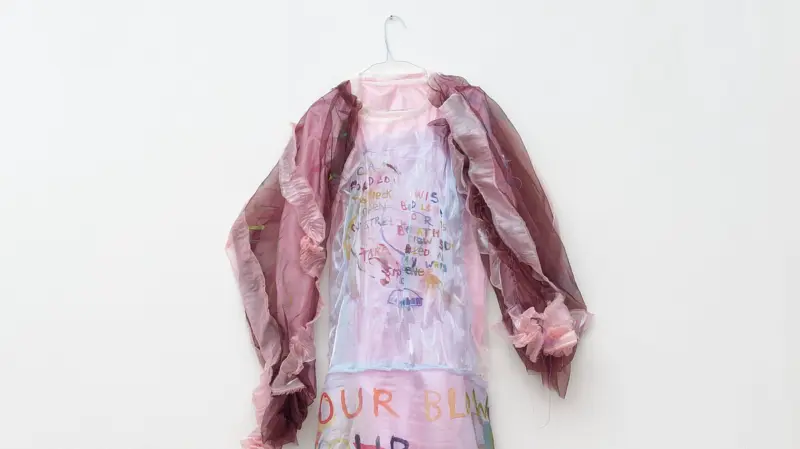
The Ursula K Le Guin quote draws attention as one enters the room where artist Afra Eisma's work is displayed at the Museum of Art and Photography in Bengaluru. The installations of the 'Warrior Garments' series flow down from the ceiling, creating a montage of apparel with eclectic messages painted on the gowns.
It may seem disturbing, and to some extent, disorienting, when one reads the dichotomy in the title of the series, until one understands the kind of resistance that fuelled the art.
"I wanted to have a title that instantly tells you that it is not just beautiful princess-y dresses that you are looking at, but something more than that, a title that feels empowering and confusing at the same time. It raises the question, 'Wow, what are we looking at?' The works are about empowerment, fighting with intention, love and care," says the 33-year-old Dutch artist, who is a survivor of sexual assault, and who, along with several others, fought successfully for an amendment to the Netherlands' outdated Sexual Offences Act.
Multiple roles
Afra's anger is sewn in silk and organza, depicting the multiple roles a woman plays in society, including that of a warrior.
However, the war is not just external but internal too. The ersatz social narratives and the inadequacies in policy-making often put a 'victim' tag on a woman's anguish instead of providing a platform to vent it. The profusion of anger and frustration growing inside her eventually holds her in thrall, crippling the will to face and fight the demon within and without. For Afra, art became a refuge and a method of resistance, seeking change to a practice that had systematically weakened women's rights in her country.
"I felt a lot of rage in my body, and anger at the system that was letting us down and that was unable to protect us," the artist says as she describes the overwhelming emotions that have birthed her art installations, and through which she wants to break the taboo about conversations around sexual violence.
Afra not only experienced rape but was also stalked and received death threats. Adding to this was the country's law that did not see sex without consent as rape unless there is physical force, threat or coercion involved.
She started the #MeToo movement in the Netherlands in 2020 along with several other artists who were survivors of sexual assault. "For me, it (the movement) was a choice of life and death, and there was no other way out," she says.
The local media furthered the movement by highlighting cases of violence, denial of justice and the loopholes in the law.
In 2024, the country finally amended the Sexual Offences Act.
A universal message
The gender activist: For better, for verseThe art installation, which was first featured at the Kochi-Muziris Biennale last year, holds a universal message of empowerment. In her 'Warrior Garments', the body becomes instrumental as a vessel not only to nurture the anger but also to weaponise it to fight back. It talks about the choices that a woman can make and about shifting shapes between being a warrior ready for battle and a loving human being who is compassionate towards the struggles of all those trying to articulate their anger.
"I felt that our society didn't have a language to talk about rape and (other forms) of sexual violence. So, I wanted to create something that allowed me to wear my anger and also take it off," says Afra as she recollects how she was juggling her legal battle and creativity.
This emotional duality in her work is enhanced by the fabric of choice that allowed the artist to weave in her messages in layers. Elaborating on her choice of the garment material, Afra says, "The fabric is lightweight and shimmery. It looks beautiful and at the same time kitsch. I wanted a combination of all this, and organza allows that."
The translucent material is paired with imitation silk, which has a "plasticky feeling to it", allowing the artist to make overlays to hide messages close to her heart.
While she took the liberty to hide her emotions in her artwork, she spoke publicly, and for the first time, about her experience at the biennale, and later in Bengaluru.
It was not only liberating for Afra but for all women who are still grappling with the choice of words to start a conversation about sexual violence. That isolation ends in Afra's creative expression, which provides support and solace to these women who are forced to live in shame.
"Art cannot change policies, but it can address the issue and help start dialogues. It is helpful and important," says the artist.
The exhibition is on at MAP, Bengaluru, till June 21.