
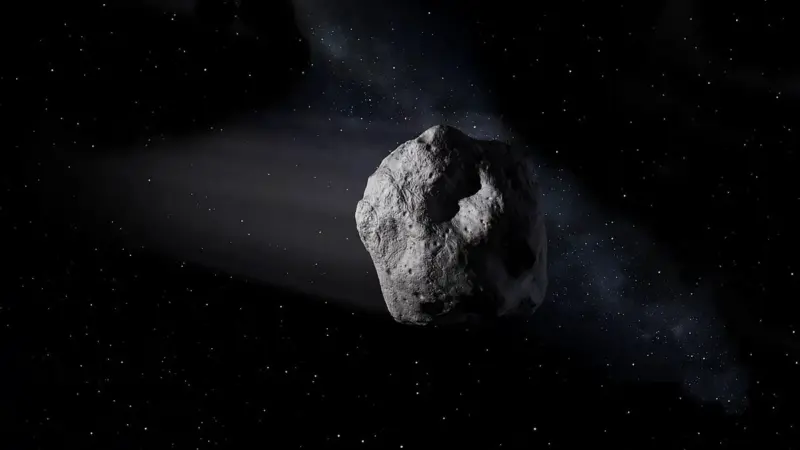

The asteroid 2024 YR4 is no longer a threat to the Moon, NASA announced on Friday. The confirmation followed a week-long observation conducted by the James Webb Space Telescope which helped refine the space rock's trajectory around the Sun.
According to previous estimates, 2024 Y4 had a little over four per cent chance of colliding with the Moon on December 22, 2032.
"This update reflects improved precision in our understanding of where the asteroid is expected to be in 2032 rather than a shift in its orbital path. Previous analyses, made before the incorporation of these new observations, suggested 2024 YR4 had a 4.3% chance of lunar impact on this date," NASA said in a statement.
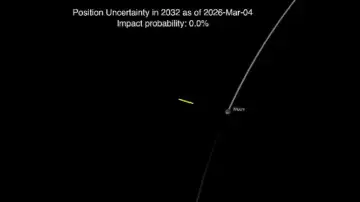
Asteroid 2024 YR4's potential location on December 22, 2032.
The asteroid will still be considerably close to the lunar surface during its fly by. Estimates now suggest YR4 will pass around 21,200 km from the Moon at its farthest.
Discovered in December 2024 by the NASA-funded Asteroid Terrestrial-impact Last Alert System in Chile, this asteroid dubbed 'city killer' initially raised alarms for its possibility of impacting Earth. It was eventually declared a false alarm last year, with the Moon becoming its next potential target.
Astronomers thought that they wouldn't get another chance to study the space rock until 2028, however, an international team of astronomers identified two narrow opportunities and carried out the observation between February 18 and 26.
The team was led by the Johns Hopkins Applied Physics Laboratory which used Webb's Near-Infrared Camera (NIRCam). Also collaborating on this project were members of the European Space Agency's Near-Earth Object Coordination Centre and NASA's Center for Near-Earth Object Studies of the Jet Propulsion Laboratory (JPL).
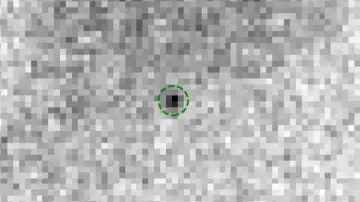
Asteroid 2024 YR4 photographed by Webb telescope.
Tracking the asteroid's orbit was challenging because Webb is designed to study vast, complex cosmic objects and massive galaxies billions of light-years away. The asteroid, on the other hand, is one of the faintest objects ever targeted by this infrared telescope. As the world's most powerful observatory, the $10 billion telescope proved its mettle yet again by pulling off this monumental task.
ESA says scientists ruled out the impact by analysing the asteroid's position relative to the stars whose positions were already well documented thanks to the Gaia mission.
Had the asteroid actually struck the Moon, it would have created a nearly 2-km wide crater and the ejecta released in the process may have reached Earth. There were predictions that the bright flash from the impact may have been visible to the naked eye, caused meteor showers on our planet and threatened satellites in orbit. Thankfully, none of that is a possibility for now.