

In academia, publications are the primary currency for advancement. Whether it is a PhD student or a tenured professor, everyone plays the 'publish or perish' game.
Publication is the logical culmination of the scientific research method. Publications close the loop from data collection and analysis to public contribution.
To ensure clarity, most journals follow the standardised Introduction, Methods, Results, and Discussion (IMRD) framework. However, in an ecosystem that has grown from two journals starting out in the 17th century to an estimated 46,000 journals today, this 'pressure to publish' is exposing a dark side: predatory publishing.
The publishing industry
The academic publishing industry is fiercely competitive, with greater profit margins than major commercial publishing sectors. This industry relies on an elaborate model of checks and balances: editorial boards, comprising established researchers, determine the 'fit' of manuscripts, which are then sent to colleagues for peer review, a rigorous form of quality control.
If the manuscript has no major flaws or concerns and requires no revisions, it is formatted and published. Typically, authors surrender their copyright to the publisher, who then profits by 'pay-walling' the knowledge. Libraries or individuals pay hefty subscription fees, often from the same public funds that supported the research, while editors and reviewers work for free, leaving the publisher to collect the dividends of a system they manage.
The open access model
The irony of pay-walling taxpayer-funded research has long been a point of contention for academics. The open access model of publishing emerged from this anguish. In this relatively recent model, the researchers pay the publisher not to pay-wall the paper.
Here, the rigour of the publishing remains the same, and if a paper is accepted, the authors pay an article processing fee. The decision-making and payment pathways are essentially separate, acting as an ethical wall. Here, the paper is available immediately and widely accessible and has a greater readership. Here is where the predatory publishing practices creep into the system.
What is a predatory journal?
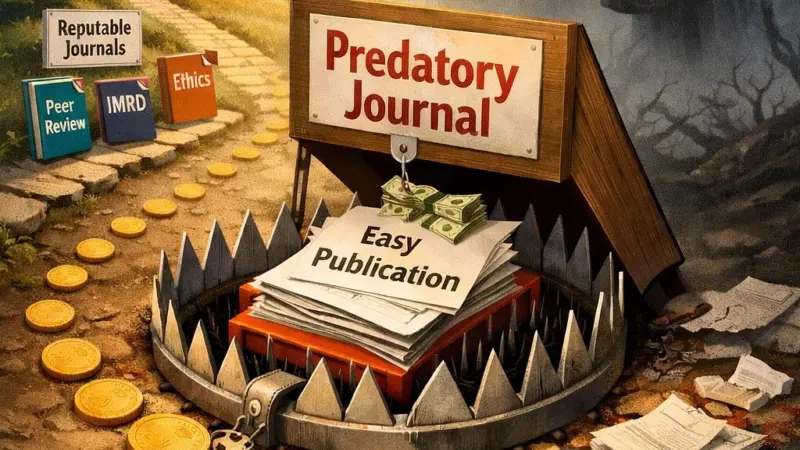
Predatory journals are counterfeit publications designed solely for profit. They capitalise on the author-pays model to generate revenue while disregarding or diluting industry professional standards. These journals often operate as 'clones' of established titles; for instance, the reputed journal Current Science, published by the Indian Academy of Sciences, has frequently issued alerts about fake journals mimicking its identity to solicit articles.
Other predatory outlets simply dismantle the ethical wall between paper acceptance and payment. In both cases, the scientific integrity is compromised: if the only barrier to entry is a fee, then flawed methods and baseless findings can easily enter the public record.
Fake news of the academic world
The hallmark of the scientific enterprise is reproducibility; science is a self-correcting process that thrives on rigorous rectification. Predatory journals fail in this foundational premise. By bypassing peer review or by publishing with low rigour, they pollute the global pool of knowledge with spurious findings, forcing future researchers to waste public funds sifting through the wheat and chaff. This is the fake news of the academic world.
An example was a paper published during COVID that was later retracted, which claimed that sound waves from beating a thali could kill the COVID-19 virus. Published in a dubious journal that has since ceased operations, such findings do more than add a line to the author's resume or bump up university rankings; they actively erode public trust in science and pose genuine risks to society.
The trap that attracts desperation
Academia is a high-stakes race where being the first to publish is often the only way to claim novelty. If a researcher delays, they risk being scooped by a peer, rendering years of work seemingly redundant. Coupled with this is the institutional bean-counting of papers to measure progress.
In India, the University Grants Commission (UGC) regulations mandate PhD students to publish in reputable journals to qualify for their degrees. When these graduation deadlines or faculty promotion windows loom, the high-speed guaranteed acceptance of a predatory journal becomes a seductive, if dangerous, shortcut. Whether through genuine oversight or sheer desperation, researchers fall into the trap of prioritising the act of publishing over the integrity of the outlet.
How to avoid this trap?
Academics are often thought to be the smartest, and falling for such scams can be embarrassing. Fortunately, there are ways to spot such journals. In 2008, librarian Jeffrey Beall began documenting suspicious publishers and later established criteria to assess a journal's veracity. Key red flags include:
-Superfast: Claims of peer review completed in days rather than the standard weeks or months.
-Hidden fees: Legitimate Open Access journals are transparent about Article Processing Charges (APCs) from the start and have an option to seek a waiver; predatory ones often spring a fee after acceptance.
-Identity theft: Mimicking the titles or websites of reputed journals.
-Broad scopes: A journal that claims to cover "Engineering, Medicine, and Poetry" all at once is likely just a fee-collection front.
-Dubious credentials: Editorial boards that lack diversity, use fake names, or include experts who never consented to being listed.
-Fake metrics: Prominently claiming readership ratings that aren't verified by the Journal Citation Reports (JCR) or focusing only on academic networking sites rather than the Directory of Open Access Journals (DOAJ).
-Retraction watch: Publications retracted or journals removed for questionable publishing practices.
Recent estimates indicate that nearly 35% of the papers in predatory journals originate from Indian authors. In 2018, the UGC introduced a list of legitimate journals, but later shifted responsibility for vetting to higher education institutions, while the UGC-CARE list remains a vital reference point. This move has placed the burden of due diligence squarely on the individual.
Today, a researcher's reputation is no longer built solely on their ability to discover truths, but also on their ability to discern. The name on the masthead of a predatory journal is not a trophy, but a tombstone. In the digital age, a paper in a predatory journal is a public admission of either laziness or a lack of integrity.
(The author is an ecologist and a faculty member at ATREE)