
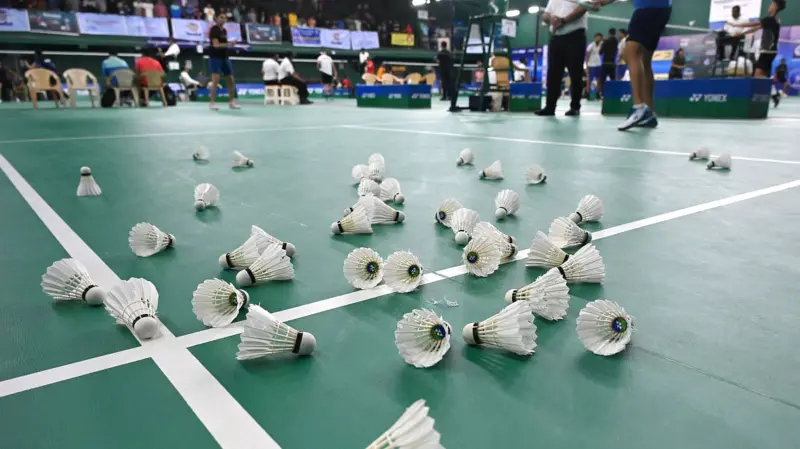

Bengaluru: How is the health and population of geese and ducks in China directly proportional to the smooth running of badminton around the world?
The answer is simple. Since the sport's most essential equipment - a shuttlecock - is made out of 16 feathers picked from a single goose/ duck (mostly from its left wing), the wellness and their numbers become critical. With badminton now more global than ever before, demand for feather shuttles is at an all-time high. In China, the biggest manufacturers, factors such as avian flu outbreaks, rising demand and export restrictions have hit the global supply chain for these shuttles.
Noting the widening gap in the demand-supply of feather shuttles, the Badminton World Federation (BWF) released a statement on April 8, announcing that the world badminton body has approved the use of synthetic shuttlecocks at BWF Grade 3 and junior international tournaments starting this month.
Why innovation, not legacy, will decide India's future as a global sports goods powerhouse"This initiative forms part of BWF's long-term approach to evaluating synthetic feather shuttlecocks for potential use at the elite level," stated the BWF release, adding that the VICTOR New Carbon Sonic Max Synthetic Shuttlecock (SC-NCS-MAX-12) and YONEX CROSSWIND 70 Synthetic Shuttlecock are the two approved products during this trial phase.
Change in material of the shuttle is naturally going to change the dynamics of the game.
"I'm a little concerned about it," says former India international and coach Vimal Kumar.
"Frankly, I think, it's a necessary initiative," feels fellow player-turned-coach Anup Sridhar.
"My fear is that playing with synthetic shuttles will lead to shorter rallies. If one rally ends in 2-3 shots, you cannot say badminton is physically very demanding. There needs to be an exchange of long, good quality rallies. If somebody is attacking, the other person has to retrieve, there are two different styles. That makes the game more interesting," points out Vimal, who competed at the 1992 Barcelona Olympics.
"The transition is not going to be smooth for sure," offers Anup, who took part in the 2008 Beijing Olympics. "Details like the shuttle's speed at different altitudes, the synthetic shuttle's weight being similar to the feather (between 4.74-5.50 grams) and sticking to the same colour are things they need to be careful about. The game is growing so much and the number of geese/ducks required to produce the number of shuttles is enormous. This is the practical way forward."
Though the opinions differ, both Vimal and Anup agree that badminton being a game of delicate touches -- lightning quick reflexes, speed and precision -- the differing behaviour between natural and artificial shuttle will require adjustments.
Vimal also has his apprehensions about manufacturers' claim that the feel and other aspects of synthetic product would be the same. "When an attacking player hits really hard, the synthetic shuttle folds. How will the deceptive strokes and flicks be? Such an experiment was made in the past which didn't get a good response so they shelved that programme."
"Feather shuttles have a natural left to right curve in their flight. Players are used to this movement. Synthetic shuttles might differ slightly, and how they behave when you play these soft delicate spin shots at the net will be the main areas of difference. But otherwise for a block, an attack, defence or clears, I think these synthetic ones are coming surprisingly close to the feather shuttles," Anup shares.
Just to put the numbers in context, there are 12 state-ranking tournaments across various age groups for boys and girls conducted in the state approved by the Karnataka Badminton Association (KBA) in a year. On an average, there are 800-1000 entries with 300-400 tubes of feather birdies (1 tube has 12 shuttles) required per tournament. While Yonex Aerosensa 2 (AS2) is used for qualifying rounds, Aerosensa 30 (AS30) is used in main draw matches.
"Yes, there will obviously be a discussion at our committee meeting. But we haven't received any instructions from the Badminton Association of India (BAI) so far to introduce synthetic ones at our events in Karnataka," says V Muralidhar, KBA honourary secretary.
BWF's latest announcement has surely ruffled some feathers yet again, but the world governing body is determined to take the route of synthetic shuttle.