
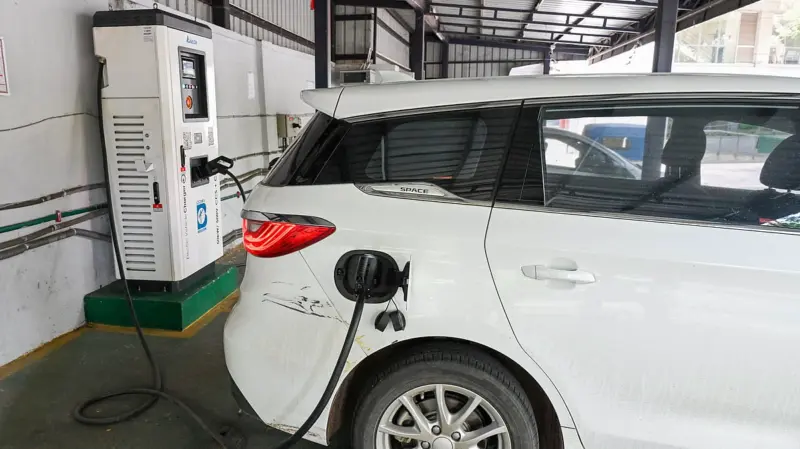

With Bengaluru's temperatures hovering between 35 and 37 degrees Celsius in the past few weeks, concerns around electric vehicle (EV) safety sharpened after a two-wheeler caught fire while charging in South Bengaluru.
The incident, triggered by overheating, raises questions about whether existing safeguards and infrastructure are keeping pace with rising EV adoption.
Smart EV chargers are designed to cut off power automatically if a vehicle overheats. In this case, that mechanism failed. A resident had plugged in his two-wheeler and left it unattended; the charger overheated, ignited, and the fire spread to two nearby vehicles. A visitor spotted the blaze, alerted security, and residents managed to contain it using fire extinguishers.
Karnataka awaiting 750 e-buses from Centre: Minister Ramalinga ReddyWhat the guidelines say
According to Bangalore Electricity Supply Company Limited (Bescom), safety is non-negotiable when installing EV charging points, particularly in apartment complexes. Equipment must meet BIS standards, with
proper earthing and insulated systems to reduce fire risks.
Public and shared chargers require inspection and approval from electrical authorities before commissioning.
The guidelines on its website (bescom.karnataka.gov.in) also stress adequate electrical provisioning to handle multiple chargers simultaneously, minimising overheating and system stress. Liability for damages caused by faulty equipment, including fires, rests squarely with the operator.
Basements: allowed, but conditional
EV chargers are not prohibited in basements, but they come with caveats. Charging stations must be installed in accessible areas with sufficient space and ventilation. Each charging point requires one Equivalent Car Space (ECS), roughly 2.5m by 5m. A standard car occupies one ECS, while a two-wheeler takes up 0.25 ECS.
"EV charging stations can be installed in basements if a fire No Objection Certificate (NOC) is obtained and safety regulations are followed. However, any incidents will make the operator accountable," said B Aravinda Shetty, Public Relations Officer at Bescom.
An industry expert who works with a multinational engineering company cautions that basements, especially in older buildings, may not be equipped to handle the electrical and thermal loads. EV battery fires are particularly difficult to control, as they can sustain combustion by generating their own oxygen. This makes ventilation and specialised containment systems critical, he adds.
Infrastructure under strain?
As EV adoption grows, the pressure on the charging infrastructure is evident. Veer Karan Goyal, co-founder of Zenergize, a manufacturer of EV chargers, points to the continuous electrical load these systems endure. "Charging stations face high stress and are vulnerable to failures from temperature and voltage fluctuations. Designing for system-level fault resilience is key in reducing thermal stress," he said, adding that reliability is essential for sustaining user trust.
Sudhanva Shetty, co-founder of Rebolt, a EV-charging network, stressed on paying attention to wiring, site selection, fire suppression, and surge protection.
Residents flag everyday challenges
For users, the problems are often more mundane than dramatic fires, but no less disruptive. Muhammad Rashaad, a college student in Hegde Nagar, describes erratic charging behaviour.
"The station auto shuts off without intimation and sends random notifications at odd hours," he said. In one instance, his scooter went into deep discharge due to interrupted charging, forcing a battery replacement. Installing a private charger is not straightforward due to NOC and fire regulations, leaving residents dependent on vendors. He currently pays Rs 14 per unit.
In J P Nagar, Reshma Khan says compliance is not the issue; access is. "We have at least 35 EV owners and only three charging stations," she said. Anand, part of the residents' welfare association (RWA)at a gated community in J P Nagar, notes that while chargers have been in place for four years, maintenance and minor technical faults persist.
In contrast, residents of Koramangala 1st block, have taken a decentralised approach. "Residents charge at their own parking spaces with private connections. We've had no accidents so far," said RWA president Padmashree Balaram.