
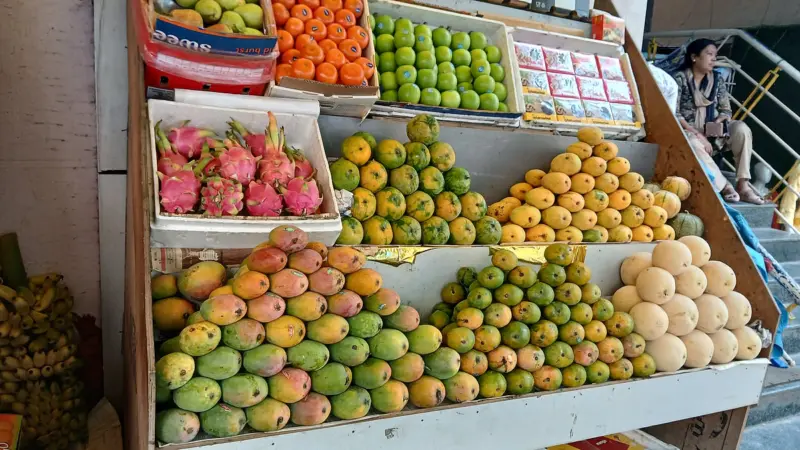

Bengaluru's heat is blazingly here, and so, it seems, are its mangoes. Across the city, from roadside carts in Padmanabhanagar to wholesale yards in Huskur, the fruit has begun to appear in noticeable quantities weeks before its usual peak.
The early arrival comes even as temperatures are expected to hover between 35-37°C this week, with no rain in sight. Typically, these are conditions that precede, not accompany, the start of the season. Yet, if the markets are anything to go by, the mango season is already stirring.
Traditionally, mangoes begin to dominate Bengaluru's markets toward the end of April, after early summer showers. This year, however, the fruit has been visible since late February, raising a natural question: Is the rising heat responsible for changing patterns?
Karnataka: Mangoes hit market at princely prices amid sharp decline in yieldM Sankaran, principal scientist at the Indian Institute of Horticultural Research, explains that the mango calendar still broadly runs from late April to mid-August, with early varieties arriving in April-May and later ones stretching into June-August. But climate change is beginning to blur these boundaries, altering flowering patterns and shifting harvest timelines. Venkatesan A, president of the Bengaluru Fruits and Mango Wholesale Commission Agents Association, shares a similar view. "Even though mangoes are already available in the market, the season has not peaked," he explains.
The mangoes currently flooding markets, Sankaran notes, are largely "off-season" produce, made possible through canopy management and growth regulators such as paclobutrazol, allowing availability from November to March. While ripening agents like ethephon and calcium carbide are banned, distinguishing between treated and organic fruit remains difficult.
A market warming up
If supply has arrived early, demand is still finding its rhythm. Street vendors report uneven sales. A cart seller in Padmanabhanagar says he stocked up four days ago but has struggled to move his produce. Just across the road, however, a more established stall tells a different story: around 70 kg sold per day, with Raspuri emerging as the crowd favourite. The pattern rings true across the city. Larger, more familiar vendors and established outlets are seeing stronger traction than newer entrants.
Online, the appetite appears even sharper. Quick commerce platform Instamart notes that Bengaluru alone accounts for nearly a third of all mango orders, with southern staples like Sindhura and Banganapalli driving demand.
Waiting for the peak
At mango mela stalls and wholesale markets, the sense is not of a season in full swing, but one gathering momentum.
Imtiyaz Ali, who runs a mango stall in RR Nagar, is currently in a holding phase. His stock, sourced from Ramanagara and neighbouring districts, includes Raspuri, Badami, Sindhura, Mallika, and Malgova. Most of it, however, is still ripening. "The mangoes are selling, but we are waiting for them to fully ripen," he says. Stored in cool, shaded conditions, the fruit is expected to be ready within a week. Alongside local varieties, he has also seen demand for out-of-state favourites like Banganapalli, Alphonso, and Dasheri.
Wholesale markets reflect a similar in-between moment. At Huskur Fruit Market, around 150 vehicles, each carrying 2-3 tonnes of raw mangoes, arrived in a single day. The supply, largely from Ramanagara and Channapatna, is moving quickly, with Sindhura, Badami, Raspuri, Imam Pasand, and Mallika among the most sought-after.
HOPCOMS outlets across the city report steady sales of 80-100 kg per day, led by Alphonso, followed by Badami and Raspuri, all grown within Karnataka.
High prices
Mangoes may be arriving early, but they are anything but light on the pocket. Retail prices currently range between Rs 150 and Rs 300 per kilogram, depending on variety and quality. This is noticeably higher than last year, vendors say. Wholesale prices, meanwhile, vary widely, from Rs 30 to Rs 200 per kilogram. Curiously, it looks like the city's mango season is becoming more elastic - starting early, stretching late, all thanks to changing weather patterns as well as human meddling.