





Bengaluru: After co-founding professional services firm Alt Digital Technologies, Goutam Bengle was working in Noida until the Covid-19 pandemic struck in 2020. He subsequently returned to his native village Bengle in Sirsi taluk of Uttara Kannada district and began working remotely.
He later set up a branch office in neighbouring Vaddinakoppa. Six years on, the company employs 40 people at Vaddinakoppa and generates overall annual revenues of around $3 million while serving clients in the United States.
Recognising the need to strengthen the local economy, the 38-year-old BIET Davangere alumnus also launched 'The Mestri', a digital platform that connects skilled workers with job opportunities.
"Setting up the centre wasn't easy at first. With unreliable internet connectivity, I had to rely on three different service providers to maintain a stable connection," Goutam says. "Today, the office enables 40 people to live and work in their village instead of migrating to a metro city, while earning salaries on par with our Noida employees."
"I never asked for government help. The real joy is that 40 families, close to 130 people, can stay back in their native place because of our company," he adds.
IT parks struggling | Execution gaps hit tech ambitionsThough Goutam has operated without any government support, he is part of a growing effort to expand economic activity beyond Bengaluru.
This momentum aligns with the state government's 'Beyond Bengaluru' initiative, launched in 2020 to decentralise industrial, digital economy and technology-driven growth by developing regional clusters outside the state capital.
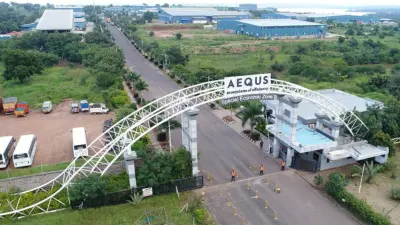
Major companies such as Infosys, Wipro and Aequs expanded beyond Bengaluru long before this term was coined. Infosys set up its Mysuru campus in 2002. Aequs built its first major special economic zone (SEZ) in Belagavi. "We could have started in Hubballi, but land availability was a constraint at the time, so we settled on Belagavi," says Aravind Melligeri, executive chairman and CEO of Aequs Limited.
He had to build everything from scratch, initially mobilising logistics, workforce, materials and other resources from outside.
"Some people laughed when we said our aerospace SEZ would be in Belgaum (Belagavi). Today it is an established global aerospace manufacturing location with every airliner having something made in Belagavi," he reminisces.
To address these gaps and drive growth outside Bengaluru, the government adopted a cluster-based development approach under the 'Beyond Bengaluru' initiative. However, the programme has struggled to achieve scale. According to data from the industries department, only 13% of the proposed Rs 4,75,991 crore investments has materialised, amounting to Rs 60,257 crore across 151 projects.
Experts say the programme requires a longer timeframe to achieve scale. Kamal Karanth, Co-founder of Xpheno, a specialist staffing firm, says, "Beyond Bengaluru needs a 10-year horizon, not instant comparison. Bengaluru became what it became over a few decades of incremental movements."
Sam Cherian Kumbukattu, founder chairman of Mysuru-based Schevaran Laboratories, says businesses need to be located where economic activity is concentrated. He says enterprises require easy access to talent, housing, infrastructure and other essential facilities. "For a businessman to come to Mysuru and start an industry, there must be ease of doing business. Land should be made available, people should also be willing to work in Mysuru," says Kumbukattu, who is also vice chairman of CII Karnataka.
"The government is proactive, but the need is more than what is available because Bengaluru is attracting attention from across the world due to its cosmopolitan nature. This needs to be extended to other cities," he adds.
Talent data backs this. The Silicon Beach Skills initiative, led by the Karnataka Digital Economy Mission (KDEM) and Xpheno, analyses the region's potential to drive growth in India's digital economy and identifies a 300-km coastal "Talent Triangle" stretching from Karwar in the north to Mangaluru and Udupi in the south, and eastwards to Hosadurga, including parts of Kerala.
The Karnataka zones of the Talent Triangle have a potential talent pool of 3.1 lakh people, of whom 2.4 lakh are in the accessible active talent pool. However, recruiters face a shortage of experienced professionals, with only 90,000 having at least one year of work experience. The rest comprise freshers and entry-level talent, many of whom leave the region to begin their careers elsewhere.
Mangaluru and Udupi have emerged as the region's key talent hubs, accounting for nearly three-fourths of the active experienced white-collar workforce.
"For the Hubballi-Belagavi, Mangaluru, Mysuru and Shivamogga regions to grow, the starting point has to be infrastructure, which remains the biggest bottleneck," Kamal says. "Improved road networks, faster and more frequent rail services and better air connectivity are essential. This must be followed by investments in physical infrastructure such as Grade A office spaces, higher education institutions and quality healthcare facilities."
Infra gaps
Industry experts point out that infrastructure gaps continue to pose challenges. Smitha Hemmigae, Chief Market Officer, ANSR, said that while the supply of Grade A office space in Mysuru and Mangaluru has improved in recent years, it remains limited compared to Bengaluru. As a result, enterprises often face longer lead times in securing ready-to-occupy, plug-and-play office spaces.
Senior talent relocation remains the most cited friction point, with professionals established in Bengaluru often reluctant to move to cities with fewer premium lifestyle and schooling options.
"The hub-plus-one model addresses this pragmatically. Keep leadership in Bengaluru, build specialised teams locally in Beyond Bengaluru cities," Hemmigae says.
However, Melligeri believes that industry needs to go to hinterlands where people are residing. A presence in a tier-II city for any business should not be a satellite office. It must be a core operation with a scalable plan for the long-term. "Most importantly, you need to have a critical mass of people, and the support of an ecosystem that covers the entire value chain," he says.
Talent moves only when regions offer multiple employment opportunities. In 2024, after Industries Minister MB Patil warned that land allotted to Infosys in Hubballi could be reclaimed if underutilised, the company announced incentives of up to Rs 8 lakh for employees willing to relocate there. In August 2025, Infosys further expanded its Hubballi presence by launching a centre for AI, cybersecurity and space technology, taking its workforce in the city past 1,000 employees.
On whether companies should offer relocation incentives, KDEM CEO Sanjeev Gupta says that several firms, including IBM, have scaled organically in Mysuru without special packages. He notes that Karnataka's GCC (Global Capability Centers) Policy supports employee relocation by covering shifting expenses and subsidising employers' EPF contributions, reducing costs for both companies and employees and making moves to cities such as Tumakuru, Kalaburagi, Hubballi and Mysuru more viable.
Karnataka IT-BT Minister Priyank Kharge acknowledges that investment decisions are also influenced by where talent can live and work better - with less congestion, shorter commutes and a more balanced lifestyle. "Our continued focus on infrastructure, digital connectivity, and talent development is strengthening these ecosystems, helping decongest Bengaluru while creating high-quality employment opportunities across the state. We will continue to build on this momentum through proactive policy support, faster clearances and industry partnerships," Priyank says.
Late action led to slow start
The state government started focusing on beyond tier-1 cities much later compared to states such as Tamil Nadu, Andhra Pradesh and Maharashtra.
"It takes a decade to set up an ecosystem. After identifying districts and local advantage, the government needs to incentivise and also develop the talent that is required for the industry," J Murugavel, Vice Chairman, CII Tamil Nadu State Council said, adding that Tamil Nadu houses 50 SIPCOT (State Industries Promotion Corporation of Tamil Nadu) industrial parks spread across 24 districts. Citing Tamil Nadu's example, Murugavel said Namakkal evolved into a leading poultry and egg-production hub, while Coimbatore emerged as a manufacturing powerhouse. GCCs have also expanded into cities such as Tiruchirappalli and Madurai. Sustained growth, he adds, hinges on nurturing and retaining local talent.
Apart from Mumbai, Pune and Nagpur, Maharashtra is expanding its industrial projects in emerging regions such as Nashik, Solapur and Chhatrapati Sambhajinagar (Aurangabad).
Andhra Pradesh is aggressively developing its tier-II and tier-III cities. Anantapur is attracting major EV manufacturing and charging infrastructure, while Kurnool is being positioned as a centre for heavy industry and manufacturing. With strategic hubs such as Sri City, Kopparthy and Hindupur, the state has identified growth centres across its regions and is actively building sector-specific ecosystems around them.
"All cities should have uniform growth. Andhra Pradesh is already going in that direction. The state has pharma, IT and technology-oriented industries in Visakhapatnam. Tirupati is transforming into an electronics hub," S Narendra Kumar, Chairman, CII Andhra Pradesh State Council, says.
The government is taking these steps to avoid repeating the concentration of growth seen in Bengaluru, he adds.
While significant challenges remain, the government is steadily pushing ahead with initiatives aimed at decentralising growth and creating strong technology ecosystems beyond the capital. Sanjeev Gupta says Karnataka aims for at least 10% of its IT exports - currently exceeding Rs 5.5 lakh crore - to originate from Beyond Bengaluru clusters by 2030, signalling a long-term shift towards a more geographically distributed technology economy.