




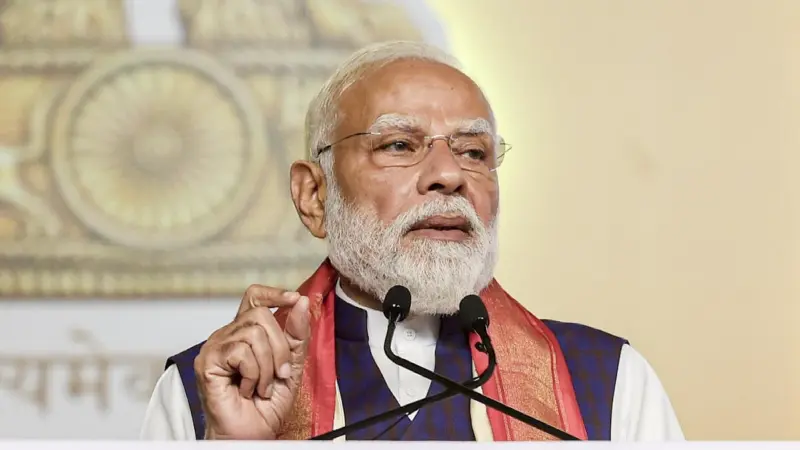

Prime Minister Narendra Modi, on May 10, urged citizens to work from home, use public transport, avoid buying gold, reduce cooking oil consumption, shun imported goods and foreign trips, and use less fertiliser.
These austerity appeals are well-timed against the backdrop of the war in West Asia and its geopolitical and economic fallout.
The call to cut oil and gas consumption and save foreign exchange is strategic, relatively easy to follow, and aligns with climate goals. Others could be replaced with stronger policy tools. Raising import duties would likely prove far more effective than appeals alone. Still, there should be no doubt about the reasons for the Prime Minister's call to citizens to contribute during a war-like situation.
One may question why the Prime Minister did not make these appeals sooner. Even assuming the conflict was always going to be extended, could the closure of the Strait of Hormuz and the resultant loss of 20% of global oil supplies have been predicted?
In fact, the Union government tried to limit the consumption of the most critical product - LPG - by restricting it mostly to domestic
consumers soon after the war started. We know the resultant havoc. For all of the above reasons, the Prime Minister's timing for the appeal is
justified.
Why should we view this as a war-like situation when India has no direct role? The answer is India's import dependence: 89% for oil, 50% for natural gas, and 70% for urea from the Gulf countries. The closure of the Strait of Hormuz chokes these supply lines. That creates two problems: physical shortages and a surge in foreign exchange demand due to higher prices.
Assume India's import basket to last for $110 per barrel for the rest of the year. The additional foreign exchange burden would be about $59 billion. If the conflict worsens, the oil price could exceed $200 per barrel. This estimate is based on my experience working for a large multinational oil company during the first two oil shocks, where I was responsible for forecasting the price.
During the 1973 and 1978 oil shocks, supply losses were far below today's estimated 10 million barrels per day, yet prices jumped 400% and 300%, respectively. At $200 per barrel, India's added foreign exchange requirement would reach $355 billion, up $218 billion from the previous year. India cannot afford that. This scenario analysis likely prompted the Prime Minister's appeal.
Whether we like it or not, India is in a war-like situation. We must set aside political differences and prepare to face the crisis together. The rupee has already fallen from 91 at the end of February to 96 per dollar. It is Asia's worst-performing currency this year. If oil prices were to increase to $200 per barrel, it may fall to below 110 per dollar. The current account deficit will also be severely impacted.
Opportunity in crisis
After the war in Iran started and oil prices started to rise, the government reduced excise taxes on petrol and diesel. Also, it did not allow the oil companies to increase the prices to pass on their higher costs of buying crude oil till May 15. Finally, the oil companies were "allowed" to raise the prices by Rs 3 per litre, the first hike in four years. Another hike of around 90 paise per litre followed on Tuesday. Still, the oil companies are estimated to be losing Rs 3,000 crore a week.
The companies are supposedly free to fix prices. In reality, however, the Union Ministry of Petroleum retains control. The opposition parties have been critical of the government over the hike in fuel prices. But that is politics - sitting in opposition, the ruling party and its allies would not have acted any differently. The more prudent and sustainable policy is to let the oil companies decide on the prices based on the international market.
Even with its potentially far-reaching fallout, the current global energy crisis provides an opportunity for India. This is a moment where we can honour the Prime Minister's appeal and build on it to develop safeguards against climate change.
Underlying many of these appeals is India's civilisational principle of simple living and high thinking. The country promoted the idea of sustainable lifestyles and patterns of consumption as a response to climate change through its Mission LiFE - Lifestyle for Environment programme at COP27 in Sharm El-Sheikh, 2022. We can apply this principle to address the current oil crisis and future challenges.
(The writer has over 50 years of experience in international oil. He has served as a USAID consultant in FSU countries and an advisor to ONGC)
Disclaimer: The views expressed above are the author's own. They do not necessarily reflect the views of DH.